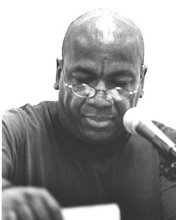
Early last November, just before my hospitalization for colon cancer, I had the privilege of participating in a fascinating symposium co-sponsored by the Poetry Foundation and the Columbia University School of Journalism called “Make It News,” on poetry and journalism. My panel, “Covering Poetry: Past, Present, and Future,” discussed both whether the amount of public coverage of poetry (mostly in America) has changed (mainly since the nineteenth century) and the ways in which the kind of coverage poetry receives has changed (mostly due to the Internet).
The critic and poet Adam Kirsch, with whom I’ve disagreed in the past (see my post "Final Thoughts on Blogging," in which I take issue with his sweeping and uninformed dismissal of literary blogs), asserted that poets don’t write to be read and don’t desire to be “popular” (he made this statement particularly about Emily Dickinson and the Modernists as a group), that they write for “posterity,” and that only “history” will sort out which poets matter. I had to disagree on all counts. When I asked him about the role of literary institutions in these decisions of “history,” he had no reply. As I should have pointed out at the time, “history” isn’t an agent; “posterity” isn’t an actor. They are the products of people’s individual and collective decisions. “History,” both prospectively and retrospectively, is what we make it.
Furthermore, it’s a myth that Emily Dickinson didn’t care about readership or publication. She was intensely ambitious and wanted to be read; she published ten poems in her lifetime (admittedly out of nearly eighteen hundred), and sent her poems to literary critic Thomas Wentworth Higginson in the hope that he would take them up. She also distributed her poems among friends and family.
The modernists all wanted to be read and appreciated, and they strenuously engaged in the work of producing their audience, of teaching readers how and why to read their work, through essays, manifestoes, and anthologies. They didn’t disdain popularity per se; they disdained the poetry that was popular at the time. Ezra Pound, for one, definitely wanted his poetry to be popular, and though he often doubted it would be—“Will people accept them?/(i.e. these songs)”—it disappointed him that it wasn’t. He wanted his work and the work he supported to supplant the “ladies’ verse” that he so despised. Though in one poem he wrote, “I join these words for four people,” in the next line he wrote, “Some others may overhear them,” and one may be sure that he hoped they would.
Pound’s work as an editor (for Poetry, The Egoist, The Little Review, The Dial, and finally of his own journal The Exile, a well as of the anthologies Des Imagistes and Profile), and as an essayist and propagandist played a crucial role in publishing, publicizing, and disseminating the work we now call “modernist.” As Lawrence Rainey notes, “[Pound’s] gifts as an impresario were…impressive. Much of the coherence of modernism as an institution derived from his canny capacity to bring together patrons, journals, and authors, creating and then exploiting institutional opportunities” (Modernism: An Anthology, 39).
As music historian Arnold Whittall has noted of some of Pound's contemporaries in another medium, “Even the concept of music as ‘bourgeois entertainment’ was not rejected out of hand by most avant-garde composers, whose belief in the rightness of their radicalism was based on the conviction that sooner or later the value of their music would be publicly, culturally accepted, and that such acceptance meant performance in conventional concert environments” (Musical Composition in the Twentieth Century, 21).
Pound also very much wanted his social, political, and economic views to be heard and taken seriously. Pound admired Mussolini’s ideas (if they can be called that), but he also admired Mussolini because he believed that Mussolini took his ideas seriously. It was Pound’s commitment to those ideas, to social credit and the like, and his desire to disseminate them more widely, that led him to broadcast over Radio Rome during World War II.
Just as every good boy deserves favor, every writer wants to be read: otherwise there’d be no reason to write. To say that one writes for posterity is just to say that one wants an audience in the future as well as in the here and now: one wants a permanent readership.
I have no wish to change the way that I write in order to appeal to a wider audience, that mythical “common reader,” nor do I think that such attempts to guess what other people want are usually successful. But I very much want my work to reach every reader who might be interested in what I do write, however few or many such readers there might be.
Showing posts with label Covering Poetry. Show all posts
Showing posts with label Covering Poetry. Show all posts
Sunday, January 20, 2008


Subscribe to:
Posts (Atom)