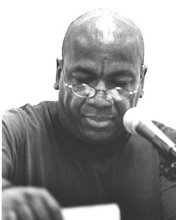
Some of the discussion in Joshua Corey's recent posts of creative writing's function as an affirmation of the self, and particularly his quote from a long and eloquent email message from the fine poet G.C. Waldrep, author of Goldbeater's Skin, regarding creative writing pedagogy, has prompted me to post this excerpt from a longer piece I have written on the teaching of creative writing. I hope that it will prove illuminating or at least interesting.
Many students attend college for no reason other than having been told that is what they should do after high school, and perhaps with the hope that they will make more money if they have a college degree. They tend to feel simultaneously resentful (“Here I am stuck in this stupid class”) and entitled (“I’m not in high school anymore, now I’m an adult”). Students often see creative writing classes as the antithesis to their other classes, in which they are forced to absorb and regurgitate all kinds of information in which they have no personal interest or investment. In a creative writing class, they can be themselves, because anything goes in a poem. (The idea that they might not yet have "selves" to "be" does not occur to them, nor does the idea that selfhood might be a process of becoming, not a fixed state of being.) Concomitantly, they also believe that poetry is too subjective to judge, because it’s all opinion and personal preference.
To acknowledge that personal preference and opinion are always factors while still maintaining that specificity, particularity of image and language, precision, concision, and avoidance of cliché are aspects of all good poetry (as sometimes needs to be pointed out, vagueness is not a style) sometimes seems beyond them, especially since they are convinced and have often been taught that if they think something then it must be true. (One great problem in American education isn’t what students don’t know, but what they know that isn’t true.) My partner has a bumper sticker on his office door that reads “Don’t believe everything you think.” It’s a caution that many might profitably take to heart.
We live in a culture which robs people of social, political, and economic agency, making them feel as if their experience counts for nothing, while simultaneously insisting that everyone’s every passing notion and experience is of supreme importance because it happened to them. These two aspects are concomitant with one another, the second offering an imaginary (that is, an ideological) compensation for the first. Much of the boom both in creative writing programs and in slam poetry, performance poetry, stand-up poetry, and the like, has more to do with a cult of the public performance of personality (á la Oprah Winfrey and Jerry Springer), on the one hand, and with the scarcity of outlets for genuine feeling and expression in our society and an ever-increasing sense of the impotence and insignificance of the individual, on the other hand, than with an interest in poetry as an art form.
The turn to creative writing, and to versions of poetry in particular, is a way of saying “I matter” in a wholly ritualized and conventionalized format, and is wholly understandable (if somewhat misdirected) as such. But again, this has to do not with an interest in the art of poetry, but rather with a sense that poetry is a mode of personal expression unsullied by commerce or social constraints. (And of course poems are shorter and thus apparently easier to write than novels or even short stories, another aspect of their appeal in a society that seeks quick results but shuns effort.) So the recent rise in the popularity of poetry doesn’t contradict poetry’s marginality in our culture any more than does the use of the word “poetry” as an all-purpose honorific: Michael Jordan, as they say, was poetry in motion on the basketball court. I prefer to think that poetry is poetry and basketball is basketball. Indeed, it is one of the functions of art to help us see things as and for themselves.
Canonical poetry, or literary poetry, or Modernist poetry, or post-Modernist poetry, or any poetry grounded in a practice of language and of writing as such, rather than one of personal expressivity and/or identity confirmation, still isn’t much read. Rather, it is disdained as one or another variety of stiff academicism, insular, "elitist" and oppressive, as opposed to the authentic expression of slam poetry or some similar construction. In this model, “creativity” is just another commodity which anyone can procure, on credit if necessary.
Showing posts with label Joshua Corey. Show all posts
Showing posts with label Joshua Corey. Show all posts
Sunday, March 11, 2007


Saturday, January 6, 2007
Salon des Pseudo-Refuseniks
In a post from his November web log, Joshua Corey, who is both a very talented poet and an insightful and committed thinker about poetry, refers to two posts on Joshua Clover’s web log attacking the foolishness and blindness of those who are naïve or ideologically deluded enough to vote. Corey has a very smart and eloquent response, but I wanted to add my own.
I am sick to death of these more-correct-than-thou types who claim to hold themselves utterly aloof from a world they see themselves as completely above, particularly those who assert that voting doesn't matter because all candidates and all parties are the same, or even that voting is a manifestation of false consciousness because it constitutes buying into the system. How anyone can believe that after over six years of George W and his accomplices despoiling pretty much the entire world is beyond me, except that their smugness and self-righteousness makes it impossible or unnecessary to actually see the world, since they always already know all about it anyway, unlike us poor benighted souls who are, as Joshua Corey so aptly points out, both to be pitied and to be held in contempt. It's interesting how much such types despise the very people for whose liberation they claim to hope, though apparently not to work.
I certainly don't know what these people, so many of whom seem to spend most of their time casting a jaundiced and superior eye down on the rest of us, are doing to bring the soi disant revolution any closer. Perhaps they believe that salvation is not by works but by faith alone. The intellectual and political Puritanism, and self-righteousness, of pseudo-purist leftists does bear striking resemblances to Calvinism at its ugliest.
On the question of what is to be done, and of what is being done, one major problem with the Manichean ultra-leftist worldview (besides its all too common hypocrisy) is that if there is on the one hand only total purity and on the other hand only total corruption, then nothing can be done, because any action will inevitably sully the purity of the intention. Between the intention and the act falls the shadow, as T.S. Eliot wrote some time ago. Thus the quietism and passivity of such types, who sit back and criticize others' actions (for what action is perfect?) while doing nothing themselves. Clean hands are idle hands. They are also never as clean as their bearers think they are.
So many Americans who consider themselves leftists or progressives would prefer nothing to something if the something isn't utopia. Or, like the several varieties of worsists, they would actually like to see disaster befall our society, or they think that they would, no matter how many people suffer, because that would trigger the revolution. Such types like to consider themselves totally outside of that which they claim to critique. Perhaps this is why is never occurs to them that they too will suffer in their implicitly-hoped-for worst case scenarios. But not voting is still participating in the system. By not voting, you are simply giving more weight to the votes of those who do bother to vote, however deluded or brainwashed they may be. In practical terms, you are voting for whoever happens to win.
Those who question or even deny the value of voting tend to be from those groups, social, economic, and racial, that have been able to take voting for granted. But people died so that I could have the right and the opportunity to vote. I don't intend to throw that opportunity away.
I am sick to death of these more-correct-than-thou types who claim to hold themselves utterly aloof from a world they see themselves as completely above, particularly those who assert that voting doesn't matter because all candidates and all parties are the same, or even that voting is a manifestation of false consciousness because it constitutes buying into the system. How anyone can believe that after over six years of George W and his accomplices despoiling pretty much the entire world is beyond me, except that their smugness and self-righteousness makes it impossible or unnecessary to actually see the world, since they always already know all about it anyway, unlike us poor benighted souls who are, as Joshua Corey so aptly points out, both to be pitied and to be held in contempt. It's interesting how much such types despise the very people for whose liberation they claim to hope, though apparently not to work.
I certainly don't know what these people, so many of whom seem to spend most of their time casting a jaundiced and superior eye down on the rest of us, are doing to bring the soi disant revolution any closer. Perhaps they believe that salvation is not by works but by faith alone. The intellectual and political Puritanism, and self-righteousness, of pseudo-purist leftists does bear striking resemblances to Calvinism at its ugliest.
On the question of what is to be done, and of what is being done, one major problem with the Manichean ultra-leftist worldview (besides its all too common hypocrisy) is that if there is on the one hand only total purity and on the other hand only total corruption, then nothing can be done, because any action will inevitably sully the purity of the intention. Between the intention and the act falls the shadow, as T.S. Eliot wrote some time ago. Thus the quietism and passivity of such types, who sit back and criticize others' actions (for what action is perfect?) while doing nothing themselves. Clean hands are idle hands. They are also never as clean as their bearers think they are.
So many Americans who consider themselves leftists or progressives would prefer nothing to something if the something isn't utopia. Or, like the several varieties of worsists, they would actually like to see disaster befall our society, or they think that they would, no matter how many people suffer, because that would trigger the revolution. Such types like to consider themselves totally outside of that which they claim to critique. Perhaps this is why is never occurs to them that they too will suffer in their implicitly-hoped-for worst case scenarios. But not voting is still participating in the system. By not voting, you are simply giving more weight to the votes of those who do bother to vote, however deluded or brainwashed they may be. In practical terms, you are voting for whoever happens to win.
Those who question or even deny the value of voting tend to be from those groups, social, economic, and racial, that have been able to take voting for granted. But people died so that I could have the right and the opportunity to vote. I don't intend to throw that opportunity away.
Subscribe to:
Posts (Atom)