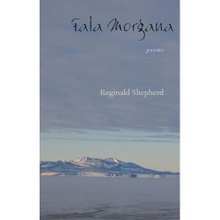
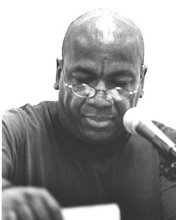
Showing posts with label Orpheus in the Bronx. Show all posts
Showing posts with label Orpheus in the Bronx. Show all posts
Sunday, February 15, 2009
Kevin Prufer on Reginald
Following up on the recent announcement that Reginald's essay collection, Orpheus in the Bronx, has been named a finalist for the award in criticism by the National Book Critics Circle, NBCC board member Kevin Prufer has posted a short piece about Reginald on the NBCC blog.


Tuesday, January 27, 2009
National Book Critics Award Finalist
Reginald's essay collection, Orpheus in the Bronx: Essays on Identity, Politics, and the Freedom of Poetry, has just been named a finalist for the award for criticism by the National Book Critics Circle. I'm obviously saddened that he didn't live to see this honor, but I'm please nonetheless by the positive attention this book of his has received. Robert Philen
Follow this link for more details.
Follow this link for more details.
Saturday, January 26, 2008
My New Book of Essays

My first book of prose, Orpheus in the Bronx: Essays on Identity, Politics, and the Freedom of Poetry, is just out in the University of Michigan Press Poets on Poetry series, and I have to share the news. This is a project on which I’ve been working for several years, and I’m incredibly excited that it’s finally come to fruition. I got my advance copies about a week ago and have been cradling the book in my arms as if it were my baby. Which it is.
Noted poet and critic James Longenbach generously writes on the back of the book that “Orpheus in the Bronx not only extols the freedom language affords us; it embodies that freedom, enacting poetry's greatest gift—the power to recognize ourselves as something other than what we are. These bracing arguments were written by a poet who sings.” I’m grateful to him for the wonderful endorsement.
The essays in Orpheus in the Bronx argue against ideological evaluations of art as either bourgeois mystification or social critique, focusing on the one hand on the liberatory possibilities of the autonomy of art and on the other hand on art’s relationship to social context and particularly to questions of social identity. For some time it’s been the fashion to see literature as a social symptom, or at best an epiphenomenon, to think that social conditions and social identity completely determine the nature and value of a piece of writing. But art’s utopian potential lies exactly in the degree to which it exceeds social determinations and definitions, bringing together the strange and the familiar, combining otherness and brotherhood.
The book includes, among others, a piece on the imbrication of homosociality and homosexuality in the libidinal economy of Jean Genet’s novel Querelle; an essay on Jorie Graham’s book Erosion which interweaves an admiring discussion of her poetry’s traversal of intellectual boundaries with a critique of the problematic relations between art and politics that her poetry often enacts; an essay arguing against the imposition of ideological or political agendas, particularly those of identity politics, on poetry; a somewhat polemical survey of the contemporary American poetry scene’s still all-too-operant binary between “mainstream” and “avant-garde” poetry which proposes the possibility of a third mode that I call, after Wittgenstein, lyrical investigations; an essay exploring the relationships of perception and conception, presence and representation, force and form in the work of Wallace Stevens; and “To Make Me Who I Am,” a longish, more personal piece on my development as a writer and a thinker, starting with my childhood in the tenements and housing projects of the Bronx. (An abridged version of this piece appears in the January/February issue of Poets and Writers Magazine.) The book also includes appreciations of individual writers whose work has meant much to me, including Samuel R. Delany, Alvin Feinman, and Linda Gregg. It concludes with an essay called “Why I Write,” which originally appeared on this blog, in which I lay out some of my motivations and ambitions as a writer, including the perhaps unfashionable desire to live forever in some form.
Friday, May 18, 2007
A Few Words About Language
French poet Yves Bonnefoy writes, “Now night has fallen (Maintenant, c’est la nuit): if by these words I claim to express my sense-experience they promptly become merely a frame from which presence has disappeared. The portraits that have seemed to us the most lifelike turn out to be mere paradigms. Our most private words become myths once we have let them go” (107). This is both a critique of language and an affirmation of its only possibility of communication. What is most intimate, coterminous with the thoughts and emotions it expresses, is simultaneously exterior and utterly other: my language is both mine and not mine at all. Similarly, physical sensations can only be articulated and vicariously shared by being turned into abstractions, virtual feelings.
Language exists in and as a liminal state between the material and the immaterial, thing and idea: it is neither sheer marks on the page, sounds in the air, nor sheer ideality, but rather it is their contingent and temporary union. (This would be Saussure’s union of signifier and signified that together produce the sign, which Saussure brackets off from the unattainable, and unsayable, real.) It cannot veer too far in either direction without losing its character as language. (The poetic avant-garde seeks to discover how closely language can approach either pole without losing its language character.) Language is neither object nor concept but their articulation. Words hover and hesitate over the abyss between being and non-being, presence and absence. They embody a non-Aristotelian logic of both/and, in which A need not equal A and simultaneously equals B, as well as some third term that’s both their combination (A/B) and some other item altogether (a not A/not B not quite reducible to C).
The notion of direct, unmediated presentation of the “as is,” Pound’s demand for “direct presentation of the thing itself,” is itself a metaphor, a speaking of one thing—the things of the phenomenal, event-full world—in terms of another—words, which are at once tangible and intangible, which are both things and non-things. The world is, for us, always a tropological world.
Language converts the intangible into the tangible (thoughts or feelings that are events into words that are objects) and the tangible into the intangible (trees or dogs or the skin of a lover into words that cannot as such be touched, heard, or even seen, yet only function as words by being heard or seen, by their materialization): poetry foregrounds this travel between realms of being, this transfer of contents. (The word “metaphor” means “transfer” in Greek.) As Mexican poet and critic Octavio Paz writes, “Language is symbolic because it tries to relate two heterogeneous realities: man and the things he names. The relation is doubly imperfect because language is a system of symbols that reduces, on the one hand, the heterogeneity of each concrete thing to equivalences and, on the other, constrains the individual man to use general symbols. Poetry, precisely, proposes to find an equivalence (that is the metaphor) in which neither things in their concrete particularity nor the individual man will disappear” (227). Language is by its very nature metaphorical, calling a near infinity of unique, individual entities all by the same name, “chair” or “fig tree” or even “person,” calling an unlimited range of movements all the same action, “walking” or “laughing” or even “writing.” The name asserts that all the phenomena it points toward are if not identical then equivalent: this is like this is like this is like this, or even, this is this is this is this.
The poem always aspires to be an object in itself (as all art aspires to the condition of music), but is always also a thing about things. The thingness of language is an asymptote (neither marks on a page nor sound in the ear is language per se): language is by definition both object and meta-object. Thus there cannot be an abstract poem in the way that there is abstract music or abstract visual art, with no content but its formal procedures, for language is not a discrete entity the way sound and color and shape are: like Gertrude Stein’s Oakland, when examined closely, there is no there there.
“Abstraction” in art is the foregrounding of the materiality (as against the referentiality) of the medium (in this sense, “abstract art” is the opposite of abstract). Given language’s tenuous materiality, its capacity to foreground that materiality and still remain language (as shapes and colors are palpable and perceptible as such even when not “representing” anything) is limited. Compared to music or painting or sculpture, language has no “as such,” which puts stricter limits on the degree to which one can successfully experiment with it as a medium. Art critic Clement Greenberg characterized the history of modern art as the process of each form stripping itself of all that is not unique to its medium, an Hegelian coming to awareness of its own essential nature. In this sense, literature has no unique medium. What poetry captures isn’t things or events, but mind’s relation to objects and events. Perhaps this is what literature has/is that is unique: all relation itself, it is perfectly suited to enact and embody relation.
The poem performs a double transformation: translating feelings (in the sense of physical sensations) into feelings (in the sense of interior phenomena), and also vice versa (thought-feelings become sense-feelings, including the words themselves as sensory experiences). It turns conceptions and emotions into analogues of sensuous experience (by turning thoughts into images) and simultaneously turns both thoughts and images into, if not the intangible, then the not-quite-tangible: that is, into words, which can function as a shared medium precisely because they are not specific to individual sensations, while at the same time they are sources of sensation.
While for Plato the actual is that which is graspable by the senses but fleeting and ultimately insubstantial, whereas imperishable but not immediately apprehensible Ideas comprise the real, for Kant the never to be attained Ding an sich is exactly the naked, unmediated physical existence—it is not the material world but mental phenomena to which we have immediate access. Following in Kant’s very regular footsteps, in his Speaker’s Meaning Owen Barfield maintains that it is not our thoughts but our physical sensations that are unique to us as individuals: anyone can have the same thought that I have had (and I can share any thought I have with another), but no one can experience the same sensation on biting, for example, into a ripe Bosc pear on a May morning at nine: I can attempt (hopelessly) to describe it, but I cannot share it with anyone. (From this perspective Williams’s poem “This Is Just to Say” assumes a wider significance than its unassuming surface pretends to: the taste and feel of the cold, delicious plums the speaker’s wife cannot experience at breakfast because he has already consumed the fruit are a figure for all physical sensation, private and unshareable.) I would assert that thoughts are more events, and thus unrepeatable in identical form, and sensations are more things, and thus reproducible, than Barfield acknowledges. The distinction he draws between thoughts and sensations, events and things, is too sharp; it is exactly the double sense of the word “feelings” (which double-faced word can here stand in for language as such) that exemplifies their interpenetration.
Works Cited
Barfield, Owen. Speaker’s Meaning. Reprint. Middletown, CT: Wesleyan UP, 1984.
Bonnefoy, Yves. The Act and the Place of Poetry: Selected Essays. Ed. John T. Naughton. Chicago: U of Chicago P, 1989.
Paz, Octavio. The Bow and the Lyre. Trans. Ruth L. C. Simms. Austin: U of Texas P, 1973.
This piece is excerpted from the essay “Thirteen Ways of Looking at a Coat: Nuances of a Theme by Stevens,” which will appear in my forthcoming collection Orpheus in the Bronx: Essays on Identity, Politics, and the Freedom of Poetry, to be published in the University of Michigan Press Poets on Poetry series in 2008.
Language exists in and as a liminal state between the material and the immaterial, thing and idea: it is neither sheer marks on the page, sounds in the air, nor sheer ideality, but rather it is their contingent and temporary union. (This would be Saussure’s union of signifier and signified that together produce the sign, which Saussure brackets off from the unattainable, and unsayable, real.) It cannot veer too far in either direction without losing its character as language. (The poetic avant-garde seeks to discover how closely language can approach either pole without losing its language character.) Language is neither object nor concept but their articulation. Words hover and hesitate over the abyss between being and non-being, presence and absence. They embody a non-Aristotelian logic of both/and, in which A need not equal A and simultaneously equals B, as well as some third term that’s both their combination (A/B) and some other item altogether (a not A/not B not quite reducible to C).
The notion of direct, unmediated presentation of the “as is,” Pound’s demand for “direct presentation of the thing itself,” is itself a metaphor, a speaking of one thing—the things of the phenomenal, event-full world—in terms of another—words, which are at once tangible and intangible, which are both things and non-things. The world is, for us, always a tropological world.
Language converts the intangible into the tangible (thoughts or feelings that are events into words that are objects) and the tangible into the intangible (trees or dogs or the skin of a lover into words that cannot as such be touched, heard, or even seen, yet only function as words by being heard or seen, by their materialization): poetry foregrounds this travel between realms of being, this transfer of contents. (The word “metaphor” means “transfer” in Greek.) As Mexican poet and critic Octavio Paz writes, “Language is symbolic because it tries to relate two heterogeneous realities: man and the things he names. The relation is doubly imperfect because language is a system of symbols that reduces, on the one hand, the heterogeneity of each concrete thing to equivalences and, on the other, constrains the individual man to use general symbols. Poetry, precisely, proposes to find an equivalence (that is the metaphor) in which neither things in their concrete particularity nor the individual man will disappear” (227). Language is by its very nature metaphorical, calling a near infinity of unique, individual entities all by the same name, “chair” or “fig tree” or even “person,” calling an unlimited range of movements all the same action, “walking” or “laughing” or even “writing.” The name asserts that all the phenomena it points toward are if not identical then equivalent: this is like this is like this is like this, or even, this is this is this is this.
The poem always aspires to be an object in itself (as all art aspires to the condition of music), but is always also a thing about things. The thingness of language is an asymptote (neither marks on a page nor sound in the ear is language per se): language is by definition both object and meta-object. Thus there cannot be an abstract poem in the way that there is abstract music or abstract visual art, with no content but its formal procedures, for language is not a discrete entity the way sound and color and shape are: like Gertrude Stein’s Oakland, when examined closely, there is no there there.
“Abstraction” in art is the foregrounding of the materiality (as against the referentiality) of the medium (in this sense, “abstract art” is the opposite of abstract). Given language’s tenuous materiality, its capacity to foreground that materiality and still remain language (as shapes and colors are palpable and perceptible as such even when not “representing” anything) is limited. Compared to music or painting or sculpture, language has no “as such,” which puts stricter limits on the degree to which one can successfully experiment with it as a medium. Art critic Clement Greenberg characterized the history of modern art as the process of each form stripping itself of all that is not unique to its medium, an Hegelian coming to awareness of its own essential nature. In this sense, literature has no unique medium. What poetry captures isn’t things or events, but mind’s relation to objects and events. Perhaps this is what literature has/is that is unique: all relation itself, it is perfectly suited to enact and embody relation.
The poem performs a double transformation: translating feelings (in the sense of physical sensations) into feelings (in the sense of interior phenomena), and also vice versa (thought-feelings become sense-feelings, including the words themselves as sensory experiences). It turns conceptions and emotions into analogues of sensuous experience (by turning thoughts into images) and simultaneously turns both thoughts and images into, if not the intangible, then the not-quite-tangible: that is, into words, which can function as a shared medium precisely because they are not specific to individual sensations, while at the same time they are sources of sensation.
While for Plato the actual is that which is graspable by the senses but fleeting and ultimately insubstantial, whereas imperishable but not immediately apprehensible Ideas comprise the real, for Kant the never to be attained Ding an sich is exactly the naked, unmediated physical existence—it is not the material world but mental phenomena to which we have immediate access. Following in Kant’s very regular footsteps, in his Speaker’s Meaning Owen Barfield maintains that it is not our thoughts but our physical sensations that are unique to us as individuals: anyone can have the same thought that I have had (and I can share any thought I have with another), but no one can experience the same sensation on biting, for example, into a ripe Bosc pear on a May morning at nine: I can attempt (hopelessly) to describe it, but I cannot share it with anyone. (From this perspective Williams’s poem “This Is Just to Say” assumes a wider significance than its unassuming surface pretends to: the taste and feel of the cold, delicious plums the speaker’s wife cannot experience at breakfast because he has already consumed the fruit are a figure for all physical sensation, private and unshareable.) I would assert that thoughts are more events, and thus unrepeatable in identical form, and sensations are more things, and thus reproducible, than Barfield acknowledges. The distinction he draws between thoughts and sensations, events and things, is too sharp; it is exactly the double sense of the word “feelings” (which double-faced word can here stand in for language as such) that exemplifies their interpenetration.
Works Cited
Barfield, Owen. Speaker’s Meaning. Reprint. Middletown, CT: Wesleyan UP, 1984.
Bonnefoy, Yves. The Act and the Place of Poetry: Selected Essays. Ed. John T. Naughton. Chicago: U of Chicago P, 1989.
Paz, Octavio. The Bow and the Lyre. Trans. Ruth L. C. Simms. Austin: U of Texas P, 1973.
This piece is excerpted from the essay “Thirteen Ways of Looking at a Coat: Nuances of a Theme by Stevens,” which will appear in my forthcoming collection Orpheus in the Bronx: Essays on Identity, Politics, and the Freedom of Poetry, to be published in the University of Michigan Press Poets on Poetry series in 2008.
Tuesday, May 8, 2007
Music for Boys
When I was in high school in the 1970s, poetry was the brooding lyrics of Tim Buckley, Neil Young, and Jefferson Airplane I copied into blue-lined notebooks, cueing up the records over and over to make sure I hadn’t missed a word. To this day, listening to “Coming Back to Me” or “Today” can bring me to the verge of tears. I wrote down all the words to “MacArthur Park” and Cream’s “Tales of Brave Ulysses” (particularly excited that my obsession with mythology could merge with my musical obsessions), Simon and Garfunkle’s “I Am a Rock” and Dan Fogelberg’s “Nether Lands,” Tim Buckley’s “Morning Glory” and Fleetwood Mac’s “Silver Spring,” and all the words I could make out of Patti Smith’s “Easter” and “Because the Night.” Music for people too sensitive for this world, who had only books and music to protect them.
My attachment to the music I loved was as much about what I wanted to feel or thought I should feel as about what I actually felt, about becoming or pretending to be the kind of person who felt those things. Music represented something that was not me, but felt like a truer version of me. The songs did the feeling for me, an externalization of my own emotions. Later, poems, my own and those by others, did that work too. (As Eliot wrote of the poet, “emotions which he has never experienced will serve his turn as well as those familiar to him.”) For a long time when I listened to that music and relived the periods of my life with which I associated it, I felt nostalgia for times when I felt an unhappiness that in retrospect seemed more pure, more noble, even, though there was nothing elevated about it at the time. I would listen to sad music to make myself sad, trying to recapture that negative golden age, seeking a sense of connection with periods when I felt more deeply, endured a sadness less adulterated. (By, among other things, practical concerns: to be able to lie in bed hating one’s life, to be miserable and not have to do anything about it, is a great luxury.) I went in search of lost misery: remembrance of sorrows past. Now I hate to be reminded of those times, and wish that I could listen to that music remembering only what it meant to me, but not the pain. I look back on my past as a blighted wasteland, and what survives of value are music, poems, and a few friendships. And now there is my partner, Robert, who saved me from myself. Everything But the Girl sang that both desire and despair are hard to sustain, but I have managed both for too long.
And when I actually am sad, I find myself consoled by sad songs. They confirm that I not alone in my misery; they make my mundane unhappiness something shapely and beautiful, something the world not only wants to hear but wants to listen to. As Louise Glück has written, “There is always something to be made of pain.” I find that assurance comforting.
Patti Smith was my first image of what “a poet” might be (except perhaps for Neil Young, longing to live on Sugar Mountain, wondering what color is left when black is burned). She turned social ostracism into rebellious outsiderhood, loneliness into proud isolation from the uncomprehending mass. The mass of people I encountered couldn’t comprehend me: perhaps I could be a poet too. “Outside of society, that’s where I want to be”: I wanted to be there too, instead of just being on the bottom of society’s shoe. Listening to Patti Smith eventually led me to read Rimbaud, though he was more important to me as a figure of what a poet could and should be (a voyant, a visionary, an other to himself and the world) than as a writer, especially since I didn’t read French. I was more fascinated by the translator Paul Schmidt’s account of having tried to relive Rimbaud’s life, of having deranged all his senses in the hope of inhabiting Rimbaud’s skin, than by the lively but, I was told in college by friends who read French, rather inaccurate translations.
I suspect that for many contemporary poets popular music formed our first ideas of poetry. Some older poets have written about the importance of such figures as Elvis Presley (who, as Public Enemy rapped, didn’t mean shit to me) or The Beatles, whom I enjoyed but whose songs rarely seemed sufficiently “poetic,” though a song like “Hey, You’ve Got to Hide Your Love Away” spoke to me very painfully. (I had a notion of the poetic long before I had any acquaintance with actual poems.) It has primarily been what used to be called New Wave and its various offshoots that has haunted my poems: arty music for artistically minded misfits, or at least for misfits who hoped that their social dysfunction might mean they were artistic, that being artists might validate their inability to fit in. I wanted to write poems as evocative as Echo and the Bunnymen’s “Ocean Rain” or Kate Bush’s “The Man with the Child in His Eyes,” as coolly passionate as Japan’s “Ghosts” or David Sylvian’s “Forbidden Colours.” (Early in my encounter with poetry I understood that restraint was a form of passion, and longed for that power over my own emotions, which too often overpowered me.) I wanted to write poems as bitingly incisive as the Psychedelic Furs’ “Into You Like a Train,” poems that captured the perfectly poised sadness of This Mortal Coil’s “Song to the Siren” or “I Must Have Been Blind.” (Both were cover versions of Tim Buckley songs. I learned about intertextuality from music also.) Along with the artists I’ve already mentioned, The Blue Nile, China Crisis, The Comsat Angels, Culture Club, The Cure, Brian Eno, Everything But the Girl, The Smiths, Talk Talk, were as much my influences as any poets that I read. That most of these groups and songs were more or less my secret, or a secret I shared only with a few friends, made my relationship to their music feel all the more intimate. It always upset me when a singer or group I liked became popular, as if something had been stolen from me.
Music still possesses my mind and my poetry, holds me in its loving and inextricable grip. My poetry is a palimpsest of various voices and discourses, shot through with song titles and song lyrics. They make up a large proportion of the voices in my head, and hearing a song will prompt a line almost as often as reading a poem will.
When I was a college student in Vermont in the early 1980s and a college dropout in Boston in the mid-1980s, I had a few friends who shared my musical obsessions, mostly gay boys from small towns and suburbs who had run away to Boston to become the gay men they’d always hoped to be. They collected Kate Bush or Culture Club picture discs, import singles and B-sides like “December Will Be Magic Again,” objects which encapsulated their emotions and experiences (loneliness and longing, mostly), the feelings they had and wanted to have, and gave them back to them as music. I collected those things too, and they’re in my poetry to this day.
In part, my will to become a poet arose from a desire to take a more active role in that transaction, to be not only the audience for my own revised emotions but their author as well, to produce others’ emotions for them.
Much more recently, I saw a banner in the music section of my local Barnes and Noble which featured a remarkable quote from someone of whom I’ve never heard, one Edward H. Howe: “When people hear good music, it makes them homesick for something they never had, and never will have.” I think that “something” is freedom, which music hints at, promises even, but never gives for more than moments. The song remains the same, but the song always ends.
It sometimes occurs to me that I know almost no one who still has that particular relationship with music, who still has that degree of emotional investment—everyone has moved past that, though to what I don’t always know—and I wonder if my continuing obsession means that I am emotionally stunted, that I have never really grown up. Shouldn’t a man in his forties have put away such adolescent preoccupations? But then, Nietzsche did once call poetry a secondary sexual characteristic (so many people write poetry in their teens, and then they grow up and do other things), so perhaps to be a poet is to be a perpetual adolescent. Hardly an original thought, but what about adolescence is?
This piece is adapted from the opening autobiographical essay in my collection Orpheus in the Bronx: Essays on Identity, Politics, and the Freedom of Poetry, to be published in the University of Michigan Press Poets on Poetry series in 2008.
My attachment to the music I loved was as much about what I wanted to feel or thought I should feel as about what I actually felt, about becoming or pretending to be the kind of person who felt those things. Music represented something that was not me, but felt like a truer version of me. The songs did the feeling for me, an externalization of my own emotions. Later, poems, my own and those by others, did that work too. (As Eliot wrote of the poet, “emotions which he has never experienced will serve his turn as well as those familiar to him.”) For a long time when I listened to that music and relived the periods of my life with which I associated it, I felt nostalgia for times when I felt an unhappiness that in retrospect seemed more pure, more noble, even, though there was nothing elevated about it at the time. I would listen to sad music to make myself sad, trying to recapture that negative golden age, seeking a sense of connection with periods when I felt more deeply, endured a sadness less adulterated. (By, among other things, practical concerns: to be able to lie in bed hating one’s life, to be miserable and not have to do anything about it, is a great luxury.) I went in search of lost misery: remembrance of sorrows past. Now I hate to be reminded of those times, and wish that I could listen to that music remembering only what it meant to me, but not the pain. I look back on my past as a blighted wasteland, and what survives of value are music, poems, and a few friendships. And now there is my partner, Robert, who saved me from myself. Everything But the Girl sang that both desire and despair are hard to sustain, but I have managed both for too long.
And when I actually am sad, I find myself consoled by sad songs. They confirm that I not alone in my misery; they make my mundane unhappiness something shapely and beautiful, something the world not only wants to hear but wants to listen to. As Louise Glück has written, “There is always something to be made of pain.” I find that assurance comforting.
Patti Smith was my first image of what “a poet” might be (except perhaps for Neil Young, longing to live on Sugar Mountain, wondering what color is left when black is burned). She turned social ostracism into rebellious outsiderhood, loneliness into proud isolation from the uncomprehending mass. The mass of people I encountered couldn’t comprehend me: perhaps I could be a poet too. “Outside of society, that’s where I want to be”: I wanted to be there too, instead of just being on the bottom of society’s shoe. Listening to Patti Smith eventually led me to read Rimbaud, though he was more important to me as a figure of what a poet could and should be (a voyant, a visionary, an other to himself and the world) than as a writer, especially since I didn’t read French. I was more fascinated by the translator Paul Schmidt’s account of having tried to relive Rimbaud’s life, of having deranged all his senses in the hope of inhabiting Rimbaud’s skin, than by the lively but, I was told in college by friends who read French, rather inaccurate translations.
I suspect that for many contemporary poets popular music formed our first ideas of poetry. Some older poets have written about the importance of such figures as Elvis Presley (who, as Public Enemy rapped, didn’t mean shit to me) or The Beatles, whom I enjoyed but whose songs rarely seemed sufficiently “poetic,” though a song like “Hey, You’ve Got to Hide Your Love Away” spoke to me very painfully. (I had a notion of the poetic long before I had any acquaintance with actual poems.) It has primarily been what used to be called New Wave and its various offshoots that has haunted my poems: arty music for artistically minded misfits, or at least for misfits who hoped that their social dysfunction might mean they were artistic, that being artists might validate their inability to fit in. I wanted to write poems as evocative as Echo and the Bunnymen’s “Ocean Rain” or Kate Bush’s “The Man with the Child in His Eyes,” as coolly passionate as Japan’s “Ghosts” or David Sylvian’s “Forbidden Colours.” (Early in my encounter with poetry I understood that restraint was a form of passion, and longed for that power over my own emotions, which too often overpowered me.) I wanted to write poems as bitingly incisive as the Psychedelic Furs’ “Into You Like a Train,” poems that captured the perfectly poised sadness of This Mortal Coil’s “Song to the Siren” or “I Must Have Been Blind.” (Both were cover versions of Tim Buckley songs. I learned about intertextuality from music also.) Along with the artists I’ve already mentioned, The Blue Nile, China Crisis, The Comsat Angels, Culture Club, The Cure, Brian Eno, Everything But the Girl, The Smiths, Talk Talk, were as much my influences as any poets that I read. That most of these groups and songs were more or less my secret, or a secret I shared only with a few friends, made my relationship to their music feel all the more intimate. It always upset me when a singer or group I liked became popular, as if something had been stolen from me.
Music still possesses my mind and my poetry, holds me in its loving and inextricable grip. My poetry is a palimpsest of various voices and discourses, shot through with song titles and song lyrics. They make up a large proportion of the voices in my head, and hearing a song will prompt a line almost as often as reading a poem will.
When I was a college student in Vermont in the early 1980s and a college dropout in Boston in the mid-1980s, I had a few friends who shared my musical obsessions, mostly gay boys from small towns and suburbs who had run away to Boston to become the gay men they’d always hoped to be. They collected Kate Bush or Culture Club picture discs, import singles and B-sides like “December Will Be Magic Again,” objects which encapsulated their emotions and experiences (loneliness and longing, mostly), the feelings they had and wanted to have, and gave them back to them as music. I collected those things too, and they’re in my poetry to this day.
In part, my will to become a poet arose from a desire to take a more active role in that transaction, to be not only the audience for my own revised emotions but their author as well, to produce others’ emotions for them.
Much more recently, I saw a banner in the music section of my local Barnes and Noble which featured a remarkable quote from someone of whom I’ve never heard, one Edward H. Howe: “When people hear good music, it makes them homesick for something they never had, and never will have.” I think that “something” is freedom, which music hints at, promises even, but never gives for more than moments. The song remains the same, but the song always ends.
It sometimes occurs to me that I know almost no one who still has that particular relationship with music, who still has that degree of emotional investment—everyone has moved past that, though to what I don’t always know—and I wonder if my continuing obsession means that I am emotionally stunted, that I have never really grown up. Shouldn’t a man in his forties have put away such adolescent preoccupations? But then, Nietzsche did once call poetry a secondary sexual characteristic (so many people write poetry in their teens, and then they grow up and do other things), so perhaps to be a poet is to be a perpetual adolescent. Hardly an original thought, but what about adolescence is?
This piece is adapted from the opening autobiographical essay in my collection Orpheus in the Bronx: Essays on Identity, Politics, and the Freedom of Poetry, to be published in the University of Michigan Press Poets on Poetry series in 2008.
Tuesday, May 1, 2007
Notes Toward Beauty
“I don’t trust beauty anymore,” I once wrote, “when will I stop believing it?” And elsewhere, “because beauty (fixed, triumphant) isn’t my friend, is it?” That is part of the truth. The other part of the truth is that without a notion of beauty, an embodiment of the possible beyond the abjections of the mundane, I would not have become a poet, would not, perhaps, have left behind the Bronx housing projects and tenements at all. It is very fashionable, indeed almost de rigueur, to condemn beauty as oppressive: at worst an ideological mystification, at best a distraction from the real work. (Lenin couldn’t listen to music for this reason: he distrusted the power it had over him, fearing it would enervate him and make him too soft to do the hard things that had to be done). As poet Jay Hopler writes, “It is hard to believe beauty is the new ugliness./But it must be, why else would so many of my contemporaries mock it so?” And simplified, distorted notions of beauty have too often been deployed for vicious ends: the Nazi cult of Aryan beauty is the most egregious example. (Though I am also reminded that the sculptures of Arno Breker, Hitler’s court artist, are actually ugly. But Leni Riefenstahl’s straining, triumphant Olympians are not.) Adorno’s point remains: “Beauty of any kind has to face the question of whether it is in fact beautiful or whether it is just a fake claim resting on a static affirmation.”
It is common to confuse the beautiful with the merely pretty, an ornamental irrelevance, to oppose the pleasing to some more exigent or severe realm above and beyond the simply beautiful. This perspective situates beauty at the mid-point of a continuum from the pretty to the beautiful to the sublime: beauty is thus a form of mediocrity or compromise. It was Edmund Burke who first distinguished between the beautiful and the sublime as that which submits to us versus that which overwhelms us, that which could destroy us but does not. Immanuel Kant and (more recently) Jean-François Lyotard have elaborated on this distinction. In this view, beauty reassures and comforts: it supplies us with the already known, while the sublime crashes over us like the storm surge of an out of season hurricane. As Susan Sontag has observed, “Beauty is part of the history of idealizing, which is itself part of the history of consolation. But beauty may not always console. The beauty of face and figure torments, subjugates; that beauty is imperious. The beauty that is human, and the beauty that is made (art)—both raise the fantasy of possession. One model of the disinterested comes from the beauty of nature—a nature that is distant, overarching, unpossessable.”
Beauty is insistent; it makes demands. It demands that we see it and acknowledge it, that we acknowledge our seeing, that we be changed by the experience. As Rilke wrote, beauty is the beginning of a terror that we are barely able to endure. And as Francis Bacon wrote, there is no beauty that hath not some proportion of strangeness in it. To quote Thomas Nashe’s “A Litany in Time of Plague,” a poem that celebrates and embodies the beauty of annihilation, a poem whose speaker is, in part, dying of beauty,
Brightness falls from the air,
Queens have died young and fair,
Dust hath closèd Helen’s eye.
I am sick, I must die.
The terror that Kant equated with the sublime is synonymous with Rilke’s beauty: the sublime is beauty’s true face, like Zeus revealing himself to Semele in all his glory, like Yahweh whose back alone can be glimpsed by the mortal eye. Beauty is not kind or benign; it is a natural force, amoral, beyond good and evil. Like the pleasure/pain of orgasm, like Roland Barthes’s jouissance, it is shattering, ecstatic: we are beside ourselves, outside ourselves. Beauty burns and devours: we die to our old selves and rise reborn.
I have quoted and cited, referred and alluded, but I am still no prophet. What do I believe—and which I, and at what time? Perhaps this near-chrestomathy is evidence, however circumstantial, that beauty is not merely personal or idiosyncratic. I have felt haunted by the beauty of men that I did not possess and could not make mine (beauty calls to beauty, after all, though beauty also demands an audience, an audience that is presumably not beautiful: otherwise it would contemplate itself), and felt crushed by the distance between myself and what I wished to have, wished to become. I have felt both enraptured by and utterly alienated from the beauty of nature, which was other to me so fundamentally that there was no feeling of exclusion, but simply pure alterity. There was no wish, no possibility, that I could be a waterfall plunging into a gorge, though I have felt that vertiginous urge to plummet into white water and shale. But there was, there is, a wish to preserve that moment of apprehension. This is one of the things poetry means to me: the possibility of mediating between being and desire, of bridging alterity by articulating it. “To articulate” also means “to connect.” One way a poem begins for me is with the question, “How do these things relate to one another?” Language itself is articulation in two senses: it speaks and it connects. Liminal, nothing in itself but everything in relation, a bridge between the material and the immaterial, between image and idea, signifier and signified, all language is conjunction, copula, commingling. The real waits in a corner, never to be spoken, but only spoken of… Only connect, as E.M. Forster wrote.
I decided I wanted to be a poet (an asymptote, approached but never truly reached: in that regard like beauty itself) because I was overwhelmed by the ambivalent, contradictory beauty of Eliot’s “Love Song of J. Alfred Prufrock,” which seemed not simply to speak to and of my life but to replace it, if only fleetingly, with something more meaningful. Amorphous misery had been made form, suffering had been transformed to shape. I hated the poem for eluding me, for not surrendering itself immediately to my understanding; I loved it for its power of fascination. I sought by becoming a poet a share in that power, to be, if not a thing of beauty in myself (that would have been too much to ask for), then at least a source of beauty. As Frank O’Hara writes in his “Autobiographia Literaria,” “And here I am, the/center of all beauty!/writing these poems!/Imagine!” So much for the unkind animals and the fleeing birds…
I wrote once that many of my poems constitute an argument between beauty and justice, and it has long been the fashion to oppose the two, as if the falsehoods of beauty were unmasked by the unsparing eye of justice. But I believe, with Elaine Scarry and many others, that ultimately, and perhaps paradoxically, beauty and justice are one, that beauty presents us with the possibility of things as they should be. As Susan Sontag writes, “the various definitions of beauty come at least as close to a plausible characterization of virtue, and of a fuller humanity, as the attempts to define goodness as such.”
Beauty is outside the bounds of good and evil, and yet it enacts a rightness of relation that has an ethical dimension. (Stendhal wrote that beauty is the promise of happiness, though that promise is often broken.) In that sense beauty does embody virtue, as Plato believed, and demands of us that we embody that virtue: for who doesn’t want to be beautiful, who wouldn’t be beautiful if he could? The presence of beauty reminds us of its all too frequent absence, and demands that we remedy that absence to the best of our ability, if only to salve the pain of lack. Again in Rilke’s words, there is no part that does not see you: you must change your life. The rightness of beauty is a form of justice: just proportion, just harmony (even in seeming discord), the just relation of parts to the whole and the whole to the parts. In this sense beauty, in its form rather than its content, offers an imago of the just society. Friedrich Schlegel makes this analogy explicit when he writes that “Poetry is republican speech: a speech which is its own law and end unto itself, and in which all the parts are free citizens and have the right to vote.” The pain that beauty often induces (beauty is something we undergo, a passion) is the pain of the awareness of the absence of such a thing in or as our lives, beauty’s reminder of our own inadequacy. Rilke’s archaic torso is after all a fragment of a god: beauty shines out in what remains, reminding us of a wholeness just out of reach. It reminds us of the possible which does not exist.
Beauty isn’t particularly good for anything, except perhaps helping one get laid, if one happens to be beautiful, and I like the idea of its uselessness. In a society so over-ruled by instrumental reason, to be good for nothing is perhaps simply to be good: in its inutility, beauty manifests what Kant called the kingdom of ends, in which people and things exist in and for themselves and not as the means to other ends (profit, power). In Sartre’s terms, beauty is the domain of the for-itself and the in-itself. Beauty is gauche and inconvenient and often embarrassing (or at least our responses to beauty are, making us lose composure, lose our cool) and altogether in excess of what is required, what is asked for, what is appropriate. I dwell among these visions of excess, altogether inadequate to their demands, and hope that my failure even to attempt a definition of the beautiful might be taken as an instantiation of my title—beauty can only be approached, but never actually reached—and thus as an assent to beauty’s refusal to be mastered by the understanding.
This essay will appear in my forthcoming book Orpheus in the Bronx: Essays on Identity, Politics, and the Freedom of Poetry, to be published by the University of Michigan Press in 2008.
It is common to confuse the beautiful with the merely pretty, an ornamental irrelevance, to oppose the pleasing to some more exigent or severe realm above and beyond the simply beautiful. This perspective situates beauty at the mid-point of a continuum from the pretty to the beautiful to the sublime: beauty is thus a form of mediocrity or compromise. It was Edmund Burke who first distinguished between the beautiful and the sublime as that which submits to us versus that which overwhelms us, that which could destroy us but does not. Immanuel Kant and (more recently) Jean-François Lyotard have elaborated on this distinction. In this view, beauty reassures and comforts: it supplies us with the already known, while the sublime crashes over us like the storm surge of an out of season hurricane. As Susan Sontag has observed, “Beauty is part of the history of idealizing, which is itself part of the history of consolation. But beauty may not always console. The beauty of face and figure torments, subjugates; that beauty is imperious. The beauty that is human, and the beauty that is made (art)—both raise the fantasy of possession. One model of the disinterested comes from the beauty of nature—a nature that is distant, overarching, unpossessable.”
Beauty is insistent; it makes demands. It demands that we see it and acknowledge it, that we acknowledge our seeing, that we be changed by the experience. As Rilke wrote, beauty is the beginning of a terror that we are barely able to endure. And as Francis Bacon wrote, there is no beauty that hath not some proportion of strangeness in it. To quote Thomas Nashe’s “A Litany in Time of Plague,” a poem that celebrates and embodies the beauty of annihilation, a poem whose speaker is, in part, dying of beauty,
Brightness falls from the air,
Queens have died young and fair,
Dust hath closèd Helen’s eye.
I am sick, I must die.
The terror that Kant equated with the sublime is synonymous with Rilke’s beauty: the sublime is beauty’s true face, like Zeus revealing himself to Semele in all his glory, like Yahweh whose back alone can be glimpsed by the mortal eye. Beauty is not kind or benign; it is a natural force, amoral, beyond good and evil. Like the pleasure/pain of orgasm, like Roland Barthes’s jouissance, it is shattering, ecstatic: we are beside ourselves, outside ourselves. Beauty burns and devours: we die to our old selves and rise reborn.
I have quoted and cited, referred and alluded, but I am still no prophet. What do I believe—and which I, and at what time? Perhaps this near-chrestomathy is evidence, however circumstantial, that beauty is not merely personal or idiosyncratic. I have felt haunted by the beauty of men that I did not possess and could not make mine (beauty calls to beauty, after all, though beauty also demands an audience, an audience that is presumably not beautiful: otherwise it would contemplate itself), and felt crushed by the distance between myself and what I wished to have, wished to become. I have felt both enraptured by and utterly alienated from the beauty of nature, which was other to me so fundamentally that there was no feeling of exclusion, but simply pure alterity. There was no wish, no possibility, that I could be a waterfall plunging into a gorge, though I have felt that vertiginous urge to plummet into white water and shale. But there was, there is, a wish to preserve that moment of apprehension. This is one of the things poetry means to me: the possibility of mediating between being and desire, of bridging alterity by articulating it. “To articulate” also means “to connect.” One way a poem begins for me is with the question, “How do these things relate to one another?” Language itself is articulation in two senses: it speaks and it connects. Liminal, nothing in itself but everything in relation, a bridge between the material and the immaterial, between image and idea, signifier and signified, all language is conjunction, copula, commingling. The real waits in a corner, never to be spoken, but only spoken of… Only connect, as E.M. Forster wrote.
I decided I wanted to be a poet (an asymptote, approached but never truly reached: in that regard like beauty itself) because I was overwhelmed by the ambivalent, contradictory beauty of Eliot’s “Love Song of J. Alfred Prufrock,” which seemed not simply to speak to and of my life but to replace it, if only fleetingly, with something more meaningful. Amorphous misery had been made form, suffering had been transformed to shape. I hated the poem for eluding me, for not surrendering itself immediately to my understanding; I loved it for its power of fascination. I sought by becoming a poet a share in that power, to be, if not a thing of beauty in myself (that would have been too much to ask for), then at least a source of beauty. As Frank O’Hara writes in his “Autobiographia Literaria,” “And here I am, the/center of all beauty!/writing these poems!/Imagine!” So much for the unkind animals and the fleeing birds…
I wrote once that many of my poems constitute an argument between beauty and justice, and it has long been the fashion to oppose the two, as if the falsehoods of beauty were unmasked by the unsparing eye of justice. But I believe, with Elaine Scarry and many others, that ultimately, and perhaps paradoxically, beauty and justice are one, that beauty presents us with the possibility of things as they should be. As Susan Sontag writes, “the various definitions of beauty come at least as close to a plausible characterization of virtue, and of a fuller humanity, as the attempts to define goodness as such.”
Beauty is outside the bounds of good and evil, and yet it enacts a rightness of relation that has an ethical dimension. (Stendhal wrote that beauty is the promise of happiness, though that promise is often broken.) In that sense beauty does embody virtue, as Plato believed, and demands of us that we embody that virtue: for who doesn’t want to be beautiful, who wouldn’t be beautiful if he could? The presence of beauty reminds us of its all too frequent absence, and demands that we remedy that absence to the best of our ability, if only to salve the pain of lack. Again in Rilke’s words, there is no part that does not see you: you must change your life. The rightness of beauty is a form of justice: just proportion, just harmony (even in seeming discord), the just relation of parts to the whole and the whole to the parts. In this sense beauty, in its form rather than its content, offers an imago of the just society. Friedrich Schlegel makes this analogy explicit when he writes that “Poetry is republican speech: a speech which is its own law and end unto itself, and in which all the parts are free citizens and have the right to vote.” The pain that beauty often induces (beauty is something we undergo, a passion) is the pain of the awareness of the absence of such a thing in or as our lives, beauty’s reminder of our own inadequacy. Rilke’s archaic torso is after all a fragment of a god: beauty shines out in what remains, reminding us of a wholeness just out of reach. It reminds us of the possible which does not exist.
Beauty isn’t particularly good for anything, except perhaps helping one get laid, if one happens to be beautiful, and I like the idea of its uselessness. In a society so over-ruled by instrumental reason, to be good for nothing is perhaps simply to be good: in its inutility, beauty manifests what Kant called the kingdom of ends, in which people and things exist in and for themselves and not as the means to other ends (profit, power). In Sartre’s terms, beauty is the domain of the for-itself and the in-itself. Beauty is gauche and inconvenient and often embarrassing (or at least our responses to beauty are, making us lose composure, lose our cool) and altogether in excess of what is required, what is asked for, what is appropriate. I dwell among these visions of excess, altogether inadequate to their demands, and hope that my failure even to attempt a definition of the beautiful might be taken as an instantiation of my title—beauty can only be approached, but never actually reached—and thus as an assent to beauty’s refusal to be mastered by the understanding.
This essay will appear in my forthcoming book Orpheus in the Bronx: Essays on Identity, Politics, and the Freedom of Poetry, to be published by the University of Michigan Press in 2008.
Subscribe to:
Posts (Atom)