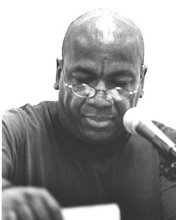
Because I am not devoid of pride, and because I always want to know whether I’m being talked about and what people are saying if I am, I periodically look myself up online or, as they say, “google” myself. (Perhaps “Google” should be capitalized, since it is a trademark.) The only other Reginald Shepherd who comes up is an aged and very Caucasian Canadian painter, a self-described “poetic realist” who seems well-known in his native Newfoundland and in neighboring Nova Scotia, but nowhere else as far as I can tell, even in Canada. I think of myself as a kind of poetic realist as well, in life and in my poetry, so perhaps our kinship is more than name deep.
Years ago, when I lived in Chicago, another, decidedly less savory Reginald Shepherd popped up when I searched myself. An apparent career criminal (all that came up were his various arrests), he was something of an evil doppelganger. I once was almost denied an apartment because there was a record of my arrest for “criminal shoplifting” (I always wondered what legal shoplifting was) in 1991, two years before I moved to Chicago. And once I received a letter from a social service agency that some woman had named me as the father of her child. I had to call and explain that the last time I had been in the vicinity of a woman’s vagina was the morning I was born. One of the other Reginald Shepherd’s old addresses even appeared on my credit report, an error (among others) I had to call and write in order to rectify. My criminal double has either settled down into legal respectability or died (either is equally likely), as he hasn’t shown up in my web searches for several years. I would like to think that he has seen the error of his ways and now become a law-abiding citizen, but I have no great desire to inquire further.
When I look up the most common misspelling of my name, Reginald Shepard, which people sometimes insist upon even when they’re publishing or paying me, no matter how many times I sign and print the correct spelling of my name, besides finding various references to my misspelled self (I try to correct them when I can), I also find references to a death row inmate in Florida by that name. I don’t know what his crime was, but I imagine that it was probably murder. I find it a little disturbing to once again have a criminal doppelganger living (though who knows for how long) in the same state. At least there are two crucial letters separating my name from his, his fate from mine. But still…
Showing posts with label names. Show all posts
Showing posts with label names. Show all posts
Saturday, August 16, 2008


Friday, August 8, 2008
What's in a Name? Part Two
Now that I am once again out of the hospital and able to sleep in my own bed without being wakened several times a night to be weighed or have my vital signs taken, I have the opportunity to think about other things every once in a while, or at least to return to thoughts over which I've been mulling for a while. Thus I present part two of my musings on names and naming.
The name Reginald has very different connotations for white people and for black people. For white people, the name sounds very English, and my Anglo accent, though one that I can’t hear, often makes them inquire as to whether I am English, or perhaps West Indian. I just reply that I got my accent from my Barbadian father (whom I met once) and my Jamaican stepfather (who abused my mother and me). But almost the only people in America nowadays with the name Reginald are black. It’s become an almost quintessentially black name, like Antoine (often spelled Antwan, or Antuan) or Leroy/Leroi (“the king”).
Mine is one of a set of categories of black names. There are the names that white Americans don’t use anymore, like Cedric or Tyrone, names that have been handed over to black people (though in the hospital I did have a white physical therapist named Tyrus—but then, the South has always been a bit backward). There are also names like Reginald, Maurice, or Roderick (this last one is on the edge) which have become predominantly black names but aren’t yet perceived so by white people. There are the made-up names, like Materia, Tawanna (a cousin of mine—she was meant to be named after the Mexican border city), or Chicalaundra (pronounced “Shalandra”). There are the Frenchified names, like LaQuan or LeVante or LeBron or LaToya (also LeToya), or the (male) driver of the Greyhound bus I used to take to work when I lived in Chicago, LaHarry. I remember joking once with a black friend that you can make any name black just by adding “La” or “Le” to it; then I realized it was true. (“De” will also work, as in DeWayne, DeMarcus or, my favorite, Da’Sean, pronounced “DAY-Shawn”—the apostrophe makes all the difference.) Then there are the faux-African names, like Kechia/Keshia/Keisha, Kena (another cousin of mine), Kima, and Kwame (this last a genuineWest African name appropriated by black Americans). There is an overlap between Frenchified black names and faux-African names, as in Lakeisha or Deshondra, and between the made-up names and the faux-African names, like Tawanna or Kima or Ebony/Eboni. There are also the Arab names, like Jamal and Malik, Omar and Raheem/Raheim. I’ve always found black Americans' tendency to give their children Muslim names odd, since Muslim Arabs were major slave traders for over a thousand years. A category which seems to have dwindled are names taken from words of rank and position, so that a white person calling a black person by (usually) his first name would still have to show respect, even if the act was meant disrespectfully. The singer Prince a/k/a “Symbol Thing” (born Prince Rogers Nelson) and poet Major Jackson would be examples. Mine is also an example of such a name, since, as I wrote earlier, my mother always told me that it meant “Great King.”
When I was a kid, and up until my mid-twenties, I went by “Reggie.” The only other two Reggies I knew of in my childhood were the baseball player Reggie Jackson and the Archie comic books laughingstock rich bad boy Reggie Mantle. He once went into an office and, unsatisfied by the secretary’s refusal to be impressed by him, announced “Someday my name will be a household word,” to which her response was, “Like dirt?”
A few months before my twenty-fifth birthday, I decided that I was too old to be called “Reggie.” That was a child’s name, and it was time for me to put aside childish things. Since then I have gone by my full name, though people still insist on calling me “Reggie” and “Reg.” But even when I went by Reggie, already a shortened version of my name, many people insisted on calling me “Reg." Besides the obvious fact that it wasn’t my name (if I wanted to be called Reg, I would introduce myself that way), as my oldest friend Merav’s mother put it, “Reg” has the air of a hale fellow well met, a football player perhaps, and that's never been me or anyone I wanted to be. I've never understood why people would need to nick a nickname, anyway. Some people still call me Reg, and I always correct them, except for my editor at the University of Pittsburgh Press, Ed Ochester. He has loyally published me for many years, so if he wanted to call me “Joe,” that would be alright with me.
The name Reginald has very different connotations for white people and for black people. For white people, the name sounds very English, and my Anglo accent, though one that I can’t hear, often makes them inquire as to whether I am English, or perhaps West Indian. I just reply that I got my accent from my Barbadian father (whom I met once) and my Jamaican stepfather (who abused my mother and me). But almost the only people in America nowadays with the name Reginald are black. It’s become an almost quintessentially black name, like Antoine (often spelled Antwan, or Antuan) or Leroy/Leroi (“the king”).
Mine is one of a set of categories of black names. There are the names that white Americans don’t use anymore, like Cedric or Tyrone, names that have been handed over to black people (though in the hospital I did have a white physical therapist named Tyrus—but then, the South has always been a bit backward). There are also names like Reginald, Maurice, or Roderick (this last one is on the edge) which have become predominantly black names but aren’t yet perceived so by white people. There are the made-up names, like Materia, Tawanna (a cousin of mine—she was meant to be named after the Mexican border city), or Chicalaundra (pronounced “Shalandra”). There are the Frenchified names, like LaQuan or LeVante or LeBron or LaToya (also LeToya), or the (male) driver of the Greyhound bus I used to take to work when I lived in Chicago, LaHarry. I remember joking once with a black friend that you can make any name black just by adding “La” or “Le” to it; then I realized it was true. (“De” will also work, as in DeWayne, DeMarcus or, my favorite, Da’Sean, pronounced “DAY-Shawn”—the apostrophe makes all the difference.) Then there are the faux-African names, like Kechia/Keshia/Keisha, Kena (another cousin of mine), Kima, and Kwame (this last a genuineWest African name appropriated by black Americans). There is an overlap between Frenchified black names and faux-African names, as in Lakeisha or Deshondra, and between the made-up names and the faux-African names, like Tawanna or Kima or Ebony/Eboni. There are also the Arab names, like Jamal and Malik, Omar and Raheem/Raheim. I’ve always found black Americans' tendency to give their children Muslim names odd, since Muslim Arabs were major slave traders for over a thousand years. A category which seems to have dwindled are names taken from words of rank and position, so that a white person calling a black person by (usually) his first name would still have to show respect, even if the act was meant disrespectfully. The singer Prince a/k/a “Symbol Thing” (born Prince Rogers Nelson) and poet Major Jackson would be examples. Mine is also an example of such a name, since, as I wrote earlier, my mother always told me that it meant “Great King.”
When I was a kid, and up until my mid-twenties, I went by “Reggie.” The only other two Reggies I knew of in my childhood were the baseball player Reggie Jackson and the Archie comic books laughingstock rich bad boy Reggie Mantle. He once went into an office and, unsatisfied by the secretary’s refusal to be impressed by him, announced “Someday my name will be a household word,” to which her response was, “Like dirt?”
A few months before my twenty-fifth birthday, I decided that I was too old to be called “Reggie.” That was a child’s name, and it was time for me to put aside childish things. Since then I have gone by my full name, though people still insist on calling me “Reggie” and “Reg.” But even when I went by Reggie, already a shortened version of my name, many people insisted on calling me “Reg." Besides the obvious fact that it wasn’t my name (if I wanted to be called Reg, I would introduce myself that way), as my oldest friend Merav’s mother put it, “Reg” has the air of a hale fellow well met, a football player perhaps, and that's never been me or anyone I wanted to be. I've never understood why people would need to nick a nickname, anyway. Some people still call me Reg, and I always correct them, except for my editor at the University of Pittsburgh Press, Ed Ochester. He has loyally published me for many years, so if he wanted to call me “Joe,” that would be alright with me.
Tuesday, August 5, 2008
What's in a Name? Part One
Steven Burt’s January post "all-name team" on the Poetry Foundation’s Harriet blog, and the posts I did in February here on this blog on gay poetry post identity politics, have had me musing about identity, social and personal, and about the role names play in producing identity. I’ve been thinking about names, what they are and what they do. As Burt points out, poetry is a kind of naming, and naming is in turn a kind of poetry. In poems, names are like magic talismans that contain and convey the essence of the thing named. So when two things are given the same name, then they are or become the same. And when the name changes, then the thing named changes.
The thought of changing names and things, in turn, has me thinking of my own name (everything makes me think of me), the changes it has undergone over the course of my life, and a couple of people with whom I share that name, whom I’m quite sure are not the same, as me or as each other. But when I look myself up, there they are. And when I look up the wrong spelling of my name, some other version of me, there I am anyway, as if I were two people who’ve led the same life, or at least who’ve published the same things in the same places. As Steve Burt points out, “Titles, names, labels ask questions, and raise possibilities.” So who are the possible me’s my name makes possible?
1
I was born Reginald Berry on the morning of April 10, 1963. Berry was my unmarried mother’s last name; like the protagonist of Diana Ross and the Supremes’ “Love Child,” I started my life in an old, cold, rundown tenement slum, burdened by the stigma of illegitimacy, which for me was the same as poverty. The birth certificate I am always losing documenting the birth of “Reginald Shepherd” was issued in 1968, after my mother had sued my deadbeat Barbadian father to prove that he was indeed my father. What we got out of that I never understood, since he almost never paid the meager thirty-five dollars a week in child support as ordered by the court.
I sometimes wonder if who I am changed when I ceased to be Reginald Berry (I was five) and became Reginald Shepherd: indeed, when I ceased ever to have been Reginald Berry. Reginald Berry was erased, as if he had never been, and his place was taken by Reginald Shepherd, as if I had always been him and he had always been me, except that Reginald Shepherd came into existence at the age of five, having completely bypassed birth and infancy, not to mention the terrible twos and threes.
I was enmeshed in the social services network at a very early age (as everyone in her family always said, my mother knew how to work the system), and to this day I am in the Social Security Administration records as Reginald Berry Shepherd, a name I have never legally had or even gone by, a name that has never been mine. They remember all the pasts, and conflate them into one.
Would my life have been different if I had remained Reginald Berry, if Reginald Berry had not been erased as if he had never existed? At the least, people would have much less occasion to misspell my name, and who knows what effect that confidence that I would be correctly spelled could have had on my self-esteem?
My mother (who went from being Blanche Berry to being Blanche Graham—my stepfather’s name—without ever having been Blanche Shepherd) always told me that my name meant “Great King” in Celtic. According to the Online Etymology Dictionary (whose only authority is that of its author, Douglas Harper), my name derives from Old High German and means “ruling with power.” According to Dictionary.com Unabridged (which bases its claim to authority on the Random House Unabridged Dictionary), it derives from an Old English word meaning “counsel and rule.” I believe that it’s related to the name of the Celtic goddess Rigantona, whose name means “Great Queen.” Someone in college told me that my name was the ablative form of the Latin rex, “king,” meaning something like “of the.” Perhaps I was the king’s favorite shepherd or, in my previous life, his favorite fruit. My younger half sister is named Regina (my mother had a plan); her name unambiguously means “Queen.” I confess to being a bit jealous of her name’s indisputable authority.
But despite the grandeurs of my first name, I have felt a little deprived that I don’t have a middle name. My mother had one, later my abusive Jamaican stepfather had one, and still later my younger half-sister had one. I settled on “Alexander” as an appropriate middle name: Alexander the Great was a famous king and conqueror, and the initials “RAS” spelled out the Amharic word for “prince.” (The late Emperor Haile Selassie I of Ethiopia was known was Ras Tafari Makonnen, “Prince Tafari Makonnen,” before his ascension to the throne. Hence the group name Rastafarian, though this quasi-religion has never had any connection with Ethiopia.) But I never had my name legally changed, and as I got older I lost interest in the matter.
The thought of changing names and things, in turn, has me thinking of my own name (everything makes me think of me), the changes it has undergone over the course of my life, and a couple of people with whom I share that name, whom I’m quite sure are not the same, as me or as each other. But when I look myself up, there they are. And when I look up the wrong spelling of my name, some other version of me, there I am anyway, as if I were two people who’ve led the same life, or at least who’ve published the same things in the same places. As Steve Burt points out, “Titles, names, labels ask questions, and raise possibilities.” So who are the possible me’s my name makes possible?
1
I was born Reginald Berry on the morning of April 10, 1963. Berry was my unmarried mother’s last name; like the protagonist of Diana Ross and the Supremes’ “Love Child,” I started my life in an old, cold, rundown tenement slum, burdened by the stigma of illegitimacy, which for me was the same as poverty. The birth certificate I am always losing documenting the birth of “Reginald Shepherd” was issued in 1968, after my mother had sued my deadbeat Barbadian father to prove that he was indeed my father. What we got out of that I never understood, since he almost never paid the meager thirty-five dollars a week in child support as ordered by the court.
I sometimes wonder if who I am changed when I ceased to be Reginald Berry (I was five) and became Reginald Shepherd: indeed, when I ceased ever to have been Reginald Berry. Reginald Berry was erased, as if he had never been, and his place was taken by Reginald Shepherd, as if I had always been him and he had always been me, except that Reginald Shepherd came into existence at the age of five, having completely bypassed birth and infancy, not to mention the terrible twos and threes.
I was enmeshed in the social services network at a very early age (as everyone in her family always said, my mother knew how to work the system), and to this day I am in the Social Security Administration records as Reginald Berry Shepherd, a name I have never legally had or even gone by, a name that has never been mine. They remember all the pasts, and conflate them into one.
Would my life have been different if I had remained Reginald Berry, if Reginald Berry had not been erased as if he had never existed? At the least, people would have much less occasion to misspell my name, and who knows what effect that confidence that I would be correctly spelled could have had on my self-esteem?
My mother (who went from being Blanche Berry to being Blanche Graham—my stepfather’s name—without ever having been Blanche Shepherd) always told me that my name meant “Great King” in Celtic. According to the Online Etymology Dictionary (whose only authority is that of its author, Douglas Harper), my name derives from Old High German and means “ruling with power.” According to Dictionary.com Unabridged (which bases its claim to authority on the Random House Unabridged Dictionary), it derives from an Old English word meaning “counsel and rule.” I believe that it’s related to the name of the Celtic goddess Rigantona, whose name means “Great Queen.” Someone in college told me that my name was the ablative form of the Latin rex, “king,” meaning something like “of the.” Perhaps I was the king’s favorite shepherd or, in my previous life, his favorite fruit. My younger half sister is named Regina (my mother had a plan); her name unambiguously means “Queen.” I confess to being a bit jealous of her name’s indisputable authority.
But despite the grandeurs of my first name, I have felt a little deprived that I don’t have a middle name. My mother had one, later my abusive Jamaican stepfather had one, and still later my younger half-sister had one. I settled on “Alexander” as an appropriate middle name: Alexander the Great was a famous king and conqueror, and the initials “RAS” spelled out the Amharic word for “prince.” (The late Emperor Haile Selassie I of Ethiopia was known was Ras Tafari Makonnen, “Prince Tafari Makonnen,” before his ascension to the throne. Hence the group name Rastafarian, though this quasi-religion has never had any connection with Ethiopia.) But I never had my name legally changed, and as I got older I lost interest in the matter.
Subscribe to:
Posts (Atom)