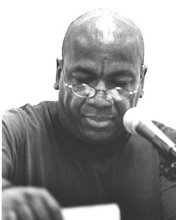
Because of the schools I have attended (all on assorted scholarships), because of my publishing success (it took me three years and three hundred submissions before I published a single poem), because I do not comport myself in a stereotypical lower-class manner, some people assume that I come from an economically comfortable background, that I have always known success, or that my success as a writer is due to social connections. Nothing could be farther from the truth. I am sure that everyone experiences a degree of cognitive dissonance between their own self-conceptions and the way they are seen by others. But if one is black, if one is gay, if one has been raised in poverty (as I was, in tenements and housing projects in the Bronx), if as an individual one has never fit into the various social contexts to which one has been expected or even to which one has hoped to belong, the burden of the distance between one’s own sense of self and the fixed and often distorted images others have of one is especially heavy.
Though I have a publishing career, some highly contingent place in the literary world, that still feels as if it could be snatched away at any time, and my material life is quite precarious. I certainly don’t have the financial security and stability I had hoped and expected to achieve by this age and this point in my career. I haven’t done the things that one should do to be successful. I haven’t networked, haven’t schmoozed. I’ve been no one’s sycophant, and though I would have liked to have had patronage, to have been someone’s protégé (something I had naively hoped to get out of attending Iowa), that hasn’t happened. I even foolishly removed the thanks to my teachers from my first book, afraid that readers would think that I owed my publications to them. Nor have I ever been a member of any club or clique.
Unlike the vast majority of those in academia or the literary world, I have nothing to fall back on. Since leaving my Aunt Mildred's house in Macon, Georgia, where I lived for two years after my mother's death, at seventeen, I have been on my own. It’s vanishingly rare for someone from my background, having nothing (no family, no independent resources, no “home”), to have achieved anything in the literary world, which often seems the preserve of those born with trust funds. English in particular seems to be largely populated by those who aspire to an Edith Wharton-esque, prissy, propriety-obsessed hyper-WASPiness: something which as I recall from The House of Mirth made all concerned quite miserable.
Several years ago I read a profile in The New Yorker of Jorie Graham, who as my teacher at Iowa once told me that I had had everything handed to me, to my ex-lover Chris Cutrone, a video-maker and critical theorist who grew up in a working class neighborhood on Long Island. He and I had bonded, among other grounds, as intellectuals and artists from poor backgrounds, people who as kids knew lots of words we couldn’t pronounce correctly, because we’d only read them in books. Hearing about Graham’s childhood in an Italian villa, the lavish parties her mother (a prominent sculptor once featured in a Gap ad) threw attended by Roman Catholic cardinals and Italian nobility, her marriage to the son of the owner of The Washington Post, Chris turned to me and said, “It reminds you that people like us weren’t meant to be artists, doesn’t it?” The art that saved me has so often belonged to the wealthy and privileged that it’s hard to remember that it’s not merely an ornament of power. Part of my project as a writer has necessarily (in order for me to be a writer at all) been to attempt to disentangle art’s liberatory from its oppressive aspects, to remember that those who so often own art don’t define it, that (as Adorno pointed out) art is the enemy of culture and culture is the enemy of art.
I had a dream that perfectly encapsulated my relationship to academia. I was in graduate school, walking with two professors, one an older white man and one a young hipster (swarthy, indeterminately ethnic, shoulder length hair, snazzy green blazer). The older professor was musing over some rhetorical question whose answer he didn’t really care about (something faux-political, as I recall), but I tried to respond anyway, and the hip young professor put his hand over my mouth and said, “We don’t need to hear from you about this.”
As the John Lennon song my title alludes to points out, they hate you if you’re clever, and they despise a fool. But I will be heard from. I’m determined not to leave the field to those born with spoons of various precious metals in their mouths (who nowadays include the children of the black bourgeoisie, however much they whine about “the rage of a privileged class”). The culture I’ve acquired with so much work may be their birthright, but I appreciate it in a way that those who take it for granted rarely do. It means something to me—it means everything to me. Sometimes I stand in the poetry section of Barnes and Noble and wonder how many authors there come from backgrounds like mine. They can be counted on the fingers of one hand.
My oldest friend’s mother once asked me why, coming from what I came from, I thought that the world would or should be fair. I didn’t have an answer then, but now I realize that it’s because I believed that the world outside the prison house in which I was born and raised would be different. It was that hope, that faith, really, that kept me going, that keeps me going. Every “A” I got, every prize I won, was a punch in my ticket to that elsewhere. I wanted to escape the ghetto, but I also wanted to go somewhere better, which meant believing that there was somewhere better: my version of optimism, or simply blind faith. I have gone from place to place, from circumstance to circumstance, and still haven’t found that fair, just place, but I continue to search, hoping and believing that there’s a place for me.
I know that there are many smart and talented young people in the ghettos who haven’t have the luck I had, the opportunities, or just a mother determined that they would be something more than a statistic, but I also know that sometimes the system that puts one in one’s place and keeps one there with an iron-toed boot pressed down on one’s throat can be circumvented, though hardly defeated. Indeed, if one doesn’t come from privilege, one has no choice but to circumvent that system if one wants to breathe at all, and I have always insisted on drawing on my own breath. I am living proof of both the possibility and the precariousness of such an escape. I was not meant to survive this world. Many people have tried to crush me, sometimes with the best of intentions, as I know they have crushed others who have refused to know their place. I consider my survival a form of victory, however tenuous and conditional.
*For those who miss the irony in my title, seeing it as mere self-aggrandizement or self-pity, I point out the irony here. In the song to which this title refers, John Lennon means both that a working class hero is something to be and that a working class hero is nothing to be.
Showing posts with label Christopher Cutrone. Show all posts
Showing posts with label Christopher Cutrone. Show all posts
Saturday, August 25, 2007


Subscribe to:
Posts (Atom)