This is a highly revised amalgamation of two much earlier posts.
“What are these songs
straining at sense—
you the consequence?”
Louis Zukofsky, Anew 10
1
It’s been the fashion at least since the Modernists to complain that contemporary poetry has become difficult, and that this difficulty has alienated the readers who used to flock to poetry as they now flock to John Grisham novels and American Idol marathons. I am not sure what constitutes the easy poetry these people look back to: Shakespeare? Donne? Milton? I’m also not sure when and where this massive poetry audience existed. The great majority of the nineteenth century counterparts of those who now watch television and read pulp fiction were barely literate. They certainly weren’t seduced away from their immersion in Keats and Browning by the advent of the mass media. Conversely, Dylan Thomas was one of the most popular poets of the Nineteen Forties and Fifties, on both sides of the Atlantic, and his work is nothing if not “difficult” (and it isn’t nothing, though it is somewhat forgotten today). And both avant-gardeners and poetic populists are often too busy bashing T.S. Eliot to remember that he practically filled arenas when he gave readings. Today John Ashbery and Jorie Graham, whose work is usually considered to be challenging at the least, are among our most popular poets, prominent enough to have each been profiled in The New Yorker, a magazine not usually known for overly taxing its readers.
I don’t believe that the imaginary “average person” doesn’t want to be challenged and stimulated. There is, for example, a whole industry of verbal challenges that the so-called general public relishes, as evidenced by the popularity of crossword puzzles of all kinds.
In the perennially popular “death of poetry” discourse, there’s a consensus that people don’t read poetry because it’s too hard, too “elitist” (another word that should be expunged from the English language: it’s never descriptive, only pejorative). I’ve always thought the opposite, that most poetry isn’t hard enough, in the sense that’s it’s not interesting or engaging enough. It doesn’t hold the attention—you read it once or twice and you’ve used it up. That engagement I look for and too often miss is a kind of pleasure, in the words, the rhythms, the palpable texture of the poem. It’s the opposite of boredom.
Literary critic Vernon Shetley, who observes that most contemporary poetry has grown less, not more difficult, since the Moderns (perhaps it might be more accurate to say, most contemporary “mainstream” poetry), argues in his book After the Death of Poetry: Poet and Audience in Contemporary America that “only by increasing the level of intellectual challenge it offers can poetry once again make itself a vital part of intellectual culture” (3-4). I would add that poetry’s challenges and pleasures are far more diverse than the intellectual, though I do believe that the intellectual is an essential element in poetry: to modify Eliot’s dictum, the poem must be as intelligent as possible.
Many years ago I sat in on a class of Ted Kooser’s in which he asserted that a reader wants to be led by the hand through a poem, that readers have no patience with being baffled, no tolerance for mystery. I had to interject that I hated to be led by the hand through a poem. I’d rather that the poet assume that I can make my own way through a poem, though I do prefer that there at least be pathways, even if they’re not paved and lit. I don’t object to being baffled, though I may not wish to remain in bafflement indefinitely. Just as mystery can be part of a person’s allure, so mystery in poetry can be a lure. Yeats calls this “the fascination of what’s difficult.” One wants to solve the mystery, or at least better understand its source. Sometimes one discovers that the mystery isn’t to be solved, but still that process of exploration has helped one to know it better, to experience it more fully. (Superficial mystery is merely shallowness posing as depth. As Howard Nemerov notes, some poets “wish to make common matters singular, easy matters hard, and shallow thoughts profound.”) Billy Collins has written that, “in the best of all possible worlds of reading, dealing with difficulty can be listed among poetry’s pleasures” (“Poetry, Pleasure, and the Hedonist Reader,” in The Eye of the Poet: Six Views of the Art and Craft of Poetry, edited by David Citino, 25).
What I cannot bear, as a reader or as a person, is to be bored. For a poem to be boring is much worse than for a poem to be baffling. In Marianne Moore’s words, “Paramount as a rule for any kind of writing—scientific, commercial, informal, prose or verse—we dare not be dull” (“Idiosyncrasy and Technique,” A Marianne Moore Reader 172). (Dullness is as much the enemy of poetry now as it was when Pope wrote.) Incomprehension and even frustration can seduce in poems just as they can in people: many objects of desire are obscure, but their outlines are clear. What does the sunlight breaking through the clouds that have hovered all day, then filtering through the leaves of the giant live oak tree in my back yard, “mean”? It is, I saw it, I felt in on my skin. You can see something too, feel that slight difference in the temperature when you step out from under that tree, your feet sinking a little into the thick layer of leaf litter. Too many bad poems, dull poems, are just meaning, with nothing or too little doing the meaning. I know what they mean, but I can’t be bothered to care. As Charles Bernstein notes, some poems are easy because they have nothing to say. Conversely, some poems are difficult for the same reason, in an attempt to cover up their vacuity. Poet Mark Granier points out that some poems are difficult merely in the manner of a difficult child, sullenly or gleefully sticking out their tongues at the reader.
It’s often said that “difficult” poems exclude potential readers. I feel excluded by poems that give me nothing to do as a reader, that offer me no new experience and nothing I didn’t already know. It’s wearying to read such poems, it makes me want to watch music videos instead, where at least one sometimes gets some glimpses of shirtless guys with six-pack abs. Any good poem gives the reader something, what Allen Grossman calls the interest of the world: feelings, sensations, experiences. T.S. Eliot wrote that genuine poetry can communicate before it’s understood. I would say analogously that good poetry can and should give pleasure before it’s understood. As Wallace Stevens noted of his supreme fiction, it must give pleasure. It’s this pleasure that makes one want to understand the poem. Whether my poems are always immediately graspable in terms of subject matter, I’ve always tried to give the reader something, in terms of language, imagery, rhythm, etc., to make the poem a sensual experience. Understanding something can be a pleasurable experience (it can also be intensely painful), but in poetry as in life there are other pleasures than understanding. In Billy Collins’s words, “Surely, you can enjoy a poem before you understand it….The grasping of a poem’s meaning, however provisional it may be, is only one of the many pleasures that poetry offers” (op. cit. 29).
I don’t “understand” some of my favorite poems. I don’t know what they “mean,” but I know what happens to me when I read them; I know the experience I’ve had and its effect on me. Hart Crane has been one of my favorite poets for over twenty years, but until I taught him I didn’t “understand” “The Broken Tower.” I’m glad that I do now, but only because that understanding has enriched an experience I was already having.
Geoffrey Hill observes that “difficult poetry is the most democratic, because you are doing your audience the honour of supposing that they are intelligent human beings. If you write as if you had to placate or in any way entice their lack of interest, then I think you are making condescending assumptions about people. I mean people are not fools. But so much of the populist poetry of today treats people as if they were fools.” I don’t want to be patronized or condescended to, as a reader or a person; I would prefer that the poet assume that I am both intelligent and interested.
The ideal reader is on the one hand willing and alert enough to actively participate in the poem’s production of meaning and on the other hand demanding enough to insist that the poem provide the material with which to produce such meaning and perceptive enough to see whether or not these pieces actually do form some kind of gestalt, however unexpected its shape. The poem may not adhere to standard, linear logic, but it must have a logic of its own.
2
It’s always important to define one’s terms, and yet it’s so rarely done. In order to clarify my topic of discussion, I offer here my anatomy of difficulty in poetry. I present the several kinds of difficulty in order of ascending complexity.
There is, first, lexical difficulty: the poem contains words with whose sense we are unfamiliar, or words used at variance from or even contrary to their dictionary definitions. Hart Crane’s poetry is a perfect example of such difficulty, full both of arcane and recherché words (“infrangible,” “transmemberment”) and of words given idiosyncratic or private meanings: for example, the use of the word “calyx” to mean both a cornucopia (ironic, since the bounty is death’s) and “the vortex made by a sinking vessel” (Crane’s explication) in this stanza from “At Melville’s Tomb”:
And wrecks passed without sound of bells,
The calyx of death’s bounty giving back
A scattered chapter, livid hieroglyph,
The portent wound in corridors of shells.
Then there is allusive difficulty; the poem that alludes frequently eludes. The poet refers to something we’ve not heard of, assumes a piece of knowledge we don’t have. If one doesn’t know that Herman Melville wrote obsessively about the sea, then one won’t understand that the ocean itself is treated as his final resting place, though the man himself died on dry land. If one does not have “But at my back I always hear/Time’s wingèd chariot hurrying near,” and the rest of “To His Coy Mistress,” in one’s ear, the relationship of poem and title of Archibald MacLeish’s “You, Andrew Marvell” will appear rather opaque, and some of the poem’s sense of doom may be lost. Similarly, if one does not recognize the place names (“And Lebanon fade out and Crete/High through the clouds and overblown//And over Sicily the air/Still flashing”), one will miss the grim irony of darkness flooding in from the east, usually associated with sunrise, rather than from the west. Sometimes the allusion is implicit or indirect: one will miss some of the force (and some of the humor) of Frost’s “For Once, Then, Something,” if one misses the presence of Narcissus in love with his own image in a pool in its description of a man who sees “Me myself in the summer heaven” reflected in the water of a well. In this case, one must not only recognize the allusion, but notice that an allusion is being made at all. Poems considered difficult often allude to material outside the common literary or intellectual frame of reference. Modernist poetry is particularly difficult in its wide range and idiosyncratic, often inexplicit, deployment of allusion.
There is also syntactical difficulty, the obstacle of complex, unfamiliar, dislocated, broken, or incomplete syntax: one cannot discern or reconstruct the relations of the grammatical units. Swerving away from the conventions of prose syntax has long been an integral part of poetic practice: as Howard Nemerov explains, it is “precisely the sort of rhetorical and musical variation which properly belongs to poetry and distinguishes it from prose” (“The Difficulty of Difficult Poetry,” Reflexions on Poetry and Poetics 25). The long, Latinate sentences of Milton’s Paradise Lost are one example of this kind of difficulty; the fragmented, fractured syntax of much experimental poetry is another. In the case of Paradise Lost, one can parse the syntax with patience and careful attention; in many avant-garde poems, the syntax is intended to remain indeterminate, deliberately unparsable, resisting the reader’s desire to make it cohere.
There is also semantic difficulty: we have trouble determining or deciding what a poem says or means, we cannot immediately decipher or interpret it. (It is important here to remember that sense and reference are distinct: sense is internal to the poem, as it is to language itself. As linguist David Crystal elucidates in How Language Works, “Sense is the meaning of a word within a language. Reference is what a word refers to in the world outside language” [188]. From this perspective, it’s more useful to think of the poem as a field of meanings than as a thing that means something else, a container for or vehicle of meaning.) Semantic difficulty encompasses figurative difficulty, in which we can’t unpack the poem’s metaphors, or can’t determine what is tenor and what is vehicle, especially when, as is frequently the case, one or the other is omitted, or when the presence and process of figuration is only implied. (This might be called the difficulty of elliptical figuration.) Difficulties interpreting tone, determining the stance and attitude the poem takes and wants the reader to take toward its material, would also fall under the heading of semantic difficulty.
Semantic difficulty can in turn be broken down into difficulty of explication and difficulty of interpretation. Some poems present both kinds of difficulty, some only one or the other. In the case of explicative difficulty, the reader cannot decipher the literal sense of the poem: “What is this poem saying?” One encounters this in Hart Crane’s “At Melville’s Tomb,” and he wrote an extensive explication of the poem for Harriet Monroe, founding editor of Poetry. In the case of interpretive difficulty, one grasps what is being said on the literal level, but doesn’t know what it means, what it is meant to do. John Ashbery’s poems, usually syntactically and explicationally clear, often present this interpretive difficulty. In a different way, and because of their very simplicity and bareness, William Carlos Williams’s “This Is Just to Say” or “Poem” (“As the cat/climbed over/the top of//the jamcloset”) present extreme cases of interpretive difficulty, in which the “what” is so clear as seemingly to preclude a “why.” To say that one doesn’t know what a poem means, if one understands its literal sense, is to say that one doesn’t know why it’s saying what it’s saying. The reader asks, “Why am I being told or shown this?”
It is semantic difficulty which readers are usually experiencing when they say, “I don’t understand this poem.”
Then there is formal difficulty, what John Hollander calls the difficulty of problematical form: one cannot ascertain the poem’s shape, cannot hold it in one’s head as a construct. Or one cannot determine what kind of poem it is, and thus doesn’t know how to read it, in much the same sense that one might try and fail to “read” a person. The reader cannot determine or recognize the formal contract (on the analogy of Hollander’s concept of the metrical contract) to which the poem asks him or her to agree. This difficulty is most commonly encountered with poems that play with or violate conventions and expectations, that try to break and/or recreate form: remembering always the intimate relation of form and content, which, as Creeley wrote, are extensions of one another. The question the reader asks is, “What kind of poem is this?”
In the case of formal difficulty, one could add the possibility that the reader understands the terms of the poem’s formal contract, but refuses or feels unable to accede to them. Many American poetry readers today, raised on free verse, find it difficult to read metrical and/or rhyming poetry. They can’t hear its shape, can’t feel its rhythms; its sounds don’t make sense to their ears. This type of formal difficulty can be called rhythmic difficulty.
Formal difficulty is a particular case of what George Steiner, cited by Shetley, calls modal difficulty, my final kind. When we experience modal difficulty, “we fail to see a justification for poetic form, the root-occasion of the poem’s composition eludes or repels our internalized sense of what poetry should or should not be” (Shetley, After the Death of Poetry 7). Steiner actually writes, “what poetry should or should not be about,” but I broaden his statement to encompass not just topic or occasion but the poem’s status and recognizability as a poem. The two poems by Williams mentioned earlier are prime examples of modal difficulty. To some readers, they are not poems at all, in the same way that Jackson Pollock paintings are not “art” to some viewers. This another way of saying that those readers lack a frame for these poems. (One often suspects that those same readers, if they accept “The Red Wheelbarrow” as a poem, only do so because it has been taught so often as one; they have been trained to look for its supposed hidden meanings.) Clark Coolidge’s poems appear as gibberish to many readers: they present both semantic and modal difficulty. In the case of modal difficulty, a reader asks, “What makes this a poem?”
When people call a poem difficult, they are generally experiencing either semantic difficulty (“I don’t know what this poem is saying” or “I don’t know why this poem is saying what it’s saying”), formal difficulty (“I can’t see/hear the shape of this poem”), or modal difficulty (“I don’t recognize this as a poem”).
Another way to divide up the field would be to distinguish between difficulties of explication (which would include lexical, allusive, and syntactic difficulty), difficulties of interpretation (which would comprise the several varieties of semantic difficulty), and difficulties of recognition (which would encompass both formal and modal difficulty). These categories, of course, can and do overlap to a certain extent.
All of the kinds of difficulty I have enumerated and described are violations of readerly expectations. All readers, no matter how catholic in their tastes and in their knowledge, come to poems with some or another set of expectations. Readers may and do vary widely in their expectations of a poem, and they may have different expectations of different poems and different kinds of poems, but it’s impossible to approach a poem as if one were a blank slate, as in the philosophy of John Locke. Shetley points out that “readers’ training, expectations, and knowledge have everything to do with whether particular forms of language are experienced as difficult….Different groups of readers have different skills and expectations; allusions familiar to one…audience may be mysterious to another, and received conventions that structure the sense of what makes an utterance a poem may vary widely” (op. cit. 6,9). Every reader encounters poetic difficulty of some kind at some point.
3
Difficulty is not equivalent to complexity. Despite their deceptive surface simplicity, Ben Jonson’s poems on the deaths of his children, “On My First Daughter” and “On My First Son,” are complex; but they are not difficult. Many of e.e. cummings’s more typographically wayward poems are difficult, but not complex. This is another way of saying that they are obscure.
There is a difference between difficulty and obscurity. All obscure poetry is difficult, but (contrary to popular opinion) not all difficult poetry is obscure. Obscurity is a lack of clarity; it is a flaw.* Difficulty is not a virtue in and of itself, but obscurity is always a defect. Marianne Moore wrote that “one should be as clear as one’s own natural reticence allows one to be” (“Idiosyncrasy and Technique,” op. cit. 171). This can be rephrased as, one should be no more difficult than necessary. But it may prove necessary to be very difficult indeed, although there are some poets for whom difficulty is an end in itself, either for the sake of a sense of superiority over the reader or other poets, or for the sake of a sense of rebellion or transgression. Some forms of “difficulty” are as rote as the most well-rehearsed stump speech. I never set out to be “difficult” in my poems, nor do I try to hide things from the reader. Moore asks, “How obscure may one be?” and replies, “I suppose one should not be consciously obscure at all” (“Humility, Concentration, and Gusto,” op. cit. 125).
I take Moore’s admonition to refer to the clarity of the materials, of the saying and showing itself, not of what it means or how it’s to be interpreted. This is the clarity of an experience: the poem is an experience the reader has, and though one doesn’t always know what the experience “means,” one knows what happened, what one experienced. But if what happened isn’t clear, then there’s no possibility of making meaning out of it. As poet and critic Joan Houlihan points out, incoherence is neither mysterious nor difficult: it’s just another source of boredom. Moore again: “Nor can we dignify confusion by calling it baroque” (“Humility, Concentration, and Gusto,” op. cit. 123). The poet should provide the reader with the elements out of which the meaning or meanings can be assembled or produced, and the pieces of the mosaic should be clear and distinct (like Descartes’ ideas), even if their relations to one another are not immediately apparent. “Sometimes it appears to candid reflexion that great works of art give no meaning, but give, instead, like the world of nature and history itself, materials whose arrangement suggests a tropism toward meaning, order and form” (Howard Nemerov, “The Difficulty of Difficult Poetry,” op. cit. 30).
4
“To read a poem should be an experience, like experiencing an act” (Stevens, “Adagia,” Collected Poetry and Prose 905). The idea of the artwork as an experience also produces a basis for aesthetic judgment. One can (and should) ask, Does this artwork provide a unique, distinctive experience, one that hasn’t already been experienced, known, understood? Walter Benjamin describes shock and distraction as the modern mode of consciousness (or unconsciousness), in which most of our experience is not really experienced, doesn’t actually exist for us at all. Although art should be the antidote to this non-experience of distraction, most of what we read simply repeats and re-presents what has already been experienced (or non-experienced). A real work of art makes us stop and pay attention. It breaks through our crust of habit and routine.
I believe that all artists want to communicate with some audience or another, though that potential audience may vary enormously in size and/or kind. If one truly cared nothing about making contact with others, however few or select (not every poem is for every reader, or even for the same reader at every time and in every mood), there would be no reason to make art. One could simply commune with oneself within the confines of one’s own mind. But the will to communicate does not define the what or the how of communicating. A poem can communicate itself, in the way that a classical Greek statue or a Jackson Pollock painting does. This is another way of saying that poems are, or should be, experiences in themselves, and not just accounts of or commentaries on experience; they should be additions to the world, not simply annotations to it. If people think of poems as merely road markers or sign posts to something else, it’s no wonder that they don’t want to read them. I’d rather go to a place myself than look at a sign pointing out the direction to the place.
Those who define or evaluate a poem in terms of its content are making a serious category mistake. Poems are utterances, but they are first and foremost aesthetic artifacts, events and occasions in language. They often contain propositional statements, but those propositions are, in Susanne Langer’s term, sheerly virtual, the form of content, the shape of saying. It is this which distinguishes poetry from most other modes of discourse, in which the expressive or communicative function of language is dominant and in which the materiality of language is suppressed or ignored, or at best used only instrumentally to produce a desired effect in the reader or listener.
As Howard Nemerov has written, “The flat statement that poetry is or ought to be communication, even if it happened to be true, would be uninteresting. Some poetry, not necessarily the most interesting sort, has the clear intention of communicating—meanings. Other poetry has the clear intention of deepening the silence and space about itself…. Meanings, generally speaking, are derived from the world and meanings are communicable, but is the world communicable? The work of art imitates in the first place world, it does not immediately imitate meanings except as these occur in the world” (op. cit. 30).
Walter Pater famously asserted that all art aspires to the condition of music, and the musical analogy is very suggestive. On the one hand, music is intensely expressive, and on the other hand it’s hard (at least with instrumental music) to pin down exactly what is being expressed. Also, music is by definition organized and ordered, or it isn’t music, just noise or random sound, and the “meaning” of a piece of music is inextricable from its structure. Similarly, a poem means as much through its form, its shape in space and time, as through its content or “subject matter.” Poetry is a way of happening, as Auden wrote. The what of saying, though hardly insignificant or irrelevant, is something that poetry shares with any other mode of discourse or expression: it’s how a poem happens that sets it apart.
A destination is also an end, but as Nietzsche wrote, the end of a melody isn’t its goal. Too often understanding is the prize you get after you’ve consumed the poem. Now that you’ve taken it apart to get the decoder ring, you’re done with the poem, you can throw it away. I don’t see poems as things I want to get over with, any more than I see life as something I want to get over with. The end of life is death, and we start dying from the minute we’re born. But on the road to the contagious hospital there are muddy fields full of new growth if we just take the time to look closely. We’ll get down that road soon enough. Death is contagious, people are always catching it; the time we don’t take will be taken from us. There’s no need to hurry oneself along.
I will allow Howard Nemerov the last word. “If poetry reaches the point which chess has reached, where the decisive, profound, and elegant combinations lie within the scope only of masters, and are appreciable only to competent and trained players, that will seem to many people a sorry state of affairs, and to some people a consequence simply of the sinfulness of poets; but it will not in the least mean that poetry is, as they say, dead; rather the reverse. It is when poetry becomes altogether too easy, too accessible, runs down to a few derivative formulae and caters to low tastes and lazy minds—it is then that the life of the art is in danger” (op. cit. 30).
*Vernon Shetley offers a different distinction between obscurity and difficulty, “using the former term to refer to those elements of language that resist easy semantic processing, and the latter for the reader’s response to those elements. Obscurity, then, refers to features within a text, such as allusion, syntactical dislocations, and figurative substitutions, while difficulty refers to something that occurs between reader and text, one kind of possible response to textual obscurity” (After the Death of Poetry 5-6). Shetley does not make clear why his terms could not just as easily be reversed (a reader could find a text obscure, hard to see, hard to read, because it is difficult).
Showing posts with label Vernon Shetley. Show all posts
Showing posts with label Vernon Shetley. Show all posts
Tuesday, June 19, 2007


Saturday, February 24, 2007
The Mirage That We Call "Poetry"
1
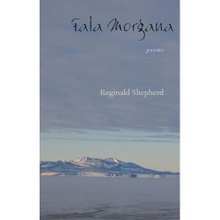
When seen from a distance or just casually glanced at, poetry appears to be a substantive and singular thing. But when looked at more closely and attentively, this apparent solidity and unity dissolves: the fata morgana dissipates into the air.
Reading an article in The New Yorker on the Poetry Foundation and its president John Barr, and soon after reading the entries in The New Princeton Encyclopedia of Poetry and Poetics on “Lyric” and “Poetic Meaning,” both dealing largely with problems in the definitions and uses of the terms, has reminded me of the emptiness of the word and the mental category “poetry.” As evidenced by the failure of all attempts at a comprehensive definition, we use the word “poetry” to refer to many different things. There is a nebulous family resemblance among these different things. But their attributes and aims are so distinct that it’s hard to believe they are all “poetry” in the same sense.
There is no such single thing as poetry that does or should do a single thing or set of things. When we say, “This is what poetry is” or “This is what poetry does,” we almost always mean, “This is what the kind of poetry that interests me is” or “This is what the kind of poetry that I like does.” I know what I value in poems, what I want poems to do. But I also know that what I value isn’t the definition of poetry, if only because there are so many poems that do other things, that aim at other goals. They can’t all be dismissed as bad poems. Some of them certainly are; perhaps most are. But that’s because they’re badly done in their own terms, not because they don’t match my definitions. They represent competing ideas of what poems are, of what poetry is. Ted Kooser, Barrett Watten and, to take a poet from the tradition, Milton hardly seem to inhabit the same poetic universe at all. And yet all three are “poets,” whatever adjectives one attaches to that noun.
2
This is not a new confusion. To adapt queer theorist David Halperin’s words to a completely different context, the definitional incoherence at the core of the modern notion of poetry is a sign of its historical evolution. These days, when we think of poetry, we think primarily of the lyric in its various permutations. Historically, however, different genres of poems have been recognized, each performing a different function. Beginning with the classical triad of lyric, narrative or epic, and dramatic poetry, these types have proliferated over the ages into lyric poems, narrative poems, epic poems, philosophical poems, didactic poems, satirical poems, meditative poems, elegies, etc. The categories often overlap, but one would not fault a satirical poem for being insufficiently elegiac.
To take only classical examples, The Iliad (an epic narrative), the Homeric Hymns, Pindar’s panegyrics to the winner of athletic competitions, Sappho’s love lyrics, and Lucretius’s De rerum natura (“The Nature of Things,” a didactic treatise on the nature of the physical and metaphysical universe) don’t operate by the same principles. The range of possible poems has exponentially increased since then.
The word “lyric” derives from the word “lyre.” Originally a lyric was a poem written to be sung, often to musical accompaniment (this sense is preserved in the use of the word “lyrics” to refer to the words of a song). Lyric has traditionally been defined by its foregrounding of the musical elements deriving from its origin (rhythmic and sonic patterning), though often the concept of “music” is metaphorical. Now the category of lyric has become a catchall or grab bag for any poem that is not explicitly and exclusively narrative or didactic, or perhaps satirical (humor tends to be excluded from most definitions of the lyric, though irony, subtler and better behaved, is welcome). The New Princeton Encyclopedia of Poetry and Poetics entry on “Lyric” points out that “Much of the confusion in the modern critical usage of ‘lyric’ (i.e. usage after 1550) is due to an overextension of the term to cover a body of poetic writing that has radically altered its nature over the centuries of its development” (714).
“Lyric” uncomfortably accommodates a disparate and often contradictory array of kinds of poems. As The New Princeton Encyclopedia of Poetry and Poetics puts it, “in contemporary critical usage it may be said that ‘lyric’ is a general, categorical, and nominal term, whereas in the pre-Renaissance sense it was specific, generic, and descriptive” (715). Lyric has tended to slip from a description of a kind of poetry to a prescription for what poetry should be.
3
This piece was originally called “There’s No Such Thing as Poetry," a deliberately provocative title. Poet and critic Joan Houlihan asked whether I would still believe that statement if I substituted the word “writing” for the word “poetry.” If one simply means putting symbolic marks on a surface with the intent of communicating something to someone, if only to oneself, or simply of recording something, then certainly there is such a thing as writing. It’s a material and social practice, and readily identifiable. If one means something more second-order than that, by which some things would qualify as “writing” and some things wouldn’t, moving from description to prescription, things get much more complicated.
Given the enormous range of things that can come under the heading of “writing,” from grocery lists to love letters to newspaper articles to poems to scientific treatises to street signs to warning labels, one could realistically say that there's no such thing as writing, even more so than one could say for poetry. It doesn’t follow from that premise that there's no such thing as good or bad writing. One would just have to define that in terms of the function of each kind of writing. Good writing for a nutritional label on a box of breakfast cereal is going to be rather different than good writing for a political speech or for a romance novel.
Any kind of writing can be well or badly written, more or less clear and accurate. Grammatical and factual accuracy, for example, are necessary to any good or effective writing, writing that successfully achieves its aims (though factual accuracy may be counter-indicated if one’s intention with a piece of writing is to deceive). Beyond this foundation of communicating accurately on the literal level (making sense in the most basic sense), the different genres of writing, from street signs to poems to instruction manuals to press releases, have different standards of evaluation, depending on their intentions and their uses. The very ambiguity that renders an instruction manual useless can be the thing we value in a poem, opening it up to multiple interpretations. When you’re trying to put together a grill from a set of instructions, semantic polyvalence is the last thing you want to encounter; but in a poem, we may find its absence a flaw, rendering the poem too flat and literal.
4
It would make things more clear, and eliminate much controversy and polemic, if we acknowledged that poetry isn’t a singular thing, that there are different kinds of poetry, and that these different kinds have different aims, different audiences, and different effects. Let’s see them for the distinct things they are and the distinct things they do. Sometimes one wants to be challenged. At other times one wants to be entertained, or soothed when one is stressed, or comforted when one is sad. Sometimes one wants to discover something new; sometimes one seeks familiarity. There’s no reason to think that poems should fulfill all these different needs, or that they should be expected to do so. On the other hand, there’s no reason to think that there aren’t legitimately different kinds of poems that differently address different readers’ needs and desires, or even the same reader’s different needs at different times and in different moods. To refer to another mode of artistic experience, sometimes I want to listen to Wagner and sometimes I want to listen to Webern (to take two extremes of scale); sometimes I want to listen to Joy Division and sometimes I want to listen to Kylie Minogue.
The New Yorker writes that “[John] Barr envisions a poetry more engaged, public-minded, and audience-beloved than modernism—intellectual, personal, and sometimes even willfully obscure—could ever be. ‘American poetry has yet to produce its Mark Twain,’ he wrote.” I have no desire to read the poetic equivalent of Mark Twain. But I have no desire to prevent someone else from doing so. And if Barr wants to give Billy Collins a prize for writing funny poems, that’s his right. No one wants to be challenged all the time. But no one wants to chuckle or be sung to sleep all the time either.
I agree with Barr on at least one point. While I don’t think that poems need be entertaining, they should engage the reader. Poems shouldn’t be boring. A boring poem is a bad poem, no matter what its style, mode, or genre.
What troubles me about Barr’s position is what troubles me about Ron Silliman’s. Both assert that their kind of poetry is the only worthwhile kind. The vast majority of poetry out there doesn’t interest me. Much of it I actively dislike. But except in my grumpier moods, I don’t begrudge it its right to exist in its own spheres. I just don’t want to read it. I don’t object to the Rod McKuens and Matty J. Stepaneks of the world. In high school I was very taken with Hugh Prather’s New Age prattling, which I found in the poetry section of the Macon Mall’s Waldenbooks. I don’t even mind if Jewel and Ashanti and T-Boz want to write poetry, though it would be nice if Jewel knew what the word “casualty” meant. I had never heard of Jack Prelutsky, whom the Poetry Foundation named as America’s first Children’s Poet Laureate, but his rhymes about tomatoes and asparaguses seem harmless enough, and even somewhat amusing. Such work might as well exist on other planets; those worlds don’t impinge on mine.
What angers me is when the work that I care for is weighed and found wanting not because it fails to live up to its aims but because it doesn’t offer the comforting homilies of the Prairie Home Companion (which to be fair does sometimes feature interesting poems) or the narrowly defined entertainment value John Barr demands. It angers me that “intellectual” is used as a pejorative. It angers me that such pseudo-populism is held up as a model of what all poetry should be for all people. Barr even objects to writing for posterity, which would disqualify much of the English language poetic tradition.
Barr’s complaints, and those of others who bemoan contemporary poetry’s difficulty and inaccessibility, show a real lack of familiarity with contemporary poetry. He needn’t like contemporary poetry, but he should at least describe it accurately. Barr is openly hostile to modernism, but Eliot and Stevens, condemned by many then and now for their “intellectualism,” have been dead for a long time. Besides the fact that they write in free verse, for most contemporary American poets Modernism might as well never have happened. Vernon Shetley, in his book After the Death of Poetry: Poet and Audience in Contemporary America, which argues that contemporary poetry needs to be more complex and challenging to capture and hold readers’ interest, quotes Joseph Epstein’s observation that “contemporary poetry has not grown more but less difficult” (3). The Ron Sillimans and Clark Coolidges of the poetry world(s) are far outnumbered by the legions of competent poets writing completely accessible poems about their divorces and their dying grandmothers. Barr’s grumblings remind me of the readers Howard Nemerov wrote of many years ago: “they don’t like poetry, even though some of them feel they ought to; and they very naturally want poems to be as easy as possible, in order that there may be no intellectual embarrassment about despising them. These readers get their entire pleasure, not from reading poems, but from wrangling interminably over ‘communication,’ as though each of them lived in his own telephone booth” (“The Difficulty of Difficult Poetry,” Reflexions on Poetry & Poetics 24).
The problem, in poetry as in our culture in general, is of leveling. Everything is brought down to the lowest common denominator. Some years ago, in Chicago, I attended a screening of a film biography of the Martinican Négritude poet Aimé Césaire, a fascinating and difficult poet who has also had a rather interesting life. During the question and answer period someone asked, “What does this film have to say to the average black kid on the street corner?” I wondered, “Why does it have to speak to him? Isn’t there enough in our culture that’s addressed to him, that panders, however patronizingly and exploitatively, to him?” And isn’t it insulting to assume that he couldn’t find something interesting and engaging in Césaire if he were given the chance to do so? To assume that the mythical “average person” can’t appreciate anything complex is rank condescension. But in our culture, anything “intellectual,” anything complex or difficult, is not only marginalized but dismissed as irrelevant or, most damningly, “elitist,” often by members of the socio-economic elite, like John Barr.
5
I believe that all good writing, from a political speech to a love letter to a philosophical disquisition to a detective thriller to, yes, even a poem, shares grammatical fluency (one must know the rules of syntax to break them effectively), lexical accuracy (one must know a word’s meaning in order to play with or revise it), particularity and specificity of diction, phrasing, and imagery, and an avoidance of cliché and vagueness. What may work for a song lyric or spoken word poem will probably not work for a poem on the page, bereft of the musical texture, the grain of the performer’s voice, the gestures of performance. But with regard to particularity and some degree of uniqueness, good song lyrics are not different from good poems for the page.
Within the very broad and capacious limits of what might be called good writing, I say let a hundred flowers bloom. That emphatically includes the more exotic and recherché, even the off-putting. Not all flowers are beautiful, and not all smell lovely. (Philosopher and art critic Arthur C. Danto has pointed out that some art isn’t meant to be beautiful, and even that some art, given the effect it aims for, shouldn’t be beautiful.) Let there be room for that which doesn’t appeal to the widest possible audience and doesn’t intend to. I have as much a right to my aesthetic pleasures (and challenges: I enjoy reading poetry, but pleasure isn’t the only reason for reading) as John Barr or Ted Kooser or Dana Gioia does. I refuse to submit poetry, or life in general, to the tyranny of the majority. There are worse things than being unpopular, and just because you’re outnumbered doesn’t mean that you’re wrong.
As a corrective to prevalent misunderstandings and misuses of the term and the concept, anthropologist Marshall Sahlins offers the following clarification: “Cultural relativism is first and last an interpretive [methodological] procedure. It is not the moral argument that any culture or custom is as good as any other, if not better. Relativism is the simple prescription that, in order to be intelligible, other people’s practices and ideals must be placed in their own historical context, understood as positional values in the field of their own cultural relationships rather than appreciated by categorical and moral judgments of our own making. Relativity is the provisional suspension of one’s own judgments in order to situate the practices at issue in the historical and cultural order that made them possible. It is in no other way a matter of advocacy” (Waiting for Foucault, Still 46).
Just as anthropologists have recognized that there is no such singular and universal thing as “culture,” we in the literary world should acknowledge that there is no such unitary thing as “poetry.” I call for a poetic relativism modeled on Marshall Sahlins’s definition of cultural relativism, which doesn’t exclude judgment, but postpones such judgment until the poem has been understood on its own terms. It is only then that one can determine one’s position toward those terms, to evaluate whether what was done was done well or badly, and to decide whether it was worth doing at all. Joan Houlihan cogently points out that letting all flowers bloom doesn’t preclude the possibility or even the necessity of weeding once they’ve done so, though this would hardly be the wholesale mowing-down (of poems or of poets) that the allusion to Mao might imply.
When seen from a distance or just casually glanced at, poetry appears to be a substantive and singular thing. But when looked at more closely and attentively, this apparent solidity and unity dissolves: the fata morgana dissipates into the air.
Reading an article in The New Yorker on the Poetry Foundation and its president John Barr, and soon after reading the entries in The New Princeton Encyclopedia of Poetry and Poetics on “Lyric” and “Poetic Meaning,” both dealing largely with problems in the definitions and uses of the terms, has reminded me of the emptiness of the word and the mental category “poetry.” As evidenced by the failure of all attempts at a comprehensive definition, we use the word “poetry” to refer to many different things. There is a nebulous family resemblance among these different things. But their attributes and aims are so distinct that it’s hard to believe they are all “poetry” in the same sense.
There is no such single thing as poetry that does or should do a single thing or set of things. When we say, “This is what poetry is” or “This is what poetry does,” we almost always mean, “This is what the kind of poetry that interests me is” or “This is what the kind of poetry that I like does.” I know what I value in poems, what I want poems to do. But I also know that what I value isn’t the definition of poetry, if only because there are so many poems that do other things, that aim at other goals. They can’t all be dismissed as bad poems. Some of them certainly are; perhaps most are. But that’s because they’re badly done in their own terms, not because they don’t match my definitions. They represent competing ideas of what poems are, of what poetry is. Ted Kooser, Barrett Watten and, to take a poet from the tradition, Milton hardly seem to inhabit the same poetic universe at all. And yet all three are “poets,” whatever adjectives one attaches to that noun.
2
This is not a new confusion. To adapt queer theorist David Halperin’s words to a completely different context, the definitional incoherence at the core of the modern notion of poetry is a sign of its historical evolution. These days, when we think of poetry, we think primarily of the lyric in its various permutations. Historically, however, different genres of poems have been recognized, each performing a different function. Beginning with the classical triad of lyric, narrative or epic, and dramatic poetry, these types have proliferated over the ages into lyric poems, narrative poems, epic poems, philosophical poems, didactic poems, satirical poems, meditative poems, elegies, etc. The categories often overlap, but one would not fault a satirical poem for being insufficiently elegiac.
To take only classical examples, The Iliad (an epic narrative), the Homeric Hymns, Pindar’s panegyrics to the winner of athletic competitions, Sappho’s love lyrics, and Lucretius’s De rerum natura (“The Nature of Things,” a didactic treatise on the nature of the physical and metaphysical universe) don’t operate by the same principles. The range of possible poems has exponentially increased since then.
The word “lyric” derives from the word “lyre.” Originally a lyric was a poem written to be sung, often to musical accompaniment (this sense is preserved in the use of the word “lyrics” to refer to the words of a song). Lyric has traditionally been defined by its foregrounding of the musical elements deriving from its origin (rhythmic and sonic patterning), though often the concept of “music” is metaphorical. Now the category of lyric has become a catchall or grab bag for any poem that is not explicitly and exclusively narrative or didactic, or perhaps satirical (humor tends to be excluded from most definitions of the lyric, though irony, subtler and better behaved, is welcome). The New Princeton Encyclopedia of Poetry and Poetics entry on “Lyric” points out that “Much of the confusion in the modern critical usage of ‘lyric’ (i.e. usage after 1550) is due to an overextension of the term to cover a body of poetic writing that has radically altered its nature over the centuries of its development” (714).
“Lyric” uncomfortably accommodates a disparate and often contradictory array of kinds of poems. As The New Princeton Encyclopedia of Poetry and Poetics puts it, “in contemporary critical usage it may be said that ‘lyric’ is a general, categorical, and nominal term, whereas in the pre-Renaissance sense it was specific, generic, and descriptive” (715). Lyric has tended to slip from a description of a kind of poetry to a prescription for what poetry should be.
3
This piece was originally called “There’s No Such Thing as Poetry," a deliberately provocative title. Poet and critic Joan Houlihan asked whether I would still believe that statement if I substituted the word “writing” for the word “poetry.” If one simply means putting symbolic marks on a surface with the intent of communicating something to someone, if only to oneself, or simply of recording something, then certainly there is such a thing as writing. It’s a material and social practice, and readily identifiable. If one means something more second-order than that, by which some things would qualify as “writing” and some things wouldn’t, moving from description to prescription, things get much more complicated.
Given the enormous range of things that can come under the heading of “writing,” from grocery lists to love letters to newspaper articles to poems to scientific treatises to street signs to warning labels, one could realistically say that there's no such thing as writing, even more so than one could say for poetry. It doesn’t follow from that premise that there's no such thing as good or bad writing. One would just have to define that in terms of the function of each kind of writing. Good writing for a nutritional label on a box of breakfast cereal is going to be rather different than good writing for a political speech or for a romance novel.
Any kind of writing can be well or badly written, more or less clear and accurate. Grammatical and factual accuracy, for example, are necessary to any good or effective writing, writing that successfully achieves its aims (though factual accuracy may be counter-indicated if one’s intention with a piece of writing is to deceive). Beyond this foundation of communicating accurately on the literal level (making sense in the most basic sense), the different genres of writing, from street signs to poems to instruction manuals to press releases, have different standards of evaluation, depending on their intentions and their uses. The very ambiguity that renders an instruction manual useless can be the thing we value in a poem, opening it up to multiple interpretations. When you’re trying to put together a grill from a set of instructions, semantic polyvalence is the last thing you want to encounter; but in a poem, we may find its absence a flaw, rendering the poem too flat and literal.
4
It would make things more clear, and eliminate much controversy and polemic, if we acknowledged that poetry isn’t a singular thing, that there are different kinds of poetry, and that these different kinds have different aims, different audiences, and different effects. Let’s see them for the distinct things they are and the distinct things they do. Sometimes one wants to be challenged. At other times one wants to be entertained, or soothed when one is stressed, or comforted when one is sad. Sometimes one wants to discover something new; sometimes one seeks familiarity. There’s no reason to think that poems should fulfill all these different needs, or that they should be expected to do so. On the other hand, there’s no reason to think that there aren’t legitimately different kinds of poems that differently address different readers’ needs and desires, or even the same reader’s different needs at different times and in different moods. To refer to another mode of artistic experience, sometimes I want to listen to Wagner and sometimes I want to listen to Webern (to take two extremes of scale); sometimes I want to listen to Joy Division and sometimes I want to listen to Kylie Minogue.
The New Yorker writes that “[John] Barr envisions a poetry more engaged, public-minded, and audience-beloved than modernism—intellectual, personal, and sometimes even willfully obscure—could ever be. ‘American poetry has yet to produce its Mark Twain,’ he wrote.” I have no desire to read the poetic equivalent of Mark Twain. But I have no desire to prevent someone else from doing so. And if Barr wants to give Billy Collins a prize for writing funny poems, that’s his right. No one wants to be challenged all the time. But no one wants to chuckle or be sung to sleep all the time either.
I agree with Barr on at least one point. While I don’t think that poems need be entertaining, they should engage the reader. Poems shouldn’t be boring. A boring poem is a bad poem, no matter what its style, mode, or genre.
What troubles me about Barr’s position is what troubles me about Ron Silliman’s. Both assert that their kind of poetry is the only worthwhile kind. The vast majority of poetry out there doesn’t interest me. Much of it I actively dislike. But except in my grumpier moods, I don’t begrudge it its right to exist in its own spheres. I just don’t want to read it. I don’t object to the Rod McKuens and Matty J. Stepaneks of the world. In high school I was very taken with Hugh Prather’s New Age prattling, which I found in the poetry section of the Macon Mall’s Waldenbooks. I don’t even mind if Jewel and Ashanti and T-Boz want to write poetry, though it would be nice if Jewel knew what the word “casualty” meant. I had never heard of Jack Prelutsky, whom the Poetry Foundation named as America’s first Children’s Poet Laureate, but his rhymes about tomatoes and asparaguses seem harmless enough, and even somewhat amusing. Such work might as well exist on other planets; those worlds don’t impinge on mine.
What angers me is when the work that I care for is weighed and found wanting not because it fails to live up to its aims but because it doesn’t offer the comforting homilies of the Prairie Home Companion (which to be fair does sometimes feature interesting poems) or the narrowly defined entertainment value John Barr demands. It angers me that “intellectual” is used as a pejorative. It angers me that such pseudo-populism is held up as a model of what all poetry should be for all people. Barr even objects to writing for posterity, which would disqualify much of the English language poetic tradition.
Barr’s complaints, and those of others who bemoan contemporary poetry’s difficulty and inaccessibility, show a real lack of familiarity with contemporary poetry. He needn’t like contemporary poetry, but he should at least describe it accurately. Barr is openly hostile to modernism, but Eliot and Stevens, condemned by many then and now for their “intellectualism,” have been dead for a long time. Besides the fact that they write in free verse, for most contemporary American poets Modernism might as well never have happened. Vernon Shetley, in his book After the Death of Poetry: Poet and Audience in Contemporary America, which argues that contemporary poetry needs to be more complex and challenging to capture and hold readers’ interest, quotes Joseph Epstein’s observation that “contemporary poetry has not grown more but less difficult” (3). The Ron Sillimans and Clark Coolidges of the poetry world(s) are far outnumbered by the legions of competent poets writing completely accessible poems about their divorces and their dying grandmothers. Barr’s grumblings remind me of the readers Howard Nemerov wrote of many years ago: “they don’t like poetry, even though some of them feel they ought to; and they very naturally want poems to be as easy as possible, in order that there may be no intellectual embarrassment about despising them. These readers get their entire pleasure, not from reading poems, but from wrangling interminably over ‘communication,’ as though each of them lived in his own telephone booth” (“The Difficulty of Difficult Poetry,” Reflexions on Poetry & Poetics 24).
The problem, in poetry as in our culture in general, is of leveling. Everything is brought down to the lowest common denominator. Some years ago, in Chicago, I attended a screening of a film biography of the Martinican Négritude poet Aimé Césaire, a fascinating and difficult poet who has also had a rather interesting life. During the question and answer period someone asked, “What does this film have to say to the average black kid on the street corner?” I wondered, “Why does it have to speak to him? Isn’t there enough in our culture that’s addressed to him, that panders, however patronizingly and exploitatively, to him?” And isn’t it insulting to assume that he couldn’t find something interesting and engaging in Césaire if he were given the chance to do so? To assume that the mythical “average person” can’t appreciate anything complex is rank condescension. But in our culture, anything “intellectual,” anything complex or difficult, is not only marginalized but dismissed as irrelevant or, most damningly, “elitist,” often by members of the socio-economic elite, like John Barr.
5
I believe that all good writing, from a political speech to a love letter to a philosophical disquisition to a detective thriller to, yes, even a poem, shares grammatical fluency (one must know the rules of syntax to break them effectively), lexical accuracy (one must know a word’s meaning in order to play with or revise it), particularity and specificity of diction, phrasing, and imagery, and an avoidance of cliché and vagueness. What may work for a song lyric or spoken word poem will probably not work for a poem on the page, bereft of the musical texture, the grain of the performer’s voice, the gestures of performance. But with regard to particularity and some degree of uniqueness, good song lyrics are not different from good poems for the page.
Within the very broad and capacious limits of what might be called good writing, I say let a hundred flowers bloom. That emphatically includes the more exotic and recherché, even the off-putting. Not all flowers are beautiful, and not all smell lovely. (Philosopher and art critic Arthur C. Danto has pointed out that some art isn’t meant to be beautiful, and even that some art, given the effect it aims for, shouldn’t be beautiful.) Let there be room for that which doesn’t appeal to the widest possible audience and doesn’t intend to. I have as much a right to my aesthetic pleasures (and challenges: I enjoy reading poetry, but pleasure isn’t the only reason for reading) as John Barr or Ted Kooser or Dana Gioia does. I refuse to submit poetry, or life in general, to the tyranny of the majority. There are worse things than being unpopular, and just because you’re outnumbered doesn’t mean that you’re wrong.
As a corrective to prevalent misunderstandings and misuses of the term and the concept, anthropologist Marshall Sahlins offers the following clarification: “Cultural relativism is first and last an interpretive [methodological] procedure. It is not the moral argument that any culture or custom is as good as any other, if not better. Relativism is the simple prescription that, in order to be intelligible, other people’s practices and ideals must be placed in their own historical context, understood as positional values in the field of their own cultural relationships rather than appreciated by categorical and moral judgments of our own making. Relativity is the provisional suspension of one’s own judgments in order to situate the practices at issue in the historical and cultural order that made them possible. It is in no other way a matter of advocacy” (Waiting for Foucault, Still 46).
Just as anthropologists have recognized that there is no such singular and universal thing as “culture,” we in the literary world should acknowledge that there is no such unitary thing as “poetry.” I call for a poetic relativism modeled on Marshall Sahlins’s definition of cultural relativism, which doesn’t exclude judgment, but postpones such judgment until the poem has been understood on its own terms. It is only then that one can determine one’s position toward those terms, to evaluate whether what was done was done well or badly, and to decide whether it was worth doing at all. Joan Houlihan cogently points out that letting all flowers bloom doesn’t preclude the possibility or even the necessity of weeding once they’ve done so, though this would hardly be the wholesale mowing-down (of poems or of poets) that the allusion to Mao might imply.
Thursday, January 25, 2007
Defining Difficulty in Poetry
Mark Granier accurately notes that in my post on the topic I failed to define what I meant by poetic difficulty. In order to clarify, I offer here my anatomy of difficulty. I present the several kinds of difficulty in order of ascending complexity and difficulty of resolution.
There is, first, lexical difficulty: the poem contains words with whose sense we are unfamiliar, or words used at variance from or even contrary to their dictionary definitions. Hart Crane’s poetry is a perfect example of such difficulty, full both of arcane and recherché words (“infrangible,” “transmemberment”) and of words given idiosyncratic or private meanings, as in the use of the word “calyx” to mean both a cornucopia (ironic, since the bounty is death’s) and “the vortex made by a sinking vessel” (Crane's explication) in “At Melville’s Tomb.”
Then there is allusive difficulty; the poem that alludes frequently eludes. The poet refers to something we’ve not heard of, assumes a piece of knowledge we don’t have. If one doesn’t know that Herman Melville wrote obsessively about the sea, then one won’t understand that the ocean itself is treated as his final resting place, though the man himself died on dry land. If one does not have “But at my back I always hear/Time’s wingèd chariot hurrying near,” and the rest of “To His Coy Mistress,” in one’s ear, the relationship of poem and title of Archibald MacLeish’s “You, Andrew Marvell” will appear rather opaque, and some of the poem’s sense of doom may be lost. Sometimes the allusion is only implicit: one will miss some of the force (and some of the humor) of Frost’s “For Once, Then, Something,” if one misses the presence of Narcissus in its description of a man who sees “Me myself in the summer heaven” reflected in the water of a well. Poems considered difficult often allude to material outside the common literary or intellectual frame of reference. Modernist poetry is particularly difficult in its wide range and idiosyncratic, often inexplicit, deployment of allusion.
There is also syntactical difficulty, the obstacle of complex, unfamiliar, dislocated, broken, or incomplete syntax: one cannot discern or reconstruct the relations of the grammatical units. Swerving away from the conventions of prose syntax has long been an integral part of poetic practice: as Howard Nemerov explains, it is “precisely the sort of rhetorical and musical variation which properly belongs to poetry and distinguishes it from prose” (“The Difficulty of Difficult Poetry,” in Reflexions on Poetry & Poetics). The long, Latinate sentences of Milton’s Paradise Lost are one example of this kind of difficulty; the fragmented, fractured syntax of much experimental poetry is another. In the case of Paradise Lost, one can parse the syntax with patience and careful attention; in many avant-garde poems, the syntax is intended to remain indeterminate, deliberately unparsable.
There is also semantic difficulty: we have trouble determining or deciding what a poem means, we cannot immediately interpret it. (It is important here to remember that sense and reference are distinct: sense is internal to the poem, as it is to language itself. As linguist David Crystal elucidates in How Language Works, “Sense is the meaning of a word within a language. Reference is what a word refers to in the world outside language.” From this perspective, it's more useful to think of the poem as a field of meanings than as a thing that means something else, a container for or vehicle of meaning.) Semantic difficulty encompasses figurative difficulty, in which we can’t unpack the poem’s metaphors, or can’t determine what is tenor and what is vehicle, especially when, as is frequently the case, one or the other is omitted, or when the presence and process of figuration is only implied. (This might be called the difficulty of elliptical figuration.) Difficulties interpreting tone, determining the stance and attitude the poem takes and wants the reader to take toward its material, would also fall under the heading of semantic difficulty.
Semantic difficulty can in turn be broken down into difficulty of explication and difficulty of interpretation. Some poems present both kinds of difficulty, some only one or the other. In the case of explicative difficulty, the reader cannot decipher the literal sense of the poem: “What is this poem saying?” One encounters this in Hart Crane’s “At Melville’s Tomb,” and he wrote an extensive explication of the poem for Harriet Monroe, then editor of Poetry. In the case of interpretive difficulty, one grasps what is being said on the literal level, but doesn’t know what it means, what it is meant to do. John Ashbery's poems, usually syntactically and explicationally clear, often present this interpretive difficulty. To say that one doesn’t know what a poem means, if one understands its literal sense, is to say that one doesn’t know why it’s saying what it’s saying. The reader asks, “Why am I being told/shown this?”
It is semantic difficulty which readers are usually experiencing when they say, “I don’t understand this poem.”
Then there is formal difficulty, what John Hollander calls the difficulty of problematical form: one cannot ascertain the poem’s shape, cannot hold it in one’s head as a construct. Or one cannot determine what kind of poem it is, and thus doesn’t know how to read it, in much the same sense that one might try and fail to “read” a person. The reader cannot determine or recognize the formal contract (on the analogy of Hollander’s concept of the metrical contract) to which the poem asks him or her to agree. This difficulty is most commonly encountered with poems that play with or violate conventions and expectations, that try to break and/or recreate form: remembering always the intimate relation of form and content, which, as Creeley wrote, are extensions of one another. The question the reader asks is, “What kind of poem is this?”
In the case of formal difficulty, one could add the possibility that the reader understands the terms of the poem’s formal contract, but refuses or feels unable to accede to them. Many American poetry readers today, raised on free verse, find it difficult to read metrical and/or rhyming poetry. They can’t hear its shape, can’t feel its rhythms. Ron Silliman has written that he can’t hear the rhythms of most British poetry. He can’t grasp its aural conventions; its sounds don’t make sense to his ear. This type of formal difficulty can be called rhythmic difficulty.
Formal difficulty is a particular case of what George Steiner, cited by Shetley, calls modal difficulty, my final kind. When we experience modal difficulty, “we fail to see a justification for poetic form, the root-occasion of the poem’s composition eludes or repels our internalized sense of what poetry should or should not be” (Shetley, After the Death of Poetry). Steiner actually writes, “what poetry should or should not be about,” but I broaden his statement to encompass not just topic or occasion but the poem’s status and recognizability as a poem. In the case of modal difficulty, a reader asks, “What makes this a poem?”
When people call a poem difficult, they are generally experiencing either semantic difficulty (“I don’t know what this poem is saying” or “I don’t know why this poem is saying what it’s saying”), formal difficulty (“I can’t see/hear the shape of this poem”), or modal difficulty (“I don’t recognize this as a poem”).
Another way to divide up the field would be to distinguish between difficulties of explication (which would include lexical, allusive, and syntactic difficulty), difficulties of interpretation (which would comprise the several varieties of semantic difficulty), and difficulties of recognition (which would encompass both formal and modal difficulty). These categories, of course, can and do overlap to a certain extent.
All of the kinds of difficulty I have enumerated and described are violations of readerly expectations. All readers, no matter how catholic in their tastes and in their knowledge, come to poems with some or another set of expectations. Readers may and do vary widely in their expectations of a poem, and they may have different expectations of different poems and different kinds of poems, but it’s impossible to approach a poem as if one were a Lockean blank slate. Every reader encounters poetic difficulty of some kind at some point.
There is, first, lexical difficulty: the poem contains words with whose sense we are unfamiliar, or words used at variance from or even contrary to their dictionary definitions. Hart Crane’s poetry is a perfect example of such difficulty, full both of arcane and recherché words (“infrangible,” “transmemberment”) and of words given idiosyncratic or private meanings, as in the use of the word “calyx” to mean both a cornucopia (ironic, since the bounty is death’s) and “the vortex made by a sinking vessel” (Crane's explication) in “At Melville’s Tomb.”
Then there is allusive difficulty; the poem that alludes frequently eludes. The poet refers to something we’ve not heard of, assumes a piece of knowledge we don’t have. If one doesn’t know that Herman Melville wrote obsessively about the sea, then one won’t understand that the ocean itself is treated as his final resting place, though the man himself died on dry land. If one does not have “But at my back I always hear/Time’s wingèd chariot hurrying near,” and the rest of “To His Coy Mistress,” in one’s ear, the relationship of poem and title of Archibald MacLeish’s “You, Andrew Marvell” will appear rather opaque, and some of the poem’s sense of doom may be lost. Sometimes the allusion is only implicit: one will miss some of the force (and some of the humor) of Frost’s “For Once, Then, Something,” if one misses the presence of Narcissus in its description of a man who sees “Me myself in the summer heaven” reflected in the water of a well. Poems considered difficult often allude to material outside the common literary or intellectual frame of reference. Modernist poetry is particularly difficult in its wide range and idiosyncratic, often inexplicit, deployment of allusion.
There is also syntactical difficulty, the obstacle of complex, unfamiliar, dislocated, broken, or incomplete syntax: one cannot discern or reconstruct the relations of the grammatical units. Swerving away from the conventions of prose syntax has long been an integral part of poetic practice: as Howard Nemerov explains, it is “precisely the sort of rhetorical and musical variation which properly belongs to poetry and distinguishes it from prose” (“The Difficulty of Difficult Poetry,” in Reflexions on Poetry & Poetics). The long, Latinate sentences of Milton’s Paradise Lost are one example of this kind of difficulty; the fragmented, fractured syntax of much experimental poetry is another. In the case of Paradise Lost, one can parse the syntax with patience and careful attention; in many avant-garde poems, the syntax is intended to remain indeterminate, deliberately unparsable.
There is also semantic difficulty: we have trouble determining or deciding what a poem means, we cannot immediately interpret it. (It is important here to remember that sense and reference are distinct: sense is internal to the poem, as it is to language itself. As linguist David Crystal elucidates in How Language Works, “Sense is the meaning of a word within a language. Reference is what a word refers to in the world outside language.” From this perspective, it's more useful to think of the poem as a field of meanings than as a thing that means something else, a container for or vehicle of meaning.) Semantic difficulty encompasses figurative difficulty, in which we can’t unpack the poem’s metaphors, or can’t determine what is tenor and what is vehicle, especially when, as is frequently the case, one or the other is omitted, or when the presence and process of figuration is only implied. (This might be called the difficulty of elliptical figuration.) Difficulties interpreting tone, determining the stance and attitude the poem takes and wants the reader to take toward its material, would also fall under the heading of semantic difficulty.
Semantic difficulty can in turn be broken down into difficulty of explication and difficulty of interpretation. Some poems present both kinds of difficulty, some only one or the other. In the case of explicative difficulty, the reader cannot decipher the literal sense of the poem: “What is this poem saying?” One encounters this in Hart Crane’s “At Melville’s Tomb,” and he wrote an extensive explication of the poem for Harriet Monroe, then editor of Poetry. In the case of interpretive difficulty, one grasps what is being said on the literal level, but doesn’t know what it means, what it is meant to do. John Ashbery's poems, usually syntactically and explicationally clear, often present this interpretive difficulty. To say that one doesn’t know what a poem means, if one understands its literal sense, is to say that one doesn’t know why it’s saying what it’s saying. The reader asks, “Why am I being told/shown this?”
It is semantic difficulty which readers are usually experiencing when they say, “I don’t understand this poem.”
Then there is formal difficulty, what John Hollander calls the difficulty of problematical form: one cannot ascertain the poem’s shape, cannot hold it in one’s head as a construct. Or one cannot determine what kind of poem it is, and thus doesn’t know how to read it, in much the same sense that one might try and fail to “read” a person. The reader cannot determine or recognize the formal contract (on the analogy of Hollander’s concept of the metrical contract) to which the poem asks him or her to agree. This difficulty is most commonly encountered with poems that play with or violate conventions and expectations, that try to break and/or recreate form: remembering always the intimate relation of form and content, which, as Creeley wrote, are extensions of one another. The question the reader asks is, “What kind of poem is this?”
In the case of formal difficulty, one could add the possibility that the reader understands the terms of the poem’s formal contract, but refuses or feels unable to accede to them. Many American poetry readers today, raised on free verse, find it difficult to read metrical and/or rhyming poetry. They can’t hear its shape, can’t feel its rhythms. Ron Silliman has written that he can’t hear the rhythms of most British poetry. He can’t grasp its aural conventions; its sounds don’t make sense to his ear. This type of formal difficulty can be called rhythmic difficulty.
Formal difficulty is a particular case of what George Steiner, cited by Shetley, calls modal difficulty, my final kind. When we experience modal difficulty, “we fail to see a justification for poetic form, the root-occasion of the poem’s composition eludes or repels our internalized sense of what poetry should or should not be” (Shetley, After the Death of Poetry). Steiner actually writes, “what poetry should or should not be about,” but I broaden his statement to encompass not just topic or occasion but the poem’s status and recognizability as a poem. In the case of modal difficulty, a reader asks, “What makes this a poem?”
When people call a poem difficult, they are generally experiencing either semantic difficulty (“I don’t know what this poem is saying” or “I don’t know why this poem is saying what it’s saying”), formal difficulty (“I can’t see/hear the shape of this poem”), or modal difficulty (“I don’t recognize this as a poem”).
Another way to divide up the field would be to distinguish between difficulties of explication (which would include lexical, allusive, and syntactic difficulty), difficulties of interpretation (which would comprise the several varieties of semantic difficulty), and difficulties of recognition (which would encompass both formal and modal difficulty). These categories, of course, can and do overlap to a certain extent.
All of the kinds of difficulty I have enumerated and described are violations of readerly expectations. All readers, no matter how catholic in their tastes and in their knowledge, come to poems with some or another set of expectations. Readers may and do vary widely in their expectations of a poem, and they may have different expectations of different poems and different kinds of poems, but it’s impossible to approach a poem as if one were a Lockean blank slate. Every reader encounters poetic difficulty of some kind at some point.
Wednesday, January 17, 2007
Some Thoughts on Difficulty in Poetry
It’s been the fashion at least since the Modernists to complain that contemporary poetry has become difficult, and that this difficulty has alienated the readers who used to flock to poetry as they now flock to John Grisham novels and American Idol. I am not sure what constitutes the easy poetry these people look back to: Shakespeare? Donne? Milton? I’m also not sure when and where this massive poetry audience existed. The great majority of the nineteenth century counterparts of those who now watch television and read pulp fiction were barely literate. They certainly weren’t seduced away from their immersion in Keats and Browning by the advent of the mass media. Conversely, Dylan Thomas was one of the most popular poets of the Nineteen Forties and Fifties, on both sides of the Atlantic, and his work is nothing if not “difficult” (and it isn’t nothing, though it is somewhat forgotten today). And both avant-gardeners and poetic populists are often too busy bashing T.S. Eliot to remember that he practically filled arenas when he gave readings. Today John Ashbery and Jorie Graham, whose work is usually considered to be challenging at the least, are among our most popular poets, prominent enough to have each been profiled in The New Yorker, not usually known for overly taxing its readers' attention.
In the perennially popular “death of poetry” discourse, there’s a consensus that people don’t read poetry because it’s too hard, too “elitist" (another word that should be expunged from the English language: it's never descriptive, only pejorative). I’ve always thought the opposite, that most poetry isn’t hard enough, in the sense that’s it’s not interesting or engaging enough. It doesn’t hold the attention—you read it once or twice and you’ve used it up. That engagement I look for and too often miss is a kind of pleasure, in the words, the rhythms, the palpable texture of the poem. It’s the opposite of boredom.
Literary critic Vernon Shetley, who observes that most contemporary (“mainstream”) poetry has grown less, not more difficult, since the Moderns, argues in his book After the Death of Poetry: Poet and Audience in Contemporary America that “only by increasing the level of intellectual challenge it offers can poetry once again make itself a vital part of intellectual culture.” I would add that poetry’s challenges and pleasures are far more diverse than the intellectual, though I do believe that the intellectual is an essential element in poetry, that, to modify Eliot’s dictum, the poem must be as intelligent as possible.
Many years ago I sat in on a class of Ted Kooser’s in which he asserted that a reader wants to be led by the hand through a poem, that readers have no patience with being baffled, no tolerance for mystery. I had to interject that I hated to be led by the hand through a poem. I’d rather that the poet assume that I can make my own way through a poem, though I do prefer that there at least be pathways, even if they’re not paved and lit. I don’t object to being baffled, though I may not wish to remain in bafflement indefinitely. Just as mystery can be part of a person’s allure, so mystery in poetry can be a lure. Yeats calls this “the fascination of what’s difficult.” One wants to solve the mystery, or at least better understand its source. Sometimes one discovers that the mystery isn’t to be solved, but still that process of exploration has helped one to know it better, to experience it more fully. (Superficial mystery is merely shallowness posing as depth. As Howard Nemerov notes, some poets “wish to make common matters singular, easy matters hard, and shallow thoughts profound.”) To quote a perhaps unlikely source, Billy Collins has written that, “in the best of all possible worlds of reading, dealing with difficulty can be listed among poetry’s pleasures” (“Poetry, Pleasure, and the Hedonist Reader,” in The Eye of the Poet: Six Views of the Art and Craft of Poetry, edited by David Citino).
What I cannot bear, as a reader or as a person, is to be bored. For a poem to be boring is much worse than for a poem to be baffling. In Marianne Moore's words, "Paramount as a rule for any kind of writing--scientific, commercial, informal, prose or verse--we dare not be dull" ("Idiosyncrasy and Technique"). (Dullness is as much the enemy of poetry now as it was when Pope wrote.) Incomprehension and even frustration can seduce in poems just as they can in people: many objects of desire are obscure, but their outlines are clear. What does the sunlight breaking through the clouds that have hovered all day, then filtering through the leaves of the giant live oak tree in my back yard, “mean”? It is, I saw it, I felt in on my skin. You can see something too, feel that slight difference in the temperature when you step out from under that tree, your feet sinking a little into the thick layer of leaf litter. Too many bad poems, dull poems, are just meaning, with nothing or too little doing the meaning. I know what they mean, but I can’t be bothered to care. As Charles Bernstein notes, some poems are easy because they have nothing to say. Conversely, some poems are difficult for the same reason, in an attempt to cover up their vacuity.
It’s often said that “difficult” poems exclude potential readers. I feel excluded by poems that give me nothing to do as a reader, that offer me no new experience and nothing I didn’t already know. It’s wearying to read such poems, it makes me want to watch music videos instead, where at least one sometimes gets some glimpses of shirtless guys with six-pack abs. Any good poem gives the reader something, what Allen Grossman calls the interest of the world: feelings, sensations, experiences. T.S. Eliot wrote that genuine poetry can communicate before it’s understood. I would say analogously that good poetry can and should give pleasure before it’s understood. As Wallace Stevens noted of his supreme fiction, it must give pleasure. It’s this pleasure that makes one want to understand the poem. Whether my poems are always immediately graspable in terms of theme or subject matter, I’ve always tried to give the reader something, in terms of language, imagery, rhythm, etc., to make the poem a sensual experience. Understanding something can be a pleasurable experience (it can also be intensely painful), but in poetry as in life there are other pleasures than understanding. In Billy Collins’s words, “The grasping of a poem’s meaning, however provisional it may be, is only one of the many pleasures that poetry offers” (op. cit.).
I don’t “understand” some of my favorite poems. I don’t know what they “mean,” but I know what happens to me when I read them; I know the experience I’ve had and its effect on me. Hart Crane has been one of my favorite poets for over twenty years, but until I taught him I didn’t “understand” “The Broken Tower.” I’m glad that I do now, but only because that understanding has enriched an experience I was already having.
Geoffrey Hill observes that “difficult poetry is the most democratic, because you are doing your audience the honour of supposing that they are intelligent human beings. If you write as if you had to placate or in any way entice their lack of interest, then I think you are making condescending assumptions about people. I mean people are not fools. But so much of the populist poetry of today treats people as if they were fools.” I don’t want to be patronized or condescended to, as a reader or a person; I would prefer that the poet assume that I am both intelligent and interested.
The ideal reader is on the one hand willing and alert enough to actively participate in the poem’s production of meaning and on the other hand demanding enough to insist that the poem provide the material with which to produce such meaning and perceptive enough to see whether or not these pieces actually do form some kind of gestalt, however unexpected its shape. The poem may not adhere to standard, linear logic, but it must have a logic of its own.
Difficulty is not equivalent to complexity. Despite their deceptive surface simplicity, Ben Jonson’s poems on the deaths of his children, “On My First Daughter” and “On My First Son,” are complex; but they are not difficult. Many of e.e. cummings’s more typographically wayward poems are difficult, but not complex. This is another way of saying that they are obscure.
There is a difference between difficult poetry and obscure poetry. All obscure poetry is difficult, but (contrary to popular opinion) not all difficult poetry is obscure. Obscurity is a lack of clarity; it is a flaw.* Difficulty is not a virtue in and of itself, but obscurity is always a defect. Marianne Moore wrote that “one should be as clear as one’s own natural reticence allows one to be” (“Idiosyncrasy and Technique”). This can be rephrased as, one should be no more difficult than necessary. But it may prove necessary to be very difficult indeed, although there are some poets for whom difficulty is an end in itself, either for the sake of a sense of superiority over the reader or other poets, or for the sake of a sense of rebellion or transgression. Some forms of "difficulty" are as rote as the most well-rehearsed stump speech. I never set out to be “difficult” in my poems, nor do I try to hide things from the reader. Moore asks, “How obscure may one be?” and replies, “I suppose one should not be consciously obscure at all” (“Humility, Concentration, and Gusto”).
I take Moore’s admonition to refer to the clarity of the materials, of the saying and showing itself, not of what it means or how it’s to be interpreted. This is the clarity of an experience: the poem is an experience the reader has, and though one doesn’t always know what the experience “means,” one knows what happened, what one experienced. But if what happened isn’t clear, then there’s no possibility of making meaning out of it. As Joan Houlihan points out, incoherence is neither mysterious nor difficult; it's just another source of boredom. Moore again: “Nor can we dignify confusion by calling it baroque” (“Humility, Concentration, and Gusto”). The poet should provide the reader with the elements out of which the meaning or meanings can be assembled or produced, and the pieces of the mosaic should be clear and distinct (like Descartes’ ideas), even if their relations to one another are not immediately apparent. “Sometimes it appears to candid reflexion that great works of art give no meaning, but give, instead, like the world of nature and history itself, materials whose arrangement suggests a tropism toward meaning, order and form” (Howard Nemerov, "The Difficulty of Difficult Poetry," in Reflexions on Poetry & Poetics).
The idea of the artwork as an experience also produces a basis for aesthetic judgment. One can (and should) ask, Does this artwork provide a unique, distinctive experience, one that hasn’t already been experienced, known, understood? Walter Benjamin describes shock and distraction as the modern mode of consciousness (or unconsciousness), in which most of our experience is not really experienced, doesn’t actually exist for us at all. Although art should be the antidote to this non-experience of distraction, most of what we read simply repeats and re-presents what has already been experienced (or non-experienced). A real work of art makes us stop and pay attention. It breaks through our crust of habit and routine.
I believe that all artists want to communicate with some audience or another, though that potential audience may vary enormously in size and/or kind. If one truly cared nothing about making contact with others, however few or select (not every poem need be for every reader, or even for the same reader at every time and in every mood), there would be no reason to make art. One could simply commune with oneself within the confines of one’s own mind. But the will to communicate does not define the what or the how of communicating. A poem can communicate itself, in the way that a classical Greek statue or a Jackson Pollock painting does. This is another way of saying that poems are, or should be, experiences in themselves, and not just accounts of or commentaries on experience; they should be additions to the world, not simply annotations to it. If people think of poems as merely road markers or sign posts to something else, it's no wonder that they don’t want to read them. I’d rather go to a place myself than look at a sign pointing out the direction to the place.
Those who define or evaluate a poem in terms of its content are making a serious category mistake. Poems are utterances, but they are first and foremost aesthetic artifacts, events and occasions in language. They often contain propositional statements, but those propositions are, in Susanne Langer’s term, sheerly virtual, the form of content, the shape of saying. It is this which distinguishes poetry from most other modes of discourse, in which the expressive or communicative function of language is dominant and in which the materiality of language is suppressed or ignored, or at best used only instrumentally to produce a desired effect in the reader or listener.
As Howard Nemerov has written, “The flat statement that poetry is or ought to be communication, even if it happened to be true, would be uninteresting. Some poetry, not necessarily the most interesting sort, has the clear intention of communicating—meanings. Other poetry has the clear intention of deepening the silence and space about itself…. Meanings, generally speaking, are derived from the world and meanings are communicable, but is the world communicable? The work of art imitates in the first place world, it does not immediately imitate meanings except as these occur in the world” (op. cit.).
Walter Pater famously wrote that “All art aspires to the condition of music,” and the musical analogy is very suggestive. On the one hand, music is intensely expressive, and on the other hand it’s hard (at least with instrumental music) to pin down just what is being expressed. Also, music is by definition organized and ordered, or it isn’t music, just noise or random sound, and the “meaning” of a piece of music is inextricable from its structure. Similarly, a poem means as much through its form, its shape in space and time, as through its content or “subject matter.” Poetry is a way of saying, as Auden almost wrote. The what of saying, though not insignificant or irrelevant, is something that poetry shares with any other mode of discourse or expression: it’s the how that sets it apart.
A destination is also an end, but as Nietzsche wrote, the end of a melody isn’t its goal. Too often understanding is the prize you get after you’ve consumed the poem. Now that you’ve taken it apart to get the decoder ring, you’re done with the poem, you can throw it away. I don’t see poems as things I want to get over with, any more than I see life as something I want to get over with. The end of life is death, and we start dying from the minute we’re born. But on the road to the contagious hospital there are muddy fields full of new growth if we just take the time to look closely. We’ll get down that road soon enough. Death is contagious, people are always catching it; the time we don’t take will be taken from us. There’s no need to hurry oneself along.
I will allow Howard Nemerov the last word. “If poetry reaches the point which chess has reached, where the decisive, profound, and elegant combinations lie within the scope only of masters, and are appreciable only to competent and trained players, that will seem to many people a sorry state of affairs, and to some people a consequence simply of the sinfulness of poets; but it will not in the least mean that poetry is, as they say, dead; rather the reverse. It is when poetry becomes altogether too easy, too accessible, runs down to a few derivative formulae and caters to low tastes and lazy minds—it is then that the life of the art is in danger” (op. cit.).
*Vernon Shetley offers a different distinction between obscurity and difficulty, “using the former term to refer to those elements of language that resist easy semantic processing, and the latter for the reader’s response to those elements. Obscurity, then, refers to features within a text, such as allusion, syntactical dislocations, and figurative substitutions, while difficulty refers to something that occurs between reader and text, one kind of possible response to textual obscurity” (After the Death of Poetry). Besides not understanding why his terms could not just as easily be reversed (a reader could find a text obscure, hard to see, hard to read, because it is difficult), I will not venture here into a phenomenology of reading.
I have deleted the post "Howard Nemerov on Difficulty in Poetry," as many of those quotations have been incorporated into this piece.
In the perennially popular “death of poetry” discourse, there’s a consensus that people don’t read poetry because it’s too hard, too “elitist" (another word that should be expunged from the English language: it's never descriptive, only pejorative). I’ve always thought the opposite, that most poetry isn’t hard enough, in the sense that’s it’s not interesting or engaging enough. It doesn’t hold the attention—you read it once or twice and you’ve used it up. That engagement I look for and too often miss is a kind of pleasure, in the words, the rhythms, the palpable texture of the poem. It’s the opposite of boredom.
Literary critic Vernon Shetley, who observes that most contemporary (“mainstream”) poetry has grown less, not more difficult, since the Moderns, argues in his book After the Death of Poetry: Poet and Audience in Contemporary America that “only by increasing the level of intellectual challenge it offers can poetry once again make itself a vital part of intellectual culture.” I would add that poetry’s challenges and pleasures are far more diverse than the intellectual, though I do believe that the intellectual is an essential element in poetry, that, to modify Eliot’s dictum, the poem must be as intelligent as possible.
Many years ago I sat in on a class of Ted Kooser’s in which he asserted that a reader wants to be led by the hand through a poem, that readers have no patience with being baffled, no tolerance for mystery. I had to interject that I hated to be led by the hand through a poem. I’d rather that the poet assume that I can make my own way through a poem, though I do prefer that there at least be pathways, even if they’re not paved and lit. I don’t object to being baffled, though I may not wish to remain in bafflement indefinitely. Just as mystery can be part of a person’s allure, so mystery in poetry can be a lure. Yeats calls this “the fascination of what’s difficult.” One wants to solve the mystery, or at least better understand its source. Sometimes one discovers that the mystery isn’t to be solved, but still that process of exploration has helped one to know it better, to experience it more fully. (Superficial mystery is merely shallowness posing as depth. As Howard Nemerov notes, some poets “wish to make common matters singular, easy matters hard, and shallow thoughts profound.”) To quote a perhaps unlikely source, Billy Collins has written that, “in the best of all possible worlds of reading, dealing with difficulty can be listed among poetry’s pleasures” (“Poetry, Pleasure, and the Hedonist Reader,” in The Eye of the Poet: Six Views of the Art and Craft of Poetry, edited by David Citino).
What I cannot bear, as a reader or as a person, is to be bored. For a poem to be boring is much worse than for a poem to be baffling. In Marianne Moore's words, "Paramount as a rule for any kind of writing--scientific, commercial, informal, prose or verse--we dare not be dull" ("Idiosyncrasy and Technique"). (Dullness is as much the enemy of poetry now as it was when Pope wrote.) Incomprehension and even frustration can seduce in poems just as they can in people: many objects of desire are obscure, but their outlines are clear. What does the sunlight breaking through the clouds that have hovered all day, then filtering through the leaves of the giant live oak tree in my back yard, “mean”? It is, I saw it, I felt in on my skin. You can see something too, feel that slight difference in the temperature when you step out from under that tree, your feet sinking a little into the thick layer of leaf litter. Too many bad poems, dull poems, are just meaning, with nothing or too little doing the meaning. I know what they mean, but I can’t be bothered to care. As Charles Bernstein notes, some poems are easy because they have nothing to say. Conversely, some poems are difficult for the same reason, in an attempt to cover up their vacuity.
It’s often said that “difficult” poems exclude potential readers. I feel excluded by poems that give me nothing to do as a reader, that offer me no new experience and nothing I didn’t already know. It’s wearying to read such poems, it makes me want to watch music videos instead, where at least one sometimes gets some glimpses of shirtless guys with six-pack abs. Any good poem gives the reader something, what Allen Grossman calls the interest of the world: feelings, sensations, experiences. T.S. Eliot wrote that genuine poetry can communicate before it’s understood. I would say analogously that good poetry can and should give pleasure before it’s understood. As Wallace Stevens noted of his supreme fiction, it must give pleasure. It’s this pleasure that makes one want to understand the poem. Whether my poems are always immediately graspable in terms of theme or subject matter, I’ve always tried to give the reader something, in terms of language, imagery, rhythm, etc., to make the poem a sensual experience. Understanding something can be a pleasurable experience (it can also be intensely painful), but in poetry as in life there are other pleasures than understanding. In Billy Collins’s words, “The grasping of a poem’s meaning, however provisional it may be, is only one of the many pleasures that poetry offers” (op. cit.).
I don’t “understand” some of my favorite poems. I don’t know what they “mean,” but I know what happens to me when I read them; I know the experience I’ve had and its effect on me. Hart Crane has been one of my favorite poets for over twenty years, but until I taught him I didn’t “understand” “The Broken Tower.” I’m glad that I do now, but only because that understanding has enriched an experience I was already having.
Geoffrey Hill observes that “difficult poetry is the most democratic, because you are doing your audience the honour of supposing that they are intelligent human beings. If you write as if you had to placate or in any way entice their lack of interest, then I think you are making condescending assumptions about people. I mean people are not fools. But so much of the populist poetry of today treats people as if they were fools.” I don’t want to be patronized or condescended to, as a reader or a person; I would prefer that the poet assume that I am both intelligent and interested.
The ideal reader is on the one hand willing and alert enough to actively participate in the poem’s production of meaning and on the other hand demanding enough to insist that the poem provide the material with which to produce such meaning and perceptive enough to see whether or not these pieces actually do form some kind of gestalt, however unexpected its shape. The poem may not adhere to standard, linear logic, but it must have a logic of its own.
Difficulty is not equivalent to complexity. Despite their deceptive surface simplicity, Ben Jonson’s poems on the deaths of his children, “On My First Daughter” and “On My First Son,” are complex; but they are not difficult. Many of e.e. cummings’s more typographically wayward poems are difficult, but not complex. This is another way of saying that they are obscure.
There is a difference between difficult poetry and obscure poetry. All obscure poetry is difficult, but (contrary to popular opinion) not all difficult poetry is obscure. Obscurity is a lack of clarity; it is a flaw.* Difficulty is not a virtue in and of itself, but obscurity is always a defect. Marianne Moore wrote that “one should be as clear as one’s own natural reticence allows one to be” (“Idiosyncrasy and Technique”). This can be rephrased as, one should be no more difficult than necessary. But it may prove necessary to be very difficult indeed, although there are some poets for whom difficulty is an end in itself, either for the sake of a sense of superiority over the reader or other poets, or for the sake of a sense of rebellion or transgression. Some forms of "difficulty" are as rote as the most well-rehearsed stump speech. I never set out to be “difficult” in my poems, nor do I try to hide things from the reader. Moore asks, “How obscure may one be?” and replies, “I suppose one should not be consciously obscure at all” (“Humility, Concentration, and Gusto”).
I take Moore’s admonition to refer to the clarity of the materials, of the saying and showing itself, not of what it means or how it’s to be interpreted. This is the clarity of an experience: the poem is an experience the reader has, and though one doesn’t always know what the experience “means,” one knows what happened, what one experienced. But if what happened isn’t clear, then there’s no possibility of making meaning out of it. As Joan Houlihan points out, incoherence is neither mysterious nor difficult; it's just another source of boredom. Moore again: “Nor can we dignify confusion by calling it baroque” (“Humility, Concentration, and Gusto”). The poet should provide the reader with the elements out of which the meaning or meanings can be assembled or produced, and the pieces of the mosaic should be clear and distinct (like Descartes’ ideas), even if their relations to one another are not immediately apparent. “Sometimes it appears to candid reflexion that great works of art give no meaning, but give, instead, like the world of nature and history itself, materials whose arrangement suggests a tropism toward meaning, order and form” (Howard Nemerov, "The Difficulty of Difficult Poetry," in Reflexions on Poetry & Poetics).
The idea of the artwork as an experience also produces a basis for aesthetic judgment. One can (and should) ask, Does this artwork provide a unique, distinctive experience, one that hasn’t already been experienced, known, understood? Walter Benjamin describes shock and distraction as the modern mode of consciousness (or unconsciousness), in which most of our experience is not really experienced, doesn’t actually exist for us at all. Although art should be the antidote to this non-experience of distraction, most of what we read simply repeats and re-presents what has already been experienced (or non-experienced). A real work of art makes us stop and pay attention. It breaks through our crust of habit and routine.
I believe that all artists want to communicate with some audience or another, though that potential audience may vary enormously in size and/or kind. If one truly cared nothing about making contact with others, however few or select (not every poem need be for every reader, or even for the same reader at every time and in every mood), there would be no reason to make art. One could simply commune with oneself within the confines of one’s own mind. But the will to communicate does not define the what or the how of communicating. A poem can communicate itself, in the way that a classical Greek statue or a Jackson Pollock painting does. This is another way of saying that poems are, or should be, experiences in themselves, and not just accounts of or commentaries on experience; they should be additions to the world, not simply annotations to it. If people think of poems as merely road markers or sign posts to something else, it's no wonder that they don’t want to read them. I’d rather go to a place myself than look at a sign pointing out the direction to the place.
Those who define or evaluate a poem in terms of its content are making a serious category mistake. Poems are utterances, but they are first and foremost aesthetic artifacts, events and occasions in language. They often contain propositional statements, but those propositions are, in Susanne Langer’s term, sheerly virtual, the form of content, the shape of saying. It is this which distinguishes poetry from most other modes of discourse, in which the expressive or communicative function of language is dominant and in which the materiality of language is suppressed or ignored, or at best used only instrumentally to produce a desired effect in the reader or listener.
As Howard Nemerov has written, “The flat statement that poetry is or ought to be communication, even if it happened to be true, would be uninteresting. Some poetry, not necessarily the most interesting sort, has the clear intention of communicating—meanings. Other poetry has the clear intention of deepening the silence and space about itself…. Meanings, generally speaking, are derived from the world and meanings are communicable, but is the world communicable? The work of art imitates in the first place world, it does not immediately imitate meanings except as these occur in the world” (op. cit.).
Walter Pater famously wrote that “All art aspires to the condition of music,” and the musical analogy is very suggestive. On the one hand, music is intensely expressive, and on the other hand it’s hard (at least with instrumental music) to pin down just what is being expressed. Also, music is by definition organized and ordered, or it isn’t music, just noise or random sound, and the “meaning” of a piece of music is inextricable from its structure. Similarly, a poem means as much through its form, its shape in space and time, as through its content or “subject matter.” Poetry is a way of saying, as Auden almost wrote. The what of saying, though not insignificant or irrelevant, is something that poetry shares with any other mode of discourse or expression: it’s the how that sets it apart.
A destination is also an end, but as Nietzsche wrote, the end of a melody isn’t its goal. Too often understanding is the prize you get after you’ve consumed the poem. Now that you’ve taken it apart to get the decoder ring, you’re done with the poem, you can throw it away. I don’t see poems as things I want to get over with, any more than I see life as something I want to get over with. The end of life is death, and we start dying from the minute we’re born. But on the road to the contagious hospital there are muddy fields full of new growth if we just take the time to look closely. We’ll get down that road soon enough. Death is contagious, people are always catching it; the time we don’t take will be taken from us. There’s no need to hurry oneself along.
I will allow Howard Nemerov the last word. “If poetry reaches the point which chess has reached, where the decisive, profound, and elegant combinations lie within the scope only of masters, and are appreciable only to competent and trained players, that will seem to many people a sorry state of affairs, and to some people a consequence simply of the sinfulness of poets; but it will not in the least mean that poetry is, as they say, dead; rather the reverse. It is when poetry becomes altogether too easy, too accessible, runs down to a few derivative formulae and caters to low tastes and lazy minds—it is then that the life of the art is in danger” (op. cit.).
*Vernon Shetley offers a different distinction between obscurity and difficulty, “using the former term to refer to those elements of language that resist easy semantic processing, and the latter for the reader’s response to those elements. Obscurity, then, refers to features within a text, such as allusion, syntactical dislocations, and figurative substitutions, while difficulty refers to something that occurs between reader and text, one kind of possible response to textual obscurity” (After the Death of Poetry). Besides not understanding why his terms could not just as easily be reversed (a reader could find a text obscure, hard to see, hard to read, because it is difficult), I will not venture here into a phenomenology of reading.
I have deleted the post "Howard Nemerov on Difficulty in Poetry," as many of those quotations have been incorporated into this piece.
Subscribe to:
Posts (Atom)