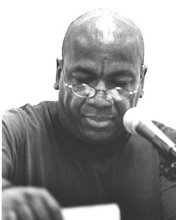
Because I am not devoid of pride, and because I always want to know whether I’m being talked about and what people are saying if I am, I periodically look myself up online or, as they say, “google” myself. (Perhaps “Google” should be capitalized, since it is a trademark.) The only other Reginald Shepherd who comes up is an aged and very Caucasian Canadian painter, a self-described “poetic realist” who seems well-known in his native Newfoundland and in neighboring Nova Scotia, but nowhere else as far as I can tell, even in Canada. I think of myself as a kind of poetic realist as well, in life and in my poetry, so perhaps our kinship is more than name deep.
Years ago, when I lived in Chicago, another, decidedly less savory Reginald Shepherd popped up when I searched myself. An apparent career criminal (all that came up were his various arrests), he was something of an evil doppelganger. I once was almost denied an apartment because there was a record of my arrest for “criminal shoplifting” (I always wondered what legal shoplifting was) in 1991, two years before I moved to Chicago. And once I received a letter from a social service agency that some woman had named me as the father of her child. I had to call and explain that the last time I had been in the vicinity of a woman’s vagina was the morning I was born. One of the other Reginald Shepherd’s old addresses even appeared on my credit report, an error (among others) I had to call and write in order to rectify. My criminal double has either settled down into legal respectability or died (either is equally likely), as he hasn’t shown up in my web searches for several years. I would like to think that he has seen the error of his ways and now become a law-abiding citizen, but I have no great desire to inquire further.
When I look up the most common misspelling of my name, Reginald Shepard, which people sometimes insist upon even when they’re publishing or paying me, no matter how many times I sign and print the correct spelling of my name, besides finding various references to my misspelled self (I try to correct them when I can), I also find references to a death row inmate in Florida by that name. I don’t know what his crime was, but I imagine that it was probably murder. I find it a little disturbing to once again have a criminal doppelganger living (though who knows for how long) in the same state. At least there are two crucial letters separating my name from his, his fate from mine. But still…
Saturday, August 16, 2008


Friday, August 8, 2008
What's in a Name? Part Two
Now that I am once again out of the hospital and able to sleep in my own bed without being wakened several times a night to be weighed or have my vital signs taken, I have the opportunity to think about other things every once in a while, or at least to return to thoughts over which I've been mulling for a while. Thus I present part two of my musings on names and naming.
The name Reginald has very different connotations for white people and for black people. For white people, the name sounds very English, and my Anglo accent, though one that I can’t hear, often makes them inquire as to whether I am English, or perhaps West Indian. I just reply that I got my accent from my Barbadian father (whom I met once) and my Jamaican stepfather (who abused my mother and me). But almost the only people in America nowadays with the name Reginald are black. It’s become an almost quintessentially black name, like Antoine (often spelled Antwan, or Antuan) or Leroy/Leroi (“the king”).
Mine is one of a set of categories of black names. There are the names that white Americans don’t use anymore, like Cedric or Tyrone, names that have been handed over to black people (though in the hospital I did have a white physical therapist named Tyrus—but then, the South has always been a bit backward). There are also names like Reginald, Maurice, or Roderick (this last one is on the edge) which have become predominantly black names but aren’t yet perceived so by white people. There are the made-up names, like Materia, Tawanna (a cousin of mine—she was meant to be named after the Mexican border city), or Chicalaundra (pronounced “Shalandra”). There are the Frenchified names, like LaQuan or LeVante or LeBron or LaToya (also LeToya), or the (male) driver of the Greyhound bus I used to take to work when I lived in Chicago, LaHarry. I remember joking once with a black friend that you can make any name black just by adding “La” or “Le” to it; then I realized it was true. (“De” will also work, as in DeWayne, DeMarcus or, my favorite, Da’Sean, pronounced “DAY-Shawn”—the apostrophe makes all the difference.) Then there are the faux-African names, like Kechia/Keshia/Keisha, Kena (another cousin of mine), Kima, and Kwame (this last a genuineWest African name appropriated by black Americans). There is an overlap between Frenchified black names and faux-African names, as in Lakeisha or Deshondra, and between the made-up names and the faux-African names, like Tawanna or Kima or Ebony/Eboni. There are also the Arab names, like Jamal and Malik, Omar and Raheem/Raheim. I’ve always found black Americans' tendency to give their children Muslim names odd, since Muslim Arabs were major slave traders for over a thousand years. A category which seems to have dwindled are names taken from words of rank and position, so that a white person calling a black person by (usually) his first name would still have to show respect, even if the act was meant disrespectfully. The singer Prince a/k/a “Symbol Thing” (born Prince Rogers Nelson) and poet Major Jackson would be examples. Mine is also an example of such a name, since, as I wrote earlier, my mother always told me that it meant “Great King.”
When I was a kid, and up until my mid-twenties, I went by “Reggie.” The only other two Reggies I knew of in my childhood were the baseball player Reggie Jackson and the Archie comic books laughingstock rich bad boy Reggie Mantle. He once went into an office and, unsatisfied by the secretary’s refusal to be impressed by him, announced “Someday my name will be a household word,” to which her response was, “Like dirt?”
A few months before my twenty-fifth birthday, I decided that I was too old to be called “Reggie.” That was a child’s name, and it was time for me to put aside childish things. Since then I have gone by my full name, though people still insist on calling me “Reggie” and “Reg.” But even when I went by Reggie, already a shortened version of my name, many people insisted on calling me “Reg." Besides the obvious fact that it wasn’t my name (if I wanted to be called Reg, I would introduce myself that way), as my oldest friend Merav’s mother put it, “Reg” has the air of a hale fellow well met, a football player perhaps, and that's never been me or anyone I wanted to be. I've never understood why people would need to nick a nickname, anyway. Some people still call me Reg, and I always correct them, except for my editor at the University of Pittsburgh Press, Ed Ochester. He has loyally published me for many years, so if he wanted to call me “Joe,” that would be alright with me.
The name Reginald has very different connotations for white people and for black people. For white people, the name sounds very English, and my Anglo accent, though one that I can’t hear, often makes them inquire as to whether I am English, or perhaps West Indian. I just reply that I got my accent from my Barbadian father (whom I met once) and my Jamaican stepfather (who abused my mother and me). But almost the only people in America nowadays with the name Reginald are black. It’s become an almost quintessentially black name, like Antoine (often spelled Antwan, or Antuan) or Leroy/Leroi (“the king”).
Mine is one of a set of categories of black names. There are the names that white Americans don’t use anymore, like Cedric or Tyrone, names that have been handed over to black people (though in the hospital I did have a white physical therapist named Tyrus—but then, the South has always been a bit backward). There are also names like Reginald, Maurice, or Roderick (this last one is on the edge) which have become predominantly black names but aren’t yet perceived so by white people. There are the made-up names, like Materia, Tawanna (a cousin of mine—she was meant to be named after the Mexican border city), or Chicalaundra (pronounced “Shalandra”). There are the Frenchified names, like LaQuan or LeVante or LeBron or LaToya (also LeToya), or the (male) driver of the Greyhound bus I used to take to work when I lived in Chicago, LaHarry. I remember joking once with a black friend that you can make any name black just by adding “La” or “Le” to it; then I realized it was true. (“De” will also work, as in DeWayne, DeMarcus or, my favorite, Da’Sean, pronounced “DAY-Shawn”—the apostrophe makes all the difference.) Then there are the faux-African names, like Kechia/Keshia/Keisha, Kena (another cousin of mine), Kima, and Kwame (this last a genuineWest African name appropriated by black Americans). There is an overlap between Frenchified black names and faux-African names, as in Lakeisha or Deshondra, and between the made-up names and the faux-African names, like Tawanna or Kima or Ebony/Eboni. There are also the Arab names, like Jamal and Malik, Omar and Raheem/Raheim. I’ve always found black Americans' tendency to give their children Muslim names odd, since Muslim Arabs were major slave traders for over a thousand years. A category which seems to have dwindled are names taken from words of rank and position, so that a white person calling a black person by (usually) his first name would still have to show respect, even if the act was meant disrespectfully. The singer Prince a/k/a “Symbol Thing” (born Prince Rogers Nelson) and poet Major Jackson would be examples. Mine is also an example of such a name, since, as I wrote earlier, my mother always told me that it meant “Great King.”
When I was a kid, and up until my mid-twenties, I went by “Reggie.” The only other two Reggies I knew of in my childhood were the baseball player Reggie Jackson and the Archie comic books laughingstock rich bad boy Reggie Mantle. He once went into an office and, unsatisfied by the secretary’s refusal to be impressed by him, announced “Someday my name will be a household word,” to which her response was, “Like dirt?”
A few months before my twenty-fifth birthday, I decided that I was too old to be called “Reggie.” That was a child’s name, and it was time for me to put aside childish things. Since then I have gone by my full name, though people still insist on calling me “Reggie” and “Reg.” But even when I went by Reggie, already a shortened version of my name, many people insisted on calling me “Reg." Besides the obvious fact that it wasn’t my name (if I wanted to be called Reg, I would introduce myself that way), as my oldest friend Merav’s mother put it, “Reg” has the air of a hale fellow well met, a football player perhaps, and that's never been me or anyone I wanted to be. I've never understood why people would need to nick a nickname, anyway. Some people still call me Reg, and I always correct them, except for my editor at the University of Pittsburgh Press, Ed Ochester. He has loyally published me for many years, so if he wanted to call me “Joe,” that would be alright with me.
Tuesday, August 5, 2008
What's in a Name? Part One
Steven Burt’s January post "all-name team" on the Poetry Foundation’s Harriet blog, and the posts I did in February here on this blog on gay poetry post identity politics, have had me musing about identity, social and personal, and about the role names play in producing identity. I’ve been thinking about names, what they are and what they do. As Burt points out, poetry is a kind of naming, and naming is in turn a kind of poetry. In poems, names are like magic talismans that contain and convey the essence of the thing named. So when two things are given the same name, then they are or become the same. And when the name changes, then the thing named changes.
The thought of changing names and things, in turn, has me thinking of my own name (everything makes me think of me), the changes it has undergone over the course of my life, and a couple of people with whom I share that name, whom I’m quite sure are not the same, as me or as each other. But when I look myself up, there they are. And when I look up the wrong spelling of my name, some other version of me, there I am anyway, as if I were two people who’ve led the same life, or at least who’ve published the same things in the same places. As Steve Burt points out, “Titles, names, labels ask questions, and raise possibilities.” So who are the possible me’s my name makes possible?
1
I was born Reginald Berry on the morning of April 10, 1963. Berry was my unmarried mother’s last name; like the protagonist of Diana Ross and the Supremes’ “Love Child,” I started my life in an old, cold, rundown tenement slum, burdened by the stigma of illegitimacy, which for me was the same as poverty. The birth certificate I am always losing documenting the birth of “Reginald Shepherd” was issued in 1968, after my mother had sued my deadbeat Barbadian father to prove that he was indeed my father. What we got out of that I never understood, since he almost never paid the meager thirty-five dollars a week in child support as ordered by the court.
I sometimes wonder if who I am changed when I ceased to be Reginald Berry (I was five) and became Reginald Shepherd: indeed, when I ceased ever to have been Reginald Berry. Reginald Berry was erased, as if he had never been, and his place was taken by Reginald Shepherd, as if I had always been him and he had always been me, except that Reginald Shepherd came into existence at the age of five, having completely bypassed birth and infancy, not to mention the terrible twos and threes.
I was enmeshed in the social services network at a very early age (as everyone in her family always said, my mother knew how to work the system), and to this day I am in the Social Security Administration records as Reginald Berry Shepherd, a name I have never legally had or even gone by, a name that has never been mine. They remember all the pasts, and conflate them into one.
Would my life have been different if I had remained Reginald Berry, if Reginald Berry had not been erased as if he had never existed? At the least, people would have much less occasion to misspell my name, and who knows what effect that confidence that I would be correctly spelled could have had on my self-esteem?
My mother (who went from being Blanche Berry to being Blanche Graham—my stepfather’s name—without ever having been Blanche Shepherd) always told me that my name meant “Great King” in Celtic. According to the Online Etymology Dictionary (whose only authority is that of its author, Douglas Harper), my name derives from Old High German and means “ruling with power.” According to Dictionary.com Unabridged (which bases its claim to authority on the Random House Unabridged Dictionary), it derives from an Old English word meaning “counsel and rule.” I believe that it’s related to the name of the Celtic goddess Rigantona, whose name means “Great Queen.” Someone in college told me that my name was the ablative form of the Latin rex, “king,” meaning something like “of the.” Perhaps I was the king’s favorite shepherd or, in my previous life, his favorite fruit. My younger half sister is named Regina (my mother had a plan); her name unambiguously means “Queen.” I confess to being a bit jealous of her name’s indisputable authority.
But despite the grandeurs of my first name, I have felt a little deprived that I don’t have a middle name. My mother had one, later my abusive Jamaican stepfather had one, and still later my younger half-sister had one. I settled on “Alexander” as an appropriate middle name: Alexander the Great was a famous king and conqueror, and the initials “RAS” spelled out the Amharic word for “prince.” (The late Emperor Haile Selassie I of Ethiopia was known was Ras Tafari Makonnen, “Prince Tafari Makonnen,” before his ascension to the throne. Hence the group name Rastafarian, though this quasi-religion has never had any connection with Ethiopia.) But I never had my name legally changed, and as I got older I lost interest in the matter.
The thought of changing names and things, in turn, has me thinking of my own name (everything makes me think of me), the changes it has undergone over the course of my life, and a couple of people with whom I share that name, whom I’m quite sure are not the same, as me or as each other. But when I look myself up, there they are. And when I look up the wrong spelling of my name, some other version of me, there I am anyway, as if I were two people who’ve led the same life, or at least who’ve published the same things in the same places. As Steve Burt points out, “Titles, names, labels ask questions, and raise possibilities.” So who are the possible me’s my name makes possible?
1
I was born Reginald Berry on the morning of April 10, 1963. Berry was my unmarried mother’s last name; like the protagonist of Diana Ross and the Supremes’ “Love Child,” I started my life in an old, cold, rundown tenement slum, burdened by the stigma of illegitimacy, which for me was the same as poverty. The birth certificate I am always losing documenting the birth of “Reginald Shepherd” was issued in 1968, after my mother had sued my deadbeat Barbadian father to prove that he was indeed my father. What we got out of that I never understood, since he almost never paid the meager thirty-five dollars a week in child support as ordered by the court.
I sometimes wonder if who I am changed when I ceased to be Reginald Berry (I was five) and became Reginald Shepherd: indeed, when I ceased ever to have been Reginald Berry. Reginald Berry was erased, as if he had never been, and his place was taken by Reginald Shepherd, as if I had always been him and he had always been me, except that Reginald Shepherd came into existence at the age of five, having completely bypassed birth and infancy, not to mention the terrible twos and threes.
I was enmeshed in the social services network at a very early age (as everyone in her family always said, my mother knew how to work the system), and to this day I am in the Social Security Administration records as Reginald Berry Shepherd, a name I have never legally had or even gone by, a name that has never been mine. They remember all the pasts, and conflate them into one.
Would my life have been different if I had remained Reginald Berry, if Reginald Berry had not been erased as if he had never existed? At the least, people would have much less occasion to misspell my name, and who knows what effect that confidence that I would be correctly spelled could have had on my self-esteem?
My mother (who went from being Blanche Berry to being Blanche Graham—my stepfather’s name—without ever having been Blanche Shepherd) always told me that my name meant “Great King” in Celtic. According to the Online Etymology Dictionary (whose only authority is that of its author, Douglas Harper), my name derives from Old High German and means “ruling with power.” According to Dictionary.com Unabridged (which bases its claim to authority on the Random House Unabridged Dictionary), it derives from an Old English word meaning “counsel and rule.” I believe that it’s related to the name of the Celtic goddess Rigantona, whose name means “Great Queen.” Someone in college told me that my name was the ablative form of the Latin rex, “king,” meaning something like “of the.” Perhaps I was the king’s favorite shepherd or, in my previous life, his favorite fruit. My younger half sister is named Regina (my mother had a plan); her name unambiguously means “Queen.” I confess to being a bit jealous of her name’s indisputable authority.
But despite the grandeurs of my first name, I have felt a little deprived that I don’t have a middle name. My mother had one, later my abusive Jamaican stepfather had one, and still later my younger half-sister had one. I settled on “Alexander” as an appropriate middle name: Alexander the Great was a famous king and conqueror, and the initials “RAS” spelled out the Amharic word for “prince.” (The late Emperor Haile Selassie I of Ethiopia was known was Ras Tafari Makonnen, “Prince Tafari Makonnen,” before his ascension to the throne. Hence the group name Rastafarian, though this quasi-religion has never had any connection with Ethiopia.) But I never had my name legally changed, and as I got older I lost interest in the matter.
Monday, July 14, 2008
In Memoriam Alvin Feinman, 1929-2008
I am still in the hospital, awaiting surgery on an abdominal fistula that refuses to heal on its own—quite the contrary—but it’s very important to me to have Robert post this piece.
In Memoriam Alvin Feinman, 1929-2008
1
The wonderful poet, teacher and friend Alvin Feinman died a few days ago after a long struggle with emphysema and Parkinson’s disease. Alvin was one of the most important people in my poetic life, and I would like to pay him some small homage here.
Alvin Feinman was born in 1929 and raised in New York City. Though he has been named by Harold Bloom as part of the essential canon of Western literature—Bloom has written that “The best of his poems stand with the most achieved work of his generation”—Feinman is not included in any of the standard anthologies of modern or modern American poetry, not even Cary Nelson’s recent Oxford Anthology of Modern American Poetry, which explicitly aims at recovering and rediscovering neglected writers. Nor is he listed in the purportedly comprehensive Contemporary Authors reference series.
Though always committed to poetry (including, in his words, “even doggerel narratives in early childhood”), he had originally decided on philosophy as a career, and did graduate work at Yale to that end, until he realized that the dominant analytical school excluded all the important philosophical questions. It was in poetry that those unanswerable questions, questions of knowledge, perception, and the relation between being and appearance, could properly be addressed. As Feinman somewhat jocularly told me, “I was, even philosophically, convinced that, as I liked to put it, if according to Aristotle, ‘Poetry is more philosophical than history,’ so is it more philosophical than philosophy. The work I’d have had to do in philosophy would be to lay out the grounds for privileging poetry—which indeed our era has been more or less doing—vide Heidegger, Rorty, Derrida, etc.”
Feinman’s first book, Preambles and Other Poems, was published by Oxford University Press in 1964 to praise from such figures as Allen Tate, Conrad Aiken, Geoffrey Hartman, and Bloom. (Bloom’s discussion of this volume in his book The Ringers in the Tower: Studies in Romantic Tradition is the only extended treatment of Feinman’s work of which I am aware.) Now out of print, it was reissued with a handful of additional poems by Princeton University Press as Poems in 1990; that volume is also out of print. Feinman’s lack of a wider reputation is partly due to the unabashed difficulty of his poems, though as Harold Bloom writes, “their difficulty is their necessity” (The Ringers in the Tower, 315). But, given the popularity of other “difficult” poets, his neglect is mostly due to his distaste for the rituals of literary self-promotion.
Alvin Feinman is a true visionary poet, heir to Stevens and Crane in the modern line and, further back, to Blake, Wordsworth, and Shelley, poets who invented human consciousness as a subject matter for poetry. In Harold Bloom’s description, “the central vision in [Preambles] is of the mind, ceaselessly an activity, engaged in the suffering process of working apart all things that are joined by it” (op. cit., 315). Bloom calls this “a tragedy of the mind, victim to its own intent, which is to make by separations” (op. cit., 316).
Feinman’s poems demand much of the reader (at times resisting the intelligence almost successfully, as Stevens said that the poem should), but they offer many rewards in return, including dazzling imagery (light and the work light does is omnipresent) and dense, rich verbal music. Eliot wrote that genuine poetry can communicate before it is understood, and Feinman’s poems do so amply.
John Hollander has written that Feinman’s poetry explores the indefinable boundary between the visual and the visionary. In one of the blurbs for Preambles, Conrad Aiken wrote that Feinman’s was “true metaphysical poetry.” His poems constitute an epistemological and phenomenological investigation of the world, a probing of the surfaces of things that moves from seeing to seeing-into to seeing-through to the other side of appearances, exposing the luminous interior of the material world. As Bloom has written, the “opposition between the imaginative self and reality seems as central to these poems as it was to Stevens’ and as grandly articulated.”
2
Alvin Feinman is also the only person in my writing life whom I could truly call a mentor. I have had professors from whom I’ve learned, who have taught me valuable things about my work (sometimes intentionally, sometimes inadvertently or even against their will). But few were truly formative, and fewer still were both consistent and constructive in their attention. For one thing, he was the first professor to understand what my poems were trying to do, even though they didn’t always succeed.
Alvin, with whom I did my undergraduate creative writing thesis at Bennington College, never did anything for me but help me write better poems. He never did anything to me but make me see that however pleased I was with something I’d written, it could always be better, had to be better if I were to call myself a poet. For Alvin, to be a poet was always an aspiration, not something that one could claim to be. I think if I’d have asked him he would have said, “I would like to be a poet.”
Alvin expected everything of poetry, his own and others’. As he once said to me, “Poetry is always close kin to the impossible, isn’t it?” There was no point in reading a poem unless it was great, and no point in writing a poem unless it (not you: it) aspired to greatness. He was especially alert to the occasions when a poem failed to live up to its own possibilities, when it fell away into the mundane from therevelations it proposed. Usually the poem failed by settling for the merely personal. For Alvin, one’s interest in oneself had no place in poetry, and in his poems one will find not face but mask. But it’s a mask more alive than the great mass of mere faces.
Alvin also helped me learn the difference between whether something was done well and whether it needed to be done at all. He warned against the dangers of what he called “fluency über alles,” of writing something because you can or because you want to. What you want has no place in poetry: only what the poem wants matters. He once said of a poem of mine that he saw little in it but my desire to write a poem, and he saw accurately. But Alvin also taught me to listen more carefully, to look more closely, to be more aware of the poem’s intentions. He was an exacting reader, and his is an example I am constantly trying to live up to.
3
I love all of Alvin’s poems, but this one in particular, the first poem of his I ever read, is one of my favorites.
November Sunday Morning
And the light, a wakened heyday of air
Tuned low and clear and wide,
A radiance now that would emblaze
And veil the most golden horn
Or any entering of a sudden clearing
To a standing, astonished, revealed…
That the actual streets I loitered in
Lay lit like fields, or narrow channels
About to open to a burning river;
All brick and window vivid and calm
As though composed in a rigid water
No random traffic would dispel…
As now through the park, and across
The chill nailed colors of the roofs,
And on near trees stripped bare,
Corrected in the scant remaining leaf
To their severe essential elegance,
Light is the all-exacting good,
That dry, forever virile stream
That wipes each thing to what it is,
The whole, collage and stone, cleansed
To its proper pastoral…
I sit
And smoke, and linger out desire.
In Memoriam Alvin Feinman, 1929-2008
1
The wonderful poet, teacher and friend Alvin Feinman died a few days ago after a long struggle with emphysema and Parkinson’s disease. Alvin was one of the most important people in my poetic life, and I would like to pay him some small homage here.
Alvin Feinman was born in 1929 and raised in New York City. Though he has been named by Harold Bloom as part of the essential canon of Western literature—Bloom has written that “The best of his poems stand with the most achieved work of his generation”—Feinman is not included in any of the standard anthologies of modern or modern American poetry, not even Cary Nelson’s recent Oxford Anthology of Modern American Poetry, which explicitly aims at recovering and rediscovering neglected writers. Nor is he listed in the purportedly comprehensive Contemporary Authors reference series.
Though always committed to poetry (including, in his words, “even doggerel narratives in early childhood”), he had originally decided on philosophy as a career, and did graduate work at Yale to that end, until he realized that the dominant analytical school excluded all the important philosophical questions. It was in poetry that those unanswerable questions, questions of knowledge, perception, and the relation between being and appearance, could properly be addressed. As Feinman somewhat jocularly told me, “I was, even philosophically, convinced that, as I liked to put it, if according to Aristotle, ‘Poetry is more philosophical than history,’ so is it more philosophical than philosophy. The work I’d have had to do in philosophy would be to lay out the grounds for privileging poetry—which indeed our era has been more or less doing—vide Heidegger, Rorty, Derrida, etc.”
Feinman’s first book, Preambles and Other Poems, was published by Oxford University Press in 1964 to praise from such figures as Allen Tate, Conrad Aiken, Geoffrey Hartman, and Bloom. (Bloom’s discussion of this volume in his book The Ringers in the Tower: Studies in Romantic Tradition is the only extended treatment of Feinman’s work of which I am aware.) Now out of print, it was reissued with a handful of additional poems by Princeton University Press as Poems in 1990; that volume is also out of print. Feinman’s lack of a wider reputation is partly due to the unabashed difficulty of his poems, though as Harold Bloom writes, “their difficulty is their necessity” (The Ringers in the Tower, 315). But, given the popularity of other “difficult” poets, his neglect is mostly due to his distaste for the rituals of literary self-promotion.
Alvin Feinman is a true visionary poet, heir to Stevens and Crane in the modern line and, further back, to Blake, Wordsworth, and Shelley, poets who invented human consciousness as a subject matter for poetry. In Harold Bloom’s description, “the central vision in [Preambles] is of the mind, ceaselessly an activity, engaged in the suffering process of working apart all things that are joined by it” (op. cit., 315). Bloom calls this “a tragedy of the mind, victim to its own intent, which is to make by separations” (op. cit., 316).
Feinman’s poems demand much of the reader (at times resisting the intelligence almost successfully, as Stevens said that the poem should), but they offer many rewards in return, including dazzling imagery (light and the work light does is omnipresent) and dense, rich verbal music. Eliot wrote that genuine poetry can communicate before it is understood, and Feinman’s poems do so amply.
John Hollander has written that Feinman’s poetry explores the indefinable boundary between the visual and the visionary. In one of the blurbs for Preambles, Conrad Aiken wrote that Feinman’s was “true metaphysical poetry.” His poems constitute an epistemological and phenomenological investigation of the world, a probing of the surfaces of things that moves from seeing to seeing-into to seeing-through to the other side of appearances, exposing the luminous interior of the material world. As Bloom has written, the “opposition between the imaginative self and reality seems as central to these poems as it was to Stevens’ and as grandly articulated.”
2
Alvin Feinman is also the only person in my writing life whom I could truly call a mentor. I have had professors from whom I’ve learned, who have taught me valuable things about my work (sometimes intentionally, sometimes inadvertently or even against their will). But few were truly formative, and fewer still were both consistent and constructive in their attention. For one thing, he was the first professor to understand what my poems were trying to do, even though they didn’t always succeed.
Alvin, with whom I did my undergraduate creative writing thesis at Bennington College, never did anything for me but help me write better poems. He never did anything to me but make me see that however pleased I was with something I’d written, it could always be better, had to be better if I were to call myself a poet. For Alvin, to be a poet was always an aspiration, not something that one could claim to be. I think if I’d have asked him he would have said, “I would like to be a poet.”
Alvin expected everything of poetry, his own and others’. As he once said to me, “Poetry is always close kin to the impossible, isn’t it?” There was no point in reading a poem unless it was great, and no point in writing a poem unless it (not you: it) aspired to greatness. He was especially alert to the occasions when a poem failed to live up to its own possibilities, when it fell away into the mundane from therevelations it proposed. Usually the poem failed by settling for the merely personal. For Alvin, one’s interest in oneself had no place in poetry, and in his poems one will find not face but mask. But it’s a mask more alive than the great mass of mere faces.
Alvin also helped me learn the difference between whether something was done well and whether it needed to be done at all. He warned against the dangers of what he called “fluency über alles,” of writing something because you can or because you want to. What you want has no place in poetry: only what the poem wants matters. He once said of a poem of mine that he saw little in it but my desire to write a poem, and he saw accurately. But Alvin also taught me to listen more carefully, to look more closely, to be more aware of the poem’s intentions. He was an exacting reader, and his is an example I am constantly trying to live up to.
3
I love all of Alvin’s poems, but this one in particular, the first poem of his I ever read, is one of my favorites.
November Sunday Morning
And the light, a wakened heyday of air
Tuned low and clear and wide,
A radiance now that would emblaze
And veil the most golden horn
Or any entering of a sudden clearing
To a standing, astonished, revealed…
That the actual streets I loitered in
Lay lit like fields, or narrow channels
About to open to a burning river;
All brick and window vivid and calm
As though composed in a rigid water
No random traffic would dispel…
As now through the park, and across
The chill nailed colors of the roofs,
And on near trees stripped bare,
Corrected in the scant remaining leaf
To their severe essential elegance,
Light is the all-exacting good,
That dry, forever virile stream
That wipes each thing to what it is,
The whole, collage and stone, cleansed
To its proper pastoral…
I sit
And smoke, and linger out desire.
Friday, June 27, 2008
On the New American Poetry
The question of what a tradition is and who is entitled to lay claim to it is quite alive these days. Many contemporary poets trace their literary ancestry back to what have come to be called the New American Poetries, after Donald M. Allen’s influential anthology The New American Poetry. Furthermore, those who claim this legacy often assert a) that the very diverse poets gathered under the rubric “New American Poetries” were political and/or social revolutionaries and b) that they shared a program of total or near-total negation.
I thought that it would be illuminating to go back to Donald M. Allen’s seminal anthology to see what was actually there. Looking through the poems and the author’s statements, though many of them manifest a strong will to transformation, the forms in which this transformation is imagined rarely correspond to political impulses, and often imagine politics as another shackle that must be broken or transcended. The rebellions which many (though hardly all) of these poets engaged or hoped for were often explicitly anti-political, as utopianism often is. In his essay “Buddhism and the Coming Revolution” (reprinted in Donald Allen and Warren Tallman’s anthology The Poetics of the New American Poetry, an assemblage of prose statements published by Grove Press in 1973), Gary Snyder writes that “The belief in a serene and generous fulfillment of natural loving desires destroys ideologies which blind, maim, and repress—and points the way to a kind of community which would amaze ‘moralists’ and transform armies of men who are fighters because they cannot be lovers” (393).
While we talk about “New American Poetries” in the plural, for Allen the new American poetry was singular, though he did divide his assembled poets into five groupings, four semi-geographic and one a catchall of “younger writers who have been associated with and in some cases influenced by the leading writers of the preceding groups, but who have evolved their own original styles and new conceptions of poetry” (xiii). He admitted that his groupings were “occasionally arbitrary and for the most part more historical than actual” and that they were for the convenience of the reader as much as a reflection of any reality other than that of geographical milieu (ibid.).
Allen was not modest in his claims for the poets in his book: “Following the practice and precepts of Ezra Pound and William Carlos Williams, [the new poetry] has built on their achievements and gone on to evolve new conceptions of the poem. These poets have already created their own tradition [an interesting feat], their own press, and their own public. They are our avant-garde, the true continuers of the modern movement in American poetry” (xi). All forty-four poets included constitute the new American poetry. If you’re not in it, you’re not in it. One the one hand, the Nineteen Fifties literary scene was rather exclusive and exclusionary, though it did find its way to giving Gwendolyn Brooks the Pulitzer Prize in 1950. On the other hand, avant-gardes traditionally define themselves by what they push away much more than by what they accept or include. (Many members of various artistic groupings hated one another and despised one another’s work. But together they all hated something else more.)
Peter Gay makes this point in Modernism: The Lure of Heresy: “Like the avant-garde clusters that came after [them]—much, in fact, like the Impressionists—the Pre-Raphaelites were united more by what they detested than what they valued” (83). But it’s important to remember that no one in this anthology called him or herself “a New American Poet,” just as no one (at the time) called himself an Impressionist or a Fauvist or a Cubist. That was a label imposed by their inclusion in this volume. To a large degree, the book produced the phenomenon it claimed to document.
Taken as a whole, the New Americans didn’t share a poetics, let alone a politics. Like most avant-gardes, they were united only by various personal affiliations (what Goethe called elective affinities) and by their opposition to what in the Nineteen Fifties could legitimately be called by Charles Bernstein’s pejorative phrase “official verse culture.” These days, the ostensible “inside” is much more diverse, open, and porous. It’s what they were against that brought them together, not what they were for: as Allen writes in his introduction, this poetry “has shown one common characteristic: a total rejection of all those qualities typical of academic verse” (xi). This was at a time when such a phrase as “academic verse” had some descriptive and not just pejorative content.
The phrase “New American Poetries” was at least in part a marketing strategy. All artistic groupings try to publicize themselves, including by means of oppositionality. That’s one of the reasons artists get together in groups. Certainly both the Dadaists and the Surrealists engaged in such artistic publicity, as did Ezra Pound on behalf of what we now call Anglo-American Modernism. Donald M. Allen assembled an anthology with an incredibly diverse array of writers who were by and large not being read by the wider poetry audience. He (and Grove Press, the publisher, who were taking a chance on such a book) needed some hook to draw in readers, to expose these writers to a wider audience. The New American Poetry (again, singular: if you want it, this is the place to get it) was that hook. There's nothing inherently cynical or sinister in that.
As Ann Lauterbach writes, “This is the main function of being identified with a group or school, to draw critical attention that individual poets, not affiliated with a movement or group, cannot easily attract. ‘New York School’ or ‘Language Poetry’ are given brand-name status, commodifying and homogenizing, so that critics (and poets) can make general identifications and totalizing critiques without having to actually contend with the specific differences among and between so-called members of the group” (“Misquotations from Reality,” Diacritics, 26:3-4, Fall/Winter 1996). A group identity, however tenuous or even illusory, will always get more attention than the individual writer, though of course no group could exist without the individuals that constitute it, and ultimately we only care about literary groups because we care about the writers in them (phenomena like Dada or Italian Futurism may be exceptions, in which we care more about the ideas than about the individual practitioners). But group identities and affiliations can become limitations for writers, who frequently break away from them as they develop (and as they establish their individual reputations).
2
Some of the poets gathered by Allen did indeed seek to transform society. Some sought to transform consciousness. Some sought to transform writing as a practice. Most just sought to write poems that felt more genuine to them than the products of the poetic orthodoxies of the 1950s. Robert Creeley, for one example, was almost purely concerned with the lyric notation of the moment-to-moment movements of his mind, emotions, and sensibilities. As he wrote in the preface to For Love: Poems 1950-1960, “Not more, say, to live than what there is, to live. I want the poem as close to this fact as I can bring it; or it me” (cited in Rosenthal, The New Poets: American and British Poetry Since World War II, 147). This implies a notion of a life more authentic or at least more awake than the one most people live, but has no necessarily political valence: various mystical disciplines of attention have the same goal.
John Ashbery was, after all, a Yale Younger Poet (and Frank O’Hara almost was, in the same year), and the revolution which interested him was what Julia Kristeva calls a revolution in poetic language largely inherited from such forebears as Raymond Roussel and Gertrude Stein, what he calls in the title of his Charles Eliot Norton lectures at Harvard “other traditions” (including Thomas Lovell Beddoes, Laura Riding, John Brooks Wheelwright, and David Schubert). It’s important to note that Ashbery has cited such canonical figures as W.H. Auden and Wallace Stevens as among the poets who most shaped his poetic idiom.
The “Statements on Poetics” at the end of the anthology give a sense of the poets’ interests and motivations. Very few refer to politics, though several refer in rather large and general terms to society and the world at large, and many refer to consciousness in various ways. Ferlinghetti writes that “I am put down by Beat natives who say that I cannot be beat and ‘committed’ at the same time.” He’s scathing about the disengagement of his fellow Beats, with the exception of “that Abominable Snowman of modern poetry, Allen Ginsberg”: “the ‘non-commitment’ of the artist is itself a suicidal and deluded variation of…nihilism” (413). That Ferlinghetti found it necessary to say this indicates that social transformation or even social intervention was not an agenda item for many of his fellow “New American” poets. In his essay “The New Modernism,” Paul Hoover points out that “the style of [Ferlinghetti’s] poetry is virtually mainstream in its transparent use of language and narrative tendency” (Fables of Representation 142): another refutation of the commonly assumed conjunction between “progressive” aesthetics and “progressive” politics.
Michael McClure, for example, writes in “From a Journal” that “The prime purpose of my writing is liberation. (Self-liberation first & hopefully that of the reader.)” (423). In his 1961 essay “Revolt,” McClure clarifies this statement: “There is no political revolt. All revolt is person and is against interior attitudes and images or against exterior bindings of Society that constrict and cause pain.
“(A ‘political’ revolution is a revolt of men against a lovestructure that has gone bad. Men join in a common urge to free themselves.)” (Poetics of the New American Poetry 437).
Charles Olson’s project of transformation was to reconnect man with his primal being, to forge or reforge a truer relationship with nature: as he writes in “Projective Verse,” “the use of a man, by himself and thus by others, lies in how he conceives his relation to nature, that force to which he owes his somewhat small existence” (395). In The New Poets: American and British Poetry Since World War II, a crucial text in the academic legitimization of “the New American Poetry,” critic M.L. Rosenthal points out that “The activist Marxian perspective implicit in the [French-language] Mao quotations is somewhat modulated by Olson throughout ‘The Kingfisher’ toward a more purely qualitative notion of dialectical process and change [“What does not change / is the will to change”]. Yet he too is programmatic, though not politically so. His attempt is to isolate and resurrect primal values that have been driven out of sight by the alienating force of European civilization” (Rosenthal 164).
The project of bringing modern man back into congruence with his natural roots was Gary Snyder’s as well, on the most visceral and immediate level: “poets don’t sing about society, they sing about nature—even if the closest they ever get to nature is their lady’s queynt. Class-structured society is a kind of mass ego. To transcend the ego is to go beyond society as well” (“Poetry and the Primitive,” Poetics of the New American Poetry 399). As he wrote in his anthology artist’s statement, “the rhythms of my poems follow the rhythm of the physical work I’m doing and life I’m leading at any given time” (420). His poetry is deeply informed by Native American cultures and folklore, anthropology, his studies of Zen Buddhism, and his use of mind-altering drugs like peyote (a psychotropic specifically tied to Native American cultures). As Snyder writes, “At the root of where our civilization goes wrong, is the mistaken belief that nature is something less than authentic, that nature is not as alive as man is, or as intelligent, that in a sense it is dead.” Snyder’s Buddhist revolution is hardly one that Marx would have recognized.
Frank O’Hara explicitly rejects any social role for his work. “I don’t think about fame or posterity (as Keats so grandly and genuinely did), nor do I care about clarifying experiences for anyone or bettering (other than accidentally) anyone’s state or social relation, nor am I for any particular technical development in the American language simply because I find it necessary. What is happening to me, allowing for lies and exaggerations which I try to avoid, goes into my poems. I don’t think my experiences are clarified or made beautiful for myself or anyone else, they are just there in whatever form I can find them” (419).
John Wieners writes in “From a Journal” that “A poem does not have to be a major thing. Or a statement?...Poems…are my salvation alone. The reader can do with them what he likes” (425). He goes on to write that “poetry even tho it does deal with language is no more holy act than, say shitting. Discharge” (426). Though not holy, shitting is, of course, absolutely necessary, so while Wieners seeks to demystify poetry (arguing against the Romantic/romantic cult of art and of the artist), he doesn’t trivialize it either. It’s one of life’s necessities, just not a higher level than anything else.
Robert Duncan, like the Suprematist painter Kasimir Malevich (who, though a supporter of the Russian Revolution, was eventually forced by the Soviet authorities to abandon abstraction in favor of Socialist Realism), was not a negationist but a visionary, seeking higher spiritual truths in and through his work, the hermetic/Gnostic knowledge. Though he wrote poems against the Vietnam War, in which he took up the role of a Biblical prophet, revealing the eternal laws of virtue “against the works of unworthy men, unfeeling judgments, and cruel deeds,” his was a spiritual, not a political, denunciation. Duncan’s friendship with Denise Levertov was destroyed by what he saw as her sullying of her exalted poet’s role with political involvement: “Years of our rapport [were wrecked by] War and the Scars upon the land.” In a review of The Letters of Robert Duncan and Denise Levertov (Stanford University Press, 2003), David Shaddock writes that “Duncan’s argument with [Levertov] was that the poet can’t serve two masters—a poetry of political commitment yokes the imagination to a priori truths and concerns, thus limiting the power of the imagination” (“Opening the Gates of the Imagination: The Duncan/Levertov Letters,” Poetry Flash, 296/297, Winter/Spring 2006, 25)
But even Levertov writes in her artist’s statement that “I do not believe that a violent imitation of the horrors of our time is the concern of poetry. Horrors are taken for granted. Disorder is ordinary. People in general take more and more ‘in their stride’—hides grow thicker. I long for poems of an inner harmony in utter contrast to the chaos in which they exist. Insofar as poetry has a social function it is to awaken sleepers by other means than shock” (412).
Levertov changed her position later, seeking to become a poet of witness, and writing in her essay “Poetry, Prophecy, and Survival” that the poet’s role was to make the horrors of her time graspable by the human mind: “The intellect by itself may point out the source of suffering; but the imagination illuminates it; by that light it becomes more comprehensible” (New & Selected Essays 145). As Anne Day Dewey writes in the Dictionary of Literary Biography, “Whereas Levertov moved toward a romantic voice and a commonly understood language as the vehicles of protest poetry, Creeley and Duncan continued to maintain that political critiques and poetic originality emerged only from experimental poetry that challenged the norms of syntax and poetic form.” But Day Dewey also points out that Levertov never lost her focus on the individual imagination as the source of political change. In this regard, she was not so far from Duncan as their rather bitter break might indicate.
The transformations that Duncan sought were first of all spiritual and intellectual and only incidentally social. As he wrote late in his life, only the imagination knows. Aaron Shurin, a protégé of both Duncan and Levertov, with a background in both the 1960s anti-war movement and the 1970s gay liberation movement, has tried to merge the two, along with sexual and linguistic transformation.
Allen Ginsberg, who is practically identified with the Nineteen-Sixties counter-culture(s), writes in “A Word for the Politicians” in his “Notes for Howl and Other Poems” that “my poetry is Angelical Ravings, & has nothing to do with dull materialistic vagaries about who should shoot who. The secrets of individual imagination—which are transconceptual & nonverbal—I mean unconditioned Spirit—are not for sale to this consciousness, are of no use to this world, except perhaps to make it shut its trap & listen to the music of the Spheres” (417). Not much use to political or social revolutionaries.
In the Vancouver Lectures, Jack Spicer explicitly dismisses the idea of a political poetry, in similar terms to those used by George Oppen some years later: “you can start out with an idea that you want to write about how terrible it is that President Johnson is an asshole [RS: ah, those were the days] and you can come up with a good poem. But it will just be by chance and will undoubtedly not just say that President Johnson is an asshole and will really have a different meaning than you started with. I mean, if you want to write a letter to the editor then it seems to me the thing to do is write a letter to the editor. It doesn’t seem to me that poetry is for that” (The Poetics of the New American Poetry 231).
3
That many of the New Americans were gay (Ashbery, Robin Blaser, James Broughton, Duncan, Edward Field, Ginsberg, O’Hara, Peter Orlovsky, James Schuyler, Spicer, Wieners, Jonathan Williams) is not incidental to their quest to find new ways of saying and, by implication (stronger in some than in others) new ways of moving through the world. But those projects were not necessarily or even often conceived of in political or even social terms.
Whatever the New Americans’ interest in social transformation, and whatever forms that interest took, it doesn’t seem to have extended to gender, at least not when it came to poetry. Only four of the forty-four poets in The New American Poetry are women, and only two of those, Barbara Guest and Denise Levertov, are even heard of now, though Robert Duncan was quite fond of Helen Adam’s romantic ballads. I’m told that it was only at his insistence that she was included at all. That can be seen as commentary on the book's gender politics. But I also wonder what other women were writing and publishing in that mode at the time. The only one I can think of is Diane di Prima, whose first book was published in 1958. Joanne Kyger's first book wasn't published until 1965, and Anne Waldman's (who was only fifteen in 1960, when the anthology came out) not until 1968.
I don't think that Allen deliberately excluded women poets. The paucity of potential female contributors says much about the sexism of the “progressive” or bohemian countercultures, especially the Beats. Interestingly, the “conservative” anthology against which The New American Poetry is often counterposed, Donald Hall, Robert Pack, and Louis Simpson’s New Poets of England and America, published in 1957, does a bit better, with seven female contributors out of fifty-one total.
LeRoi Jones, the one black poet in the Allen anthology (the omission of Bob Kaufman, a founding editor, along with Ginsberg and others, of the journal Beatitude, and credited with coining “Beat,” is curious, though it may be related to Kaufman’s aversion to writing his poems down, let alone publishing them), concerns himself in his artistic statement with “How You Sound??,” “our particular grasp on, say a. Melican speech, b. Poetries of the world, c. Our selves (which is attitudes, logics, theories, jumbles of our lives, & all that), d. And the final… The Totality Of Mind: Spiritual…God?? (or you name it): Social (zeitgeist): or Heideggerian umwelt” (424). Similarly, in his copious writings on jazz, Jones insisted on the importance of the musical experience itself, on the need to just listen. Jones later broke with his Beat/New York School milieu and became Amiri Baraka because he felt that there was no room for the political work he came to decide that he needed to do on behalf of black people, especially poor black people. While his poetry suffered, as did his thinking (more anti-Semitism), Baraka did help establish and build black community institutions in Harlem and especially in his native Newark. But neither his poems nor his statement in The New American Poetry are politically oriented.
With all of its variety, most of the work included in The New American Poetry does not strike me as particularly radical, experimental, or avant-garde aesthetically, though it was definitely unconventional for the 1950s. Fine poet though he is, there is nothing even particularly challenging about, say, Edward Field’s work. But let us assume that it was indeed “avant-garde.”
Joshua Corey insists “that to be avant-garde is a political position before it is an aesthetic one: that it assumes a negative, outsider's stance toward aesthetic establishments and institutions.” This is only true in such a general sense as to be meaningless: all new artistic movements begin outside established practices. That does not mean that, like Peter Bürger’s historical avant-garde (a project he defines as having failed), almost none have sought to destroy or undermine art as an institution. The history of art is that of the incorporation of such schools and movements into established artistic practices and institutions. But there’s no reason to designate this aesthetic outsiderhood, which is usually both situational and chosen, as “political.” Such usage drains the word of content.
It’s a mistake to believe that “progressive” artistic practices equal progressive politics, or that Bohemian or avant-garde opposition to mainstream society need have any positive or even political content. In Modern Places, Modern Times, Peter Conrad notes that “The left has no monopoly of change; there are right-wing revolutionaries as well" (383). To be anti-bourgeois is not to be anti-capitalist or pro-democracy. And as Peter Gay points out in Modernism, “there is no automatic link between political views and artistic talent.” Certainly an artist’s aesthetics don’t derive in any direct way from his political opinions or social position. Marx recognized this when he acknowledged that Balzac’s reactionary, monarchist views did not impede his novels’ clear presentation and analysis of social relations in late nineteenth century France.
The notion that “progressive” art and progressive politics go hand in hand is belied by the examples of F. T. Marinetti and the Italian futurists, whose appetite for destruction led them to call war “the world’s only hygiene,” redefined in a 1915 manifesto as “Futurism intensified”—most of those who survived World War I became Fascists; the Nobel Prize winning Norwegian novelist Knut Hamsun, author of Hunger, who published a eulogy for Hitler days after his death; the German expressionist writers Gottfried Benn and Ernst Jünger and the German expressionist painter Emil Nolde, whose embrace of the Nazis was not reciprocated—they destroyed his paintings as degenerate art, and in 1941 forbade him to paint at all; Cubist (and Jewish) writer Gertrude Stein, who quite publicly and in print supported Marshall Pétain and the Vichy regime; the anti-Semitic novelist and Vichy collaborator Louis-Ferdinand Céline, author of Journey to the End of the Night; T.S. Eliot, who in After Strange Gods pronounced that “reasons of race and religion combine to make large numbers of free-thinking Jews undesirable” in the ideal society; and Ezra Pound, sacred cow and sacred monster of the self-appointed avant-garde, who broadcast on Radio Rome during World War II—during one of his broadcasts he said that it was a shame that the Axis bombers couldn’t see the black American soldiers at night. If we were to judge works of art by their creators’ political positions, much would be ruled out of bounds.
Negation for its own sake leads to nothing (as Billy Preston sang, nothing from nothing leaves nothing), except, historically, to Fascism and Nazism (not the bogeywords people love to bandy about, but the real historical phenomena), or just to sheer nihilism. Self-proclaimed leftists, for example, often forget that critical theorist Theodor Adorno’s relentless negativity was in the service of a positive goal, a freer and more just society, the antithesis of the world in which we now live. Beat poet Michael McClure, in his essay “Revolt” from which I have quoted earlier, writes on rebellion and negation for their own sake that “In society there is a revolt-of-revolt, a hysteria, often more visible (though perhaps not more present) than true revolt. It is nihilistic and dissipative. The man caught up by revolt-by-revolt is either weak in genetic spirit or dominated by circumstance. He makes a hysterical or passionate attempt to take ANY other path than the one laid for him by society” (432). This is as true today as it was then.
I thought that it would be illuminating to go back to Donald M. Allen’s seminal anthology to see what was actually there. Looking through the poems and the author’s statements, though many of them manifest a strong will to transformation, the forms in which this transformation is imagined rarely correspond to political impulses, and often imagine politics as another shackle that must be broken or transcended. The rebellions which many (though hardly all) of these poets engaged or hoped for were often explicitly anti-political, as utopianism often is. In his essay “Buddhism and the Coming Revolution” (reprinted in Donald Allen and Warren Tallman’s anthology The Poetics of the New American Poetry, an assemblage of prose statements published by Grove Press in 1973), Gary Snyder writes that “The belief in a serene and generous fulfillment of natural loving desires destroys ideologies which blind, maim, and repress—and points the way to a kind of community which would amaze ‘moralists’ and transform armies of men who are fighters because they cannot be lovers” (393).
While we talk about “New American Poetries” in the plural, for Allen the new American poetry was singular, though he did divide his assembled poets into five groupings, four semi-geographic and one a catchall of “younger writers who have been associated with and in some cases influenced by the leading writers of the preceding groups, but who have evolved their own original styles and new conceptions of poetry” (xiii). He admitted that his groupings were “occasionally arbitrary and for the most part more historical than actual” and that they were for the convenience of the reader as much as a reflection of any reality other than that of geographical milieu (ibid.).
Allen was not modest in his claims for the poets in his book: “Following the practice and precepts of Ezra Pound and William Carlos Williams, [the new poetry] has built on their achievements and gone on to evolve new conceptions of the poem. These poets have already created their own tradition [an interesting feat], their own press, and their own public. They are our avant-garde, the true continuers of the modern movement in American poetry” (xi). All forty-four poets included constitute the new American poetry. If you’re not in it, you’re not in it. One the one hand, the Nineteen Fifties literary scene was rather exclusive and exclusionary, though it did find its way to giving Gwendolyn Brooks the Pulitzer Prize in 1950. On the other hand, avant-gardes traditionally define themselves by what they push away much more than by what they accept or include. (Many members of various artistic groupings hated one another and despised one another’s work. But together they all hated something else more.)
Peter Gay makes this point in Modernism: The Lure of Heresy: “Like the avant-garde clusters that came after [them]—much, in fact, like the Impressionists—the Pre-Raphaelites were united more by what they detested than what they valued” (83). But it’s important to remember that no one in this anthology called him or herself “a New American Poet,” just as no one (at the time) called himself an Impressionist or a Fauvist or a Cubist. That was a label imposed by their inclusion in this volume. To a large degree, the book produced the phenomenon it claimed to document.
Taken as a whole, the New Americans didn’t share a poetics, let alone a politics. Like most avant-gardes, they were united only by various personal affiliations (what Goethe called elective affinities) and by their opposition to what in the Nineteen Fifties could legitimately be called by Charles Bernstein’s pejorative phrase “official verse culture.” These days, the ostensible “inside” is much more diverse, open, and porous. It’s what they were against that brought them together, not what they were for: as Allen writes in his introduction, this poetry “has shown one common characteristic: a total rejection of all those qualities typical of academic verse” (xi). This was at a time when such a phrase as “academic verse” had some descriptive and not just pejorative content.
The phrase “New American Poetries” was at least in part a marketing strategy. All artistic groupings try to publicize themselves, including by means of oppositionality. That’s one of the reasons artists get together in groups. Certainly both the Dadaists and the Surrealists engaged in such artistic publicity, as did Ezra Pound on behalf of what we now call Anglo-American Modernism. Donald M. Allen assembled an anthology with an incredibly diverse array of writers who were by and large not being read by the wider poetry audience. He (and Grove Press, the publisher, who were taking a chance on such a book) needed some hook to draw in readers, to expose these writers to a wider audience. The New American Poetry (again, singular: if you want it, this is the place to get it) was that hook. There's nothing inherently cynical or sinister in that.
As Ann Lauterbach writes, “This is the main function of being identified with a group or school, to draw critical attention that individual poets, not affiliated with a movement or group, cannot easily attract. ‘New York School’ or ‘Language Poetry’ are given brand-name status, commodifying and homogenizing, so that critics (and poets) can make general identifications and totalizing critiques without having to actually contend with the specific differences among and between so-called members of the group” (“Misquotations from Reality,” Diacritics, 26:3-4, Fall/Winter 1996). A group identity, however tenuous or even illusory, will always get more attention than the individual writer, though of course no group could exist without the individuals that constitute it, and ultimately we only care about literary groups because we care about the writers in them (phenomena like Dada or Italian Futurism may be exceptions, in which we care more about the ideas than about the individual practitioners). But group identities and affiliations can become limitations for writers, who frequently break away from them as they develop (and as they establish their individual reputations).
2
Some of the poets gathered by Allen did indeed seek to transform society. Some sought to transform consciousness. Some sought to transform writing as a practice. Most just sought to write poems that felt more genuine to them than the products of the poetic orthodoxies of the 1950s. Robert Creeley, for one example, was almost purely concerned with the lyric notation of the moment-to-moment movements of his mind, emotions, and sensibilities. As he wrote in the preface to For Love: Poems 1950-1960, “Not more, say, to live than what there is, to live. I want the poem as close to this fact as I can bring it; or it me” (cited in Rosenthal, The New Poets: American and British Poetry Since World War II, 147). This implies a notion of a life more authentic or at least more awake than the one most people live, but has no necessarily political valence: various mystical disciplines of attention have the same goal.
John Ashbery was, after all, a Yale Younger Poet (and Frank O’Hara almost was, in the same year), and the revolution which interested him was what Julia Kristeva calls a revolution in poetic language largely inherited from such forebears as Raymond Roussel and Gertrude Stein, what he calls in the title of his Charles Eliot Norton lectures at Harvard “other traditions” (including Thomas Lovell Beddoes, Laura Riding, John Brooks Wheelwright, and David Schubert). It’s important to note that Ashbery has cited such canonical figures as W.H. Auden and Wallace Stevens as among the poets who most shaped his poetic idiom.
The “Statements on Poetics” at the end of the anthology give a sense of the poets’ interests and motivations. Very few refer to politics, though several refer in rather large and general terms to society and the world at large, and many refer to consciousness in various ways. Ferlinghetti writes that “I am put down by Beat natives who say that I cannot be beat and ‘committed’ at the same time.” He’s scathing about the disengagement of his fellow Beats, with the exception of “that Abominable Snowman of modern poetry, Allen Ginsberg”: “the ‘non-commitment’ of the artist is itself a suicidal and deluded variation of…nihilism” (413). That Ferlinghetti found it necessary to say this indicates that social transformation or even social intervention was not an agenda item for many of his fellow “New American” poets. In his essay “The New Modernism,” Paul Hoover points out that “the style of [Ferlinghetti’s] poetry is virtually mainstream in its transparent use of language and narrative tendency” (Fables of Representation 142): another refutation of the commonly assumed conjunction between “progressive” aesthetics and “progressive” politics.
Michael McClure, for example, writes in “From a Journal” that “The prime purpose of my writing is liberation. (Self-liberation first & hopefully that of the reader.)” (423). In his 1961 essay “Revolt,” McClure clarifies this statement: “There is no political revolt. All revolt is person and is against interior attitudes and images or against exterior bindings of Society that constrict and cause pain.
“(A ‘political’ revolution is a revolt of men against a lovestructure that has gone bad. Men join in a common urge to free themselves.)” (Poetics of the New American Poetry 437).
Charles Olson’s project of transformation was to reconnect man with his primal being, to forge or reforge a truer relationship with nature: as he writes in “Projective Verse,” “the use of a man, by himself and thus by others, lies in how he conceives his relation to nature, that force to which he owes his somewhat small existence” (395). In The New Poets: American and British Poetry Since World War II, a crucial text in the academic legitimization of “the New American Poetry,” critic M.L. Rosenthal points out that “The activist Marxian perspective implicit in the [French-language] Mao quotations is somewhat modulated by Olson throughout ‘The Kingfisher’ toward a more purely qualitative notion of dialectical process and change [“What does not change / is the will to change”]. Yet he too is programmatic, though not politically so. His attempt is to isolate and resurrect primal values that have been driven out of sight by the alienating force of European civilization” (Rosenthal 164).
The project of bringing modern man back into congruence with his natural roots was Gary Snyder’s as well, on the most visceral and immediate level: “poets don’t sing about society, they sing about nature—even if the closest they ever get to nature is their lady’s queynt. Class-structured society is a kind of mass ego. To transcend the ego is to go beyond society as well” (“Poetry and the Primitive,” Poetics of the New American Poetry 399). As he wrote in his anthology artist’s statement, “the rhythms of my poems follow the rhythm of the physical work I’m doing and life I’m leading at any given time” (420). His poetry is deeply informed by Native American cultures and folklore, anthropology, his studies of Zen Buddhism, and his use of mind-altering drugs like peyote (a psychotropic specifically tied to Native American cultures). As Snyder writes, “At the root of where our civilization goes wrong, is the mistaken belief that nature is something less than authentic, that nature is not as alive as man is, or as intelligent, that in a sense it is dead.” Snyder’s Buddhist revolution is hardly one that Marx would have recognized.
Frank O’Hara explicitly rejects any social role for his work. “I don’t think about fame or posterity (as Keats so grandly and genuinely did), nor do I care about clarifying experiences for anyone or bettering (other than accidentally) anyone’s state or social relation, nor am I for any particular technical development in the American language simply because I find it necessary. What is happening to me, allowing for lies and exaggerations which I try to avoid, goes into my poems. I don’t think my experiences are clarified or made beautiful for myself or anyone else, they are just there in whatever form I can find them” (419).
John Wieners writes in “From a Journal” that “A poem does not have to be a major thing. Or a statement?...Poems…are my salvation alone. The reader can do with them what he likes” (425). He goes on to write that “poetry even tho it does deal with language is no more holy act than, say shitting. Discharge” (426). Though not holy, shitting is, of course, absolutely necessary, so while Wieners seeks to demystify poetry (arguing against the Romantic/romantic cult of art and of the artist), he doesn’t trivialize it either. It’s one of life’s necessities, just not a higher level than anything else.
Robert Duncan, like the Suprematist painter Kasimir Malevich (who, though a supporter of the Russian Revolution, was eventually forced by the Soviet authorities to abandon abstraction in favor of Socialist Realism), was not a negationist but a visionary, seeking higher spiritual truths in and through his work, the hermetic/Gnostic knowledge. Though he wrote poems against the Vietnam War, in which he took up the role of a Biblical prophet, revealing the eternal laws of virtue “against the works of unworthy men, unfeeling judgments, and cruel deeds,” his was a spiritual, not a political, denunciation. Duncan’s friendship with Denise Levertov was destroyed by what he saw as her sullying of her exalted poet’s role with political involvement: “Years of our rapport [were wrecked by] War and the Scars upon the land.” In a review of The Letters of Robert Duncan and Denise Levertov (Stanford University Press, 2003), David Shaddock writes that “Duncan’s argument with [Levertov] was that the poet can’t serve two masters—a poetry of political commitment yokes the imagination to a priori truths and concerns, thus limiting the power of the imagination” (“Opening the Gates of the Imagination: The Duncan/Levertov Letters,” Poetry Flash, 296/297, Winter/Spring 2006, 25)
But even Levertov writes in her artist’s statement that “I do not believe that a violent imitation of the horrors of our time is the concern of poetry. Horrors are taken for granted. Disorder is ordinary. People in general take more and more ‘in their stride’—hides grow thicker. I long for poems of an inner harmony in utter contrast to the chaos in which they exist. Insofar as poetry has a social function it is to awaken sleepers by other means than shock” (412).
Levertov changed her position later, seeking to become a poet of witness, and writing in her essay “Poetry, Prophecy, and Survival” that the poet’s role was to make the horrors of her time graspable by the human mind: “The intellect by itself may point out the source of suffering; but the imagination illuminates it; by that light it becomes more comprehensible” (New & Selected Essays 145). As Anne Day Dewey writes in the Dictionary of Literary Biography, “Whereas Levertov moved toward a romantic voice and a commonly understood language as the vehicles of protest poetry, Creeley and Duncan continued to maintain that political critiques and poetic originality emerged only from experimental poetry that challenged the norms of syntax and poetic form.” But Day Dewey also points out that Levertov never lost her focus on the individual imagination as the source of political change. In this regard, she was not so far from Duncan as their rather bitter break might indicate.
The transformations that Duncan sought were first of all spiritual and intellectual and only incidentally social. As he wrote late in his life, only the imagination knows. Aaron Shurin, a protégé of both Duncan and Levertov, with a background in both the 1960s anti-war movement and the 1970s gay liberation movement, has tried to merge the two, along with sexual and linguistic transformation.
Allen Ginsberg, who is practically identified with the Nineteen-Sixties counter-culture(s), writes in “A Word for the Politicians” in his “Notes for Howl and Other Poems” that “my poetry is Angelical Ravings, & has nothing to do with dull materialistic vagaries about who should shoot who. The secrets of individual imagination—which are transconceptual & nonverbal—I mean unconditioned Spirit—are not for sale to this consciousness, are of no use to this world, except perhaps to make it shut its trap & listen to the music of the Spheres” (417). Not much use to political or social revolutionaries.
In the Vancouver Lectures, Jack Spicer explicitly dismisses the idea of a political poetry, in similar terms to those used by George Oppen some years later: “you can start out with an idea that you want to write about how terrible it is that President Johnson is an asshole [RS: ah, those were the days] and you can come up with a good poem. But it will just be by chance and will undoubtedly not just say that President Johnson is an asshole and will really have a different meaning than you started with. I mean, if you want to write a letter to the editor then it seems to me the thing to do is write a letter to the editor. It doesn’t seem to me that poetry is for that” (The Poetics of the New American Poetry 231).
3
That many of the New Americans were gay (Ashbery, Robin Blaser, James Broughton, Duncan, Edward Field, Ginsberg, O’Hara, Peter Orlovsky, James Schuyler, Spicer, Wieners, Jonathan Williams) is not incidental to their quest to find new ways of saying and, by implication (stronger in some than in others) new ways of moving through the world. But those projects were not necessarily or even often conceived of in political or even social terms.
Whatever the New Americans’ interest in social transformation, and whatever forms that interest took, it doesn’t seem to have extended to gender, at least not when it came to poetry. Only four of the forty-four poets in The New American Poetry are women, and only two of those, Barbara Guest and Denise Levertov, are even heard of now, though Robert Duncan was quite fond of Helen Adam’s romantic ballads. I’m told that it was only at his insistence that she was included at all. That can be seen as commentary on the book's gender politics. But I also wonder what other women were writing and publishing in that mode at the time. The only one I can think of is Diane di Prima, whose first book was published in 1958. Joanne Kyger's first book wasn't published until 1965, and Anne Waldman's (who was only fifteen in 1960, when the anthology came out) not until 1968.
I don't think that Allen deliberately excluded women poets. The paucity of potential female contributors says much about the sexism of the “progressive” or bohemian countercultures, especially the Beats. Interestingly, the “conservative” anthology against which The New American Poetry is often counterposed, Donald Hall, Robert Pack, and Louis Simpson’s New Poets of England and America, published in 1957, does a bit better, with seven female contributors out of fifty-one total.
LeRoi Jones, the one black poet in the Allen anthology (the omission of Bob Kaufman, a founding editor, along with Ginsberg and others, of the journal Beatitude, and credited with coining “Beat,” is curious, though it may be related to Kaufman’s aversion to writing his poems down, let alone publishing them), concerns himself in his artistic statement with “How You Sound??,” “our particular grasp on, say a. Melican speech, b. Poetries of the world, c. Our selves (which is attitudes, logics, theories, jumbles of our lives, & all that), d. And the final… The Totality Of Mind: Spiritual…God?? (or you name it): Social (zeitgeist): or Heideggerian umwelt” (424). Similarly, in his copious writings on jazz, Jones insisted on the importance of the musical experience itself, on the need to just listen. Jones later broke with his Beat/New York School milieu and became Amiri Baraka because he felt that there was no room for the political work he came to decide that he needed to do on behalf of black people, especially poor black people. While his poetry suffered, as did his thinking (more anti-Semitism), Baraka did help establish and build black community institutions in Harlem and especially in his native Newark. But neither his poems nor his statement in The New American Poetry are politically oriented.
With all of its variety, most of the work included in The New American Poetry does not strike me as particularly radical, experimental, or avant-garde aesthetically, though it was definitely unconventional for the 1950s. Fine poet though he is, there is nothing even particularly challenging about, say, Edward Field’s work. But let us assume that it was indeed “avant-garde.”
Joshua Corey insists “that to be avant-garde is a political position before it is an aesthetic one: that it assumes a negative, outsider's stance toward aesthetic establishments and institutions.” This is only true in such a general sense as to be meaningless: all new artistic movements begin outside established practices. That does not mean that, like Peter Bürger’s historical avant-garde (a project he defines as having failed), almost none have sought to destroy or undermine art as an institution. The history of art is that of the incorporation of such schools and movements into established artistic practices and institutions. But there’s no reason to designate this aesthetic outsiderhood, which is usually both situational and chosen, as “political.” Such usage drains the word of content.
It’s a mistake to believe that “progressive” artistic practices equal progressive politics, or that Bohemian or avant-garde opposition to mainstream society need have any positive or even political content. In Modern Places, Modern Times, Peter Conrad notes that “The left has no monopoly of change; there are right-wing revolutionaries as well" (383). To be anti-bourgeois is not to be anti-capitalist or pro-democracy. And as Peter Gay points out in Modernism, “there is no automatic link between political views and artistic talent.” Certainly an artist’s aesthetics don’t derive in any direct way from his political opinions or social position. Marx recognized this when he acknowledged that Balzac’s reactionary, monarchist views did not impede his novels’ clear presentation and analysis of social relations in late nineteenth century France.
The notion that “progressive” art and progressive politics go hand in hand is belied by the examples of F. T. Marinetti and the Italian futurists, whose appetite for destruction led them to call war “the world’s only hygiene,” redefined in a 1915 manifesto as “Futurism intensified”—most of those who survived World War I became Fascists; the Nobel Prize winning Norwegian novelist Knut Hamsun, author of Hunger, who published a eulogy for Hitler days after his death; the German expressionist writers Gottfried Benn and Ernst Jünger and the German expressionist painter Emil Nolde, whose embrace of the Nazis was not reciprocated—they destroyed his paintings as degenerate art, and in 1941 forbade him to paint at all; Cubist (and Jewish) writer Gertrude Stein, who quite publicly and in print supported Marshall Pétain and the Vichy regime; the anti-Semitic novelist and Vichy collaborator Louis-Ferdinand Céline, author of Journey to the End of the Night; T.S. Eliot, who in After Strange Gods pronounced that “reasons of race and religion combine to make large numbers of free-thinking Jews undesirable” in the ideal society; and Ezra Pound, sacred cow and sacred monster of the self-appointed avant-garde, who broadcast on Radio Rome during World War II—during one of his broadcasts he said that it was a shame that the Axis bombers couldn’t see the black American soldiers at night. If we were to judge works of art by their creators’ political positions, much would be ruled out of bounds.
Negation for its own sake leads to nothing (as Billy Preston sang, nothing from nothing leaves nothing), except, historically, to Fascism and Nazism (not the bogeywords people love to bandy about, but the real historical phenomena), or just to sheer nihilism. Self-proclaimed leftists, for example, often forget that critical theorist Theodor Adorno’s relentless negativity was in the service of a positive goal, a freer and more just society, the antithesis of the world in which we now live. Beat poet Michael McClure, in his essay “Revolt” from which I have quoted earlier, writes on rebellion and negation for their own sake that “In society there is a revolt-of-revolt, a hysteria, often more visible (though perhaps not more present) than true revolt. It is nihilistic and dissipative. The man caught up by revolt-by-revolt is either weak in genetic spirit or dominated by circumstance. He makes a hysterical or passionate attempt to take ANY other path than the one laid for him by society” (432). This is as true today as it was then.
Sunday, June 15, 2008
One of the Lesser Epics
As those who have been reading this blog know, near-fatal illness, a hospital stay of over a month, and a long and ongoing recovery process have kept me from blogging for quite a while. Although I intend to post here as I am able and have things of interest to say, things will be quiet here for a while, since I see no point in a day-to-day journal of my recovery. (As I've written before, for me at least, being sick, while it can be miserable, painful, exhausting, and draining, is usually not very interesting.)
In the meanwhile, I am posting for the Poetry Foundation's Harriet blog again, and my musings, such as they are, can be found there throughout the summer. Given my current financial state and my mounting medical expenses, that venue takes priority, as it pays.
I want to thank everyone who has directly or through this blog expressed their concern, support, and good wishes for my health and my recovery. Crises can either bring out the best in people or the worst; I've been very lucky in that mine has brought out the best in people near and far. Your support, knowing that there are people I've never even met in person, who care about my welfare and my well-being, has meant a great deal to me. I haven't the time or the energy to respond to everyone individually, but I want you to know how much this outpouring of support has meant to me. So thank you, thank you all.
I'm closing with a poem included in my most recent book, Fata Morgana, from which this post takes its title. I feel as if for the past two months at least, and probably the past year or so, I've been on some kind of minor-level (to the universe, not to me) odyssey, destination as yet unknown. But the love of my darling Robert and the support of friends near, far, and wide have made the journey much easier.
ONE OF THE LESSER EPICS
Love doesn’t need this yellowed sodium lamp
humming on the roadside winter’s five o’clock
to find the way when I am clambering myself
out of the garish hells which I’ve domesticated,
assorted underworlds in which I’ve domiciled
my monopolies of suffering, memory’s
scares and stall tactics: love finds the way by smell
or sound of you, touch of an index finger
on your freckled forearm, remembering skin,
every quirk of asphalt, tarmac, macadam
leads back to you, the light as it came upon us
all afterthought. I’ve given every person
place and thing your name, you answer to them
willingly. Then we become the sunlight
(we’ve come from that far away), scattered
so widely, as easily dispersed.
Surely someone will be saved.
In the meanwhile, I am posting for the Poetry Foundation's Harriet blog again, and my musings, such as they are, can be found there throughout the summer. Given my current financial state and my mounting medical expenses, that venue takes priority, as it pays.
I want to thank everyone who has directly or through this blog expressed their concern, support, and good wishes for my health and my recovery. Crises can either bring out the best in people or the worst; I've been very lucky in that mine has brought out the best in people near and far. Your support, knowing that there are people I've never even met in person, who care about my welfare and my well-being, has meant a great deal to me. I haven't the time or the energy to respond to everyone individually, but I want you to know how much this outpouring of support has meant to me. So thank you, thank you all.
I'm closing with a poem included in my most recent book, Fata Morgana, from which this post takes its title. I feel as if for the past two months at least, and probably the past year or so, I've been on some kind of minor-level (to the universe, not to me) odyssey, destination as yet unknown. But the love of my darling Robert and the support of friends near, far, and wide have made the journey much easier.
ONE OF THE LESSER EPICS
Love doesn’t need this yellowed sodium lamp
humming on the roadside winter’s five o’clock
to find the way when I am clambering myself
out of the garish hells which I’ve domesticated,
assorted underworlds in which I’ve domiciled
my monopolies of suffering, memory’s
scares and stall tactics: love finds the way by smell
or sound of you, touch of an index finger
on your freckled forearm, remembering skin,
every quirk of asphalt, tarmac, macadam
leads back to you, the light as it came upon us
all afterthought. I’ve given every person
place and thing your name, you answer to them
willingly. Then we become the sunlight
(we’ve come from that far away), scattered
so widely, as easily dispersed.
Surely someone will be saved.
Thursday, May 22, 2008
Speech After Long Silence
My recent extended absence from this blog, and from the Poetry Foundation's Harriet blog, has been due to severe illness (the worst of my life, including my colon cancer) and a long hospital stay.
The short version: I was in the hospital for over a month, and almost died during the first week. According to my infectious disease doctor, by the odds, and given everything that was happening to me at once, I should be dead.
The long version: Around April 14 I suffered a perforation of my small intestine which filled my abdominal cavity with unfriendly bacteria and led to a bad case of peritonitis, an inflammation of the intestinal tract. No one knows why or even exactly when the perforation occurred, so no one knows whether it might happen again, let alone how to keep it from recurring. The bacteria spread to my circulatory system, and I developed a nearly fatal case of septicemia, blood poisoning. I had three surgeries to clean out my abdomen over the course of ten days, including a resectioning that removed part of my small intestine (in addition to the portion of my colon that was removed in November along with my tumor) because it was irreparably infected. I was so swollen and distended that I couldn’t be fully closed up after the first two procedures, because the internal pressure would have been too great. Before the first operation, my blood pressure collapsed (to something like 40 over 20), I had a heart attack, and my kidneys briefly stopped functioning; immediately after the second procedure, as I was coming out of anesthesia, I had a seizure. For quite a while I was on a ventilator, because I couldn’t breathe on my own. The surgeon also discovered a bone fragment in my liver, probably the cause of some of my pain in that region.
I was unconscious or semi-conscious at most for all of this, so I have no memory of these events. I only know they happened because Robert (and my doctors) told me about them. Indeed, Robert knows more about what happened to me than I do, since he was there, while I wasn’t, at least not in any meaningful sense. I remember waking up at one point while Robert, who came to see me every day for as long as they would let him stay, was with me in the intensive care unit, and asking how long I’d been there. “Two weeks,” he replied.
That I could have died and not even known I was dying, not known that anything was happening at all, is terrifying to me, even more than the (quite terrifying in itself) knowledge that I almost died itself. There’s an element of adding primal insult to injury in the thought that my own death wouldn’t even be part of my experience, as if it weren’t mine at all.
For me, writing all this down has the dual and perhaps contradictory effect of simultaneously bringing these events closer and keeping them at a distance; it serves both to internalize and to externalize what happened to me. Writing something down, achieving the mental distance to give it shape and form, is a way to gain control over experience, rather than be overwhelmed by it. But I didn’t experience these things at the time; my knowledge of them is all after the fact. So writing this is also a way of making these experiences mine, of internalizing these events so that they become part of my experience. It makes them simultaneously more real (more mine) and less real (less crushing).
Illness is in general not interesting, though it is painful, time-consuming, and overwhelming, capable of taking over one's life. But some of the mind’s ways of coping with the body’s utter helplessness are fascinating. I was very heavily sedated for the first two weeks or so of my hospital stay, largely for my own protection—so that I wouldn’t, for example, try to rip the breathing tube out of my throat. (My wrists were in restraints for the same reason.) One strong effect of the sedation was to produce very vivid and often frightening hallucinations. At first, the hallucinations were distinct from reality, and I was often aware that I was in an hallucination. One involved playing a game based on the Disney animated series Kim Possible, about a high school cheerleader who also saves the world on a regular basis. I was on a high-speed train whose tracks were the ceiling tracks to which the hospital curtains were attached. If I could finish the game successfully, I would be able to escape the hallucination and get back to reality. But of course I couldn’t, so I was trapped. I had another hallucination that I was in the car with Robert (I could sense his presence but I couldn’t see or hear him—I spent a lot of time in my hallucinations looking for him, knowing that he was somewhere just out of reach), going from restaurant to restaurant all over town to compare their food, except that the windows were completely opaque and the car never moved. I was just stuck there, knowing that there was a world outside the car, but unable to reach it, though I could place orders for food I’d never get to eat or even see.
As I became more conscious, the hallucinations began to merge with the reality of my immersion in the intensive care unit. This was a bad thing, as the lines between hallucination and reality became more and more blurred, and I could never figure out whether something was real or a delusion. I became convinced that, as in some horror movie in which an autopsy is performed on a man who is paralyzed but still alive, the hospital and its staff were trying to kill me. Robert tells me that they would ask if I wanted any pain medicine (I was in constant agony) and I would shake my head in wide-eyed terror, fearing what they might inject me with. He’d then ask me and I’d nod yes. (I trusted him.) That they gave me the shots despite my refusals further convinced me of their evil intentions. When the nurse took out the breathing tube on which I’d been dependent, I accused her of trying to kill me. When she denied trying to suffocate me, I cried out (with a strength that apparently surprised everyone) “You lie!” When Robert pointed out fifteen minutes or so later that I was still alive, I considered the situation, and then replied, “Sometimes it takes a while to die.”
For much of this time I couldn’t even talk, because of the breathing tube down my throat (at times I was partially paralyzed, doubtless by all the sedation). Even when the breathing tube was taken out, I could only manage a few whispered, labored words before being overwhelmed by exhaustion. I got a clipboard and some paper from the nurses and would try to write messages like “Don’t kill me” and “I can speak,” but they just came out as scrawls and scribbles, because my limbs were so weak and atrophied.
As the days went by and I became more lucid, I would test my delusions to see whether I had gotten back to reality. I became more fully aware of Robert during his visits, which was a great relief—as I wrote above, I spent a lot of my time while unconscious searching for him. (Robert tells me that even when I was unconscious I would sometimes wake for a few seconds, and if he was there I would touch and even grab him, to make sure that he was real. Sometimes I almost choked him.) I remember one day in particular during which I felt a great sense of relief—“Okay, this is actually real”—until something happened (I can’t remember what) and I realized, “Oh no, I’m still in a delusion.” When the random patterns on the acoustic ceiling tiles stopped looking as if someone had covered the tiles with every possible word or phrase (in several languages) that began with the letter “I” (including every pop song title imaginable), then I knew I had finally returned to reality, though prior to that day there were several occasions on which I wanted to point out to Robert how clever how clever whoever had created that ceiling palimpsest was.
That, though, only takes me to about three weeks into my hospital stay, the rest of which was taken up with recovery and rehabilitation. And though I am finally at home, the road to wellness is long and winding. I have a large open wound along the entire length of my abdomen (it makes my colon surgery scar look like a little scratch), covered by a substantial dressing that must be changed by a registered nurse three times a week (a delicate and uncomfortable procedure). The wound is drained by a vacuum pump that is my newest and most indispensible fashion accessory; this must be detached and reattached each time the dressing is changed, and must provide an airtight seal. (The wound is apparently healing well—the nurses who’ve changed the dressing keep saying how “nice” it is.) And given the extent and intensity of my infections, I will be receiving daily intravenous antibiotic infusions into the foreseeable future—as of now, the medication has no stop date. Thanks to home health care, these are things that can be tended to in my own home. Thanks to a modicum of health insurance coverage, these are essentials to which I can actually (though just barely) afford access.
There is always the pain: dull, sharp, throbbing, stabbing, gradually building or suddenly overwhelming, ranging from the persistently uncomfortable to the excruciating. One day a physical therapist asked me, “Do you have pain?” I had to explain that the question isn’t whether I have pain, but how much pain, what kind of pain, and where. Even with the various painkillers I’ve been on continuously since my admission to the hospital, painkillers I’m now in the process of trying to wean myself from, since they’re addictive and also cause constipation of epic proportions, I’ve yet to have a day free of pain. It’s only recently that I’ve had any extended respites from pain. But though the pain subsides, it never entirely goes away. There is also the exhaustion brought on by the simplest household tasks, like walking from one room to another, due to the atrophying of my limbs after a month of lying in a very uncomfortable hospital bed. I spent a substantial amount of my time and energy in the hospital learning how to sit up again, how to stand again, how to walk again, regained skills which I now practice many times a day just going from one room to another in my house.
I don’t know how to end this piece, especially given that the story hasn’t ended—I don’t know how things will turn out, though I’m told that I’m healing well. Perhaps that optimistic note is the best place to stop.
The short version: I was in the hospital for over a month, and almost died during the first week. According to my infectious disease doctor, by the odds, and given everything that was happening to me at once, I should be dead.
The long version: Around April 14 I suffered a perforation of my small intestine which filled my abdominal cavity with unfriendly bacteria and led to a bad case of peritonitis, an inflammation of the intestinal tract. No one knows why or even exactly when the perforation occurred, so no one knows whether it might happen again, let alone how to keep it from recurring. The bacteria spread to my circulatory system, and I developed a nearly fatal case of septicemia, blood poisoning. I had three surgeries to clean out my abdomen over the course of ten days, including a resectioning that removed part of my small intestine (in addition to the portion of my colon that was removed in November along with my tumor) because it was irreparably infected. I was so swollen and distended that I couldn’t be fully closed up after the first two procedures, because the internal pressure would have been too great. Before the first operation, my blood pressure collapsed (to something like 40 over 20), I had a heart attack, and my kidneys briefly stopped functioning; immediately after the second procedure, as I was coming out of anesthesia, I had a seizure. For quite a while I was on a ventilator, because I couldn’t breathe on my own. The surgeon also discovered a bone fragment in my liver, probably the cause of some of my pain in that region.
I was unconscious or semi-conscious at most for all of this, so I have no memory of these events. I only know they happened because Robert (and my doctors) told me about them. Indeed, Robert knows more about what happened to me than I do, since he was there, while I wasn’t, at least not in any meaningful sense. I remember waking up at one point while Robert, who came to see me every day for as long as they would let him stay, was with me in the intensive care unit, and asking how long I’d been there. “Two weeks,” he replied.
That I could have died and not even known I was dying, not known that anything was happening at all, is terrifying to me, even more than the (quite terrifying in itself) knowledge that I almost died itself. There’s an element of adding primal insult to injury in the thought that my own death wouldn’t even be part of my experience, as if it weren’t mine at all.
For me, writing all this down has the dual and perhaps contradictory effect of simultaneously bringing these events closer and keeping them at a distance; it serves both to internalize and to externalize what happened to me. Writing something down, achieving the mental distance to give it shape and form, is a way to gain control over experience, rather than be overwhelmed by it. But I didn’t experience these things at the time; my knowledge of them is all after the fact. So writing this is also a way of making these experiences mine, of internalizing these events so that they become part of my experience. It makes them simultaneously more real (more mine) and less real (less crushing).
Illness is in general not interesting, though it is painful, time-consuming, and overwhelming, capable of taking over one's life. But some of the mind’s ways of coping with the body’s utter helplessness are fascinating. I was very heavily sedated for the first two weeks or so of my hospital stay, largely for my own protection—so that I wouldn’t, for example, try to rip the breathing tube out of my throat. (My wrists were in restraints for the same reason.) One strong effect of the sedation was to produce very vivid and often frightening hallucinations. At first, the hallucinations were distinct from reality, and I was often aware that I was in an hallucination. One involved playing a game based on the Disney animated series Kim Possible, about a high school cheerleader who also saves the world on a regular basis. I was on a high-speed train whose tracks were the ceiling tracks to which the hospital curtains were attached. If I could finish the game successfully, I would be able to escape the hallucination and get back to reality. But of course I couldn’t, so I was trapped. I had another hallucination that I was in the car with Robert (I could sense his presence but I couldn’t see or hear him—I spent a lot of time in my hallucinations looking for him, knowing that he was somewhere just out of reach), going from restaurant to restaurant all over town to compare their food, except that the windows were completely opaque and the car never moved. I was just stuck there, knowing that there was a world outside the car, but unable to reach it, though I could place orders for food I’d never get to eat or even see.
As I became more conscious, the hallucinations began to merge with the reality of my immersion in the intensive care unit. This was a bad thing, as the lines between hallucination and reality became more and more blurred, and I could never figure out whether something was real or a delusion. I became convinced that, as in some horror movie in which an autopsy is performed on a man who is paralyzed but still alive, the hospital and its staff were trying to kill me. Robert tells me that they would ask if I wanted any pain medicine (I was in constant agony) and I would shake my head in wide-eyed terror, fearing what they might inject me with. He’d then ask me and I’d nod yes. (I trusted him.) That they gave me the shots despite my refusals further convinced me of their evil intentions. When the nurse took out the breathing tube on which I’d been dependent, I accused her of trying to kill me. When she denied trying to suffocate me, I cried out (with a strength that apparently surprised everyone) “You lie!” When Robert pointed out fifteen minutes or so later that I was still alive, I considered the situation, and then replied, “Sometimes it takes a while to die.”
For much of this time I couldn’t even talk, because of the breathing tube down my throat (at times I was partially paralyzed, doubtless by all the sedation). Even when the breathing tube was taken out, I could only manage a few whispered, labored words before being overwhelmed by exhaustion. I got a clipboard and some paper from the nurses and would try to write messages like “Don’t kill me” and “I can speak,” but they just came out as scrawls and scribbles, because my limbs were so weak and atrophied.
As the days went by and I became more lucid, I would test my delusions to see whether I had gotten back to reality. I became more fully aware of Robert during his visits, which was a great relief—as I wrote above, I spent a lot of my time while unconscious searching for him. (Robert tells me that even when I was unconscious I would sometimes wake for a few seconds, and if he was there I would touch and even grab him, to make sure that he was real. Sometimes I almost choked him.) I remember one day in particular during which I felt a great sense of relief—“Okay, this is actually real”—until something happened (I can’t remember what) and I realized, “Oh no, I’m still in a delusion.” When the random patterns on the acoustic ceiling tiles stopped looking as if someone had covered the tiles with every possible word or phrase (in several languages) that began with the letter “I” (including every pop song title imaginable), then I knew I had finally returned to reality, though prior to that day there were several occasions on which I wanted to point out to Robert how clever how clever whoever had created that ceiling palimpsest was.
That, though, only takes me to about three weeks into my hospital stay, the rest of which was taken up with recovery and rehabilitation. And though I am finally at home, the road to wellness is long and winding. I have a large open wound along the entire length of my abdomen (it makes my colon surgery scar look like a little scratch), covered by a substantial dressing that must be changed by a registered nurse three times a week (a delicate and uncomfortable procedure). The wound is drained by a vacuum pump that is my newest and most indispensible fashion accessory; this must be detached and reattached each time the dressing is changed, and must provide an airtight seal. (The wound is apparently healing well—the nurses who’ve changed the dressing keep saying how “nice” it is.) And given the extent and intensity of my infections, I will be receiving daily intravenous antibiotic infusions into the foreseeable future—as of now, the medication has no stop date. Thanks to home health care, these are things that can be tended to in my own home. Thanks to a modicum of health insurance coverage, these are essentials to which I can actually (though just barely) afford access.
There is always the pain: dull, sharp, throbbing, stabbing, gradually building or suddenly overwhelming, ranging from the persistently uncomfortable to the excruciating. One day a physical therapist asked me, “Do you have pain?” I had to explain that the question isn’t whether I have pain, but how much pain, what kind of pain, and where. Even with the various painkillers I’ve been on continuously since my admission to the hospital, painkillers I’m now in the process of trying to wean myself from, since they’re addictive and also cause constipation of epic proportions, I’ve yet to have a day free of pain. It’s only recently that I’ve had any extended respites from pain. But though the pain subsides, it never entirely goes away. There is also the exhaustion brought on by the simplest household tasks, like walking from one room to another, due to the atrophying of my limbs after a month of lying in a very uncomfortable hospital bed. I spent a substantial amount of my time and energy in the hospital learning how to sit up again, how to stand again, how to walk again, regained skills which I now practice many times a day just going from one room to another in my house.
I don’t know how to end this piece, especially given that the story hasn’t ended—I don’t know how things will turn out, though I’m told that I’m healing well. Perhaps that optimistic note is the best place to stop.
Sunday, April 13, 2008
The Dialectic of Expression and Construction
A dichotomy is commonly made between aesthetic expression and aesthetic construction, in which the two terms are set in opposition as ways of proceeding in art. One is either exploring the possibilities of one’s medium or one is expressing one’s emotional and psychological state. One is either following formal necessities or emotional necessities. I find this dichotomy to be false. As I am noticing more and more, musicians seem to be far ahead of writers in breaking down such false oppositions.
The Cambridge Companion to Twentieth-Century Opera contains an excellent chapter by musicologist Alan Street on Schoenberg and Berg, who along with Webern comprised what has been called the Second Viennese School in music (the first being that of Haydn, Mozart, Beethoven, and Schubert—a loosely defined “school” indeed), that talks very intelligently about the dialectic of construction and expression, pointing out that in the best twentieth century operas (from Bela Bartok’s Bluebeard’s Castle and Berg’s Wozzeck onward) the two have worked together, expression through construction, construction through expression: “Schoenberg was at pains to emphasize the impossibility of distinguishing between artistic acts of spontaneous expression and deliberate construction” (89). Street quotes fellow musicologist Douglas Jarman’s description of “the seemingly paradoxical fusion of technical calculation and emotional spontaneity that gives Berg’s music its particular fascination” (94-95).
Much contemporary American poetry is stuck setting the two against one another, and tends (probably in reaction to the still-prevalent aesthetic of personal authenticity) to privilege construction over expression. Again, I feel that in other areas of artistic endeavor this dichotomy has been put to rest, at least among practitioners. (Though self-appointed music critics are still fond of dismissing or denigrating Webern’s—nonexistent—“snarling dissonance” on the basis of an utter ignorance of his crystalline work.). For that matter, I think of Charles Olson and Robert Creeley’s complementary statements on the relationship of form and content—each is only an extension of the other.
For example, Christian Bök is clearly a very intelligent and talented writer, but when I read his book Eunoia, I see all construction and no expression: it’s a clever idea, but it doesn’t go any further than that. If Bök were to attempt to do something more with the technique of using only one vowel per section, that would be more interesting and engaging. But as it is, the book is not only a one-trick pony, but its trick has been done before, by Georges Perec and Harry Mathews and the Oulipo school in general. I’m reminded of another quote from Alan Street's chapter in The Cambridge Companion to Twentieth-Century Opera, again about Schoenberg and his circle: “for a group of composers compelled, like so many of their creative contemporaries, to withdraw from the commitment to a consensual form of expression, linguistic reinvention of the medium was never allowed to become the abstract end in itself that subsequent theoretical codification might suppose” (86). They never fell into the trap of valorizing technique for its own sake.
In the words of Pierre Boulez, a doyen of the musical avant-garde, “You are not modern—you are merely expressing yourself according to the coordinates of your time, and that’s not being modern, that’s being what you are” (quoted in Arnold Whittall, Musical Composition in the Twentieth Century, 9).
The Cambridge Companion to Twentieth-Century Opera contains an excellent chapter by musicologist Alan Street on Schoenberg and Berg, who along with Webern comprised what has been called the Second Viennese School in music (the first being that of Haydn, Mozart, Beethoven, and Schubert—a loosely defined “school” indeed), that talks very intelligently about the dialectic of construction and expression, pointing out that in the best twentieth century operas (from Bela Bartok’s Bluebeard’s Castle and Berg’s Wozzeck onward) the two have worked together, expression through construction, construction through expression: “Schoenberg was at pains to emphasize the impossibility of distinguishing between artistic acts of spontaneous expression and deliberate construction” (89). Street quotes fellow musicologist Douglas Jarman’s description of “the seemingly paradoxical fusion of technical calculation and emotional spontaneity that gives Berg’s music its particular fascination” (94-95).
Much contemporary American poetry is stuck setting the two against one another, and tends (probably in reaction to the still-prevalent aesthetic of personal authenticity) to privilege construction over expression. Again, I feel that in other areas of artistic endeavor this dichotomy has been put to rest, at least among practitioners. (Though self-appointed music critics are still fond of dismissing or denigrating Webern’s—nonexistent—“snarling dissonance” on the basis of an utter ignorance of his crystalline work.). For that matter, I think of Charles Olson and Robert Creeley’s complementary statements on the relationship of form and content—each is only an extension of the other.
For example, Christian Bök is clearly a very intelligent and talented writer, but when I read his book Eunoia, I see all construction and no expression: it’s a clever idea, but it doesn’t go any further than that. If Bök were to attempt to do something more with the technique of using only one vowel per section, that would be more interesting and engaging. But as it is, the book is not only a one-trick pony, but its trick has been done before, by Georges Perec and Harry Mathews and the Oulipo school in general. I’m reminded of another quote from Alan Street's chapter in The Cambridge Companion to Twentieth-Century Opera, again about Schoenberg and his circle: “for a group of composers compelled, like so many of their creative contemporaries, to withdraw from the commitment to a consensual form of expression, linguistic reinvention of the medium was never allowed to become the abstract end in itself that subsequent theoretical codification might suppose” (86). They never fell into the trap of valorizing technique for its own sake.
In the words of Pierre Boulez, a doyen of the musical avant-garde, “You are not modern—you are merely expressing yourself according to the coordinates of your time, and that’s not being modern, that’s being what you are” (quoted in Arnold Whittall, Musical Composition in the Twentieth Century, 9).
Friday, April 4, 2008
Narcissus as Narcissus
I take my title from Allen Tate's well-known essay discussing his poem "Ode to the Confederate Dead," in which he professes himself to be far from an expert on the poem just because he happened to have written it. As I'm sure it was for him, my use of this title is somewhat tongue-in-cheek, since there's always something self-regarding about publicly discussing one's own work. But I hope that there may be something of interest and even use in my discussion beyond mere amour propre. My work, after all, is not me, nor are the ideas which inform that work. I hope that the discussion is at least true to the work.
My poetry operates within a literary tradition and a literary language to which I owe my formation as a writer, yet which is not “mine” (as a black gay man raised in Bronx housing projects): I wrestle with this necessary angel and rise renamed, blessed but also lamed. This language, the language of Yeats and Stevens, Eliot and Hart Crane, has both made me possible as a writer and made being a writer an asymptote. It is a language to which I aspire in the act of writing it and being written by it (every writer is as much the tool of language as its wielder). Thus my relationship to my own language (simultaneously mine and not mine at all) is ambivalent, constantly haunted by the questions, “Can I truly speak this language? Can this language speak through me?” Eliot wrote that the poet must always mistrust words, but the problem of language is foregrounded for me in ways it needn’t be for writers with a more settled, if illusory, sense that language is “theirs.”
It’s my intention to inscribe my presence into that language and that tradition, not to “subvert” it but to produce a place of possibility within it. I wish to make Sappho and the South Bronx, the myth of Hyacinth and the homeless black men ubiquitous in the cities of the decaying American empire, AIDS and all the beautiful, dead cultures, speak to and acknowledge one another, in order to discover what, if anything, can be made of a diminished thing (in Robert Frost’s phrase).
I am constantly working toward a poetic mode in which the lyric (a lyric I wish neither to destroy nor to consign to the trash heap of history) confronts its others, both the historical experience of abjection it has traditionally erased and the abjection of language itself that lyric “mastery” attempts to alibi and cover over. I am willing to give up none of the transformative possibilities of lyric, possibilities which have been at worst foreclosed (as pretention, presumption, or prevarication) and at best permitted to lapse in most contemporary American poetry, both the MFA mainstream practicing, ever-unobtrusively, the aesthetics of transparency, sincerity, and personal authenticity, and the Language poets so busy exposing the lying babble of media-speak that they forget the positive, creative possibilities of poetry. Nor am I willing to surrender the necessary and enabling critical-utopian distance of lyric from the society that both produces it and repudiates it, that cannot live up to its own promises. On this uncertain ground, lyric communes with the social text, while historical circumstance is refracted through the redemptive lens of a revised lyricism.
My work surrenders neither lyricism nor lucidity (in critic Charles Altieri’s terms), charting a liminal space of the coincidence of song and thought, enchantment and disenchantment, the somatic and the cerebral. I hope to uncouple what Russell Berman has called the proximity of form and domination, and thereby to salvage what Adorno (following Stendhal) called the promise of happiness (promesse du bonheur) that the lyric has embodied historically and in my own life.
In the tension or dialectic between enchantment and disenchantment, Language poetry falls squarely on the side of disenchantment. It is a negative project of unmasking, unveiling, and undoing. Language poetry is wholly critical, exposing the ideological mystifications and fracture lines of discourse. But I have not given up on poetry as a practice of creation and not just critique, on the productive possibilities of enchantment and lyricism. Thus my commitment to the lyric and the traditional resources it deploys and makes available to the poet. Both Michael Palmer and Ann Lauterbach have said that their commitment to the lyric, to the possibilities of lyricism and enchantment, prevents them from being Language poets, however experimental and interrogatory their work remains.
My relationship to the Western literary canon (which is no single and singular thing) has always been paradoxical: there is both no place already assigned me and more of a possibility of creating a place for myself than the world at large has offered. I have been oppressed by many things in my life, but not by literature, which represents and enacts potential rather than closure. It’s been the fashion for some time to see literature as a social symptom, to think that social conditions and social identity completely determine the nature and value of a piece of writing. But art’s utopian potential lies exactly in the degree to which it exceeds social determinations and definitions, bringing together the strange and the familiar, combining otherness and brotherhood.
My poetry operates within a literary tradition and a literary language to which I owe my formation as a writer, yet which is not “mine” (as a black gay man raised in Bronx housing projects): I wrestle with this necessary angel and rise renamed, blessed but also lamed. This language, the language of Yeats and Stevens, Eliot and Hart Crane, has both made me possible as a writer and made being a writer an asymptote. It is a language to which I aspire in the act of writing it and being written by it (every writer is as much the tool of language as its wielder). Thus my relationship to my own language (simultaneously mine and not mine at all) is ambivalent, constantly haunted by the questions, “Can I truly speak this language? Can this language speak through me?” Eliot wrote that the poet must always mistrust words, but the problem of language is foregrounded for me in ways it needn’t be for writers with a more settled, if illusory, sense that language is “theirs.”
It’s my intention to inscribe my presence into that language and that tradition, not to “subvert” it but to produce a place of possibility within it. I wish to make Sappho and the South Bronx, the myth of Hyacinth and the homeless black men ubiquitous in the cities of the decaying American empire, AIDS and all the beautiful, dead cultures, speak to and acknowledge one another, in order to discover what, if anything, can be made of a diminished thing (in Robert Frost’s phrase).
I am constantly working toward a poetic mode in which the lyric (a lyric I wish neither to destroy nor to consign to the trash heap of history) confronts its others, both the historical experience of abjection it has traditionally erased and the abjection of language itself that lyric “mastery” attempts to alibi and cover over. I am willing to give up none of the transformative possibilities of lyric, possibilities which have been at worst foreclosed (as pretention, presumption, or prevarication) and at best permitted to lapse in most contemporary American poetry, both the MFA mainstream practicing, ever-unobtrusively, the aesthetics of transparency, sincerity, and personal authenticity, and the Language poets so busy exposing the lying babble of media-speak that they forget the positive, creative possibilities of poetry. Nor am I willing to surrender the necessary and enabling critical-utopian distance of lyric from the society that both produces it and repudiates it, that cannot live up to its own promises. On this uncertain ground, lyric communes with the social text, while historical circumstance is refracted through the redemptive lens of a revised lyricism.
My work surrenders neither lyricism nor lucidity (in critic Charles Altieri’s terms), charting a liminal space of the coincidence of song and thought, enchantment and disenchantment, the somatic and the cerebral. I hope to uncouple what Russell Berman has called the proximity of form and domination, and thereby to salvage what Adorno (following Stendhal) called the promise of happiness (promesse du bonheur) that the lyric has embodied historically and in my own life.
In the tension or dialectic between enchantment and disenchantment, Language poetry falls squarely on the side of disenchantment. It is a negative project of unmasking, unveiling, and undoing. Language poetry is wholly critical, exposing the ideological mystifications and fracture lines of discourse. But I have not given up on poetry as a practice of creation and not just critique, on the productive possibilities of enchantment and lyricism. Thus my commitment to the lyric and the traditional resources it deploys and makes available to the poet. Both Michael Palmer and Ann Lauterbach have said that their commitment to the lyric, to the possibilities of lyricism and enchantment, prevents them from being Language poets, however experimental and interrogatory their work remains.
My relationship to the Western literary canon (which is no single and singular thing) has always been paradoxical: there is both no place already assigned me and more of a possibility of creating a place for myself than the world at large has offered. I have been oppressed by many things in my life, but not by literature, which represents and enacts potential rather than closure. It’s been the fashion for some time to see literature as a social symptom, to think that social conditions and social identity completely determine the nature and value of a piece of writing. But art’s utopian potential lies exactly in the degree to which it exceeds social determinations and definitions, bringing together the strange and the familiar, combining otherness and brotherhood.
Wednesday, April 2, 2008
Good News From My World
Now that it's official, I can finally tell the world that I have, on my fifteenth try (yes, I've been applying since 1993), been awarded a 2008 Guggenheim Foundation fellowship. While I would certainly have liked to have received one earlier, this fellowship could not have come at a time when I needed it more, as my medical bills for my cancer treatments and surgeries have been mounting at a frightening rate.
I keep looking at the list of Fellows on the Guggenheim Foundation web site to confirm that my name is still there. Sometimes the world does give one what one needs when one needs it. Just not very often...
I keep looking at the list of Fellows on the Guggenheim Foundation web site to confirm that my name is still there. Sometimes the world does give one what one needs when one needs it. Just not very often...
Subscribe to:
Posts (Atom)