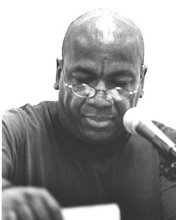
Reginald's essay collection, Orpheus in the Bronx: Essays on Identity, Politics, and the Freedom of Poetry, has just been named a finalist for the award for criticism by the National Book Critics Circle. I'm obviously saddened that he didn't live to see this honor, but I'm please nonetheless by the positive attention this book of his has received. Robert Philen
Follow this link for more details.
Tuesday, January 27, 2009


Tuesday, September 30, 2008
Comments on “Kinds of Camouflage”
KINDS OF CAMOUFLAGE
For Robert Philen
1. Déjeuner, with Herbs
Then I am sitting naked on damp grass
(it rained in my yesterday)
while two white gentlemen
in black frock coats share lunch
around me, passing chèvre, cold andouille,
and baguettes, passing bon mots
in French, in someone’s nineteenth century,
my muddled impression of one. I can’t
understand a word. There must be
a picnic basket somewhere, lined with
a red and white checked cloth,
some visual cliché, although
I know the cloth’s pale blue, pale echo
of a sky that isn’t there. They hardly
notice me (two men now passing apples, and
a bottle of medium quality red wine), or no,
I exaggerate, they don’t see me
at all, my body naked to the breeze
too cold for noon although it may
be May; my skin responds
in kind and gets no answer, a situation
I am used to. Browned warmth of my flesh
tones is quickly cooling, and the day
is downcast, overcast: the basket’s
been tipped over, grapes, peaches,
and some fruit I can’t make out
spill over, shadowing green. I hate poems
about food. I am a painting
by now, varnish smudged and darkening
in storage, and getting hungry fast.
2. Field Guide
Above the highway we drove home
between two hills of snow (from one
classical town to another), a bird
you couldn’t recognize at first
when I asked, What is that?.
Something trailing confused you,
threw you off track, a streamer,
scrap of dragon kite, festoon or
crimson plume. Oh, it’s a red-tailed
hawk, with something caught
I can’t make out. Dinner, anyway.
A piece of will defeated
in the wind, some little life’s
fluttered surrender. Perhaps
a red squirrel, rare color
around here (you told me
that), I could have thought
but didn’t. The hawk
won’t be hungry for long, we’re almost
home. It will be again.
“Kinds of Camouflage” has long been one of my favorite poems – by Reginald or anyone. The poem appears in Reginald’s most recent poetry collection, Fata Morgana, published last year, though it was written quite a while earlier, about a year or so after I first met and fell in love with Reginald, sometime during the winter of 2000 – 2001, or perhaps as late as early spring 2001. (I can place its writing in time because Part 2, in addition to being evocative poetry, is a pretty straight description of something we saw and a conversation we had while driving between Syracuse and Ithaca, New York, and that is the possible time range in which we might have made that drive with snow on the ground.)
Here I offer, paralleling the structure of the poem, two commentaries, distinct from one another, but related. Robert Philen
1.
One of the most striking things about Reginald’s poetry is the strength and power of his images.
His images are typically straightforward and clear. In reading his poetry, I’m often reminded of the clarity of imagery in some of the poems of one of Reginald’s favorite modern poets, Williams – the red wheelbarrow (upon which so much depends) beside the white chickens, or “This is just to say”’s plums so cold and so delicious, to reference two famous examples.
Reginald’s imagery is also typically highly evocative. In Part 1 of “Kinds of Camouflage,” there is of course the reference to and evocation of Manet’s painting, but also a sense of the fear of exposure of nakedness (literal and figurative), fear of lack of interest in that nakedness exposed, and perhaps also a bit of a sense of the pomposity in which others are clothed (literally and figuratively).
But as Reginald was often quick to point out, in writing, speaking, or conversation, there are no images in poetry, barring some examples of concrete poetry. An important part the workings of his poetry was the tension between imagery and the fact of the poem as comprised of words.
This tension is often made explicit through calling attention to the “wordiness” of imagery. In Part 1 here, following imagery of food with “I hate poems about food,” followed by a new fiction and image, “I am a painting by now…” Similarly, in “You, Therefore” (posted below, and also published in Fata Morgana), it is made explicit that “you” and imagery of “you” are not the same, though with the ambiguity immediately reintroduced through the use of further imagery in presenting the reality of “you:” “…if I say to you ‘To You I Say,’ you have not been / set to music… you are / a concordance of person, number, voice, / and place, strawberries spread through your name…” Also, in “Kinds of Camouflage,” we encounter the ambiguity of straightforward images misperceived or unperceived (camouflaged), except because marked as camouflaged.
2.
Among other things, Reginald was a poet of landscape and nature, though clearly not in any of the stereotypical sorts of ways.
Again, one (though only one) of the important components of most of his poetry is his striking imagery. This is one of the things that gives his corpus of work a cohesiveness, a style of its own. At the same time, the poems he wrote in different periods, and perhaps more importantly in different places, tend to have their distinct flavors. They’re all markedly “Reginald Shepherd” poems, but his Chicago poems have a different feel from his upstate New York poems from his Pensacola poems.
Much of his imagery he created or drew from subjective or interpersonal experiences or from encountering the poetry and art of others. Part 1 of “Kinds of Camouflage” uses such imagery, and taken in isolation could have been written by Reginald in any of the places he lived. Much of his imagery, though, was drawn from his physical surroundings. In Part 2 of the poem, the imagery is drawn from an incident in upstate New York. He would have emphasized, and I emphasize now, that once placed in the poem, the imagery takes on an existence independent of the occurrence, not at all dependent on the occurrence (which in this particular instance happened to have actually happened), but the imagery did have its initial inspiration in that event and place.
What I’m trying to get across here is really the simple point that he drew great inspiration from and responded to his surroundings. His Chicago poems are often full of the imagery of Lake Michigan, the waterfront, and the industrial trappings of that city – imagery largely absent from later poems. (Other waterfronts are present – but not that one.) I find it virtually impossible to imagine (aside from the fact that I know it was written in Ithaca, NY) Part 2 of “Kinds of Camouflage” having been written in Chicago. It’s possible something somewhat similar could have been written in Pensacola, though without the snow, without the classical towns, without the musing of hypothetical suppositions about whether the hawk’s dinner could have been a red squirrel, i.e. he might have written a poem in Pensacola involving a red-tailed hawk, but the total set of images bears distinct markings as one of his upstate New York poems.
For Robert Philen
1. Déjeuner, with Herbs
Then I am sitting naked on damp grass
(it rained in my yesterday)
while two white gentlemen
in black frock coats share lunch
around me, passing chèvre, cold andouille,
and baguettes, passing bon mots
in French, in someone’s nineteenth century,
my muddled impression of one. I can’t
understand a word. There must be
a picnic basket somewhere, lined with
a red and white checked cloth,
some visual cliché, although
I know the cloth’s pale blue, pale echo
of a sky that isn’t there. They hardly
notice me (two men now passing apples, and
a bottle of medium quality red wine), or no,
I exaggerate, they don’t see me
at all, my body naked to the breeze
too cold for noon although it may
be May; my skin responds
in kind and gets no answer, a situation
I am used to. Browned warmth of my flesh
tones is quickly cooling, and the day
is downcast, overcast: the basket’s
been tipped over, grapes, peaches,
and some fruit I can’t make out
spill over, shadowing green. I hate poems
about food. I am a painting
by now, varnish smudged and darkening
in storage, and getting hungry fast.
2. Field Guide
Above the highway we drove home
between two hills of snow (from one
classical town to another), a bird
you couldn’t recognize at first
when I asked, What is that?.
Something trailing confused you,
threw you off track, a streamer,
scrap of dragon kite, festoon or
crimson plume. Oh, it’s a red-tailed
hawk, with something caught
I can’t make out. Dinner, anyway.
A piece of will defeated
in the wind, some little life’s
fluttered surrender. Perhaps
a red squirrel, rare color
around here (you told me
that), I could have thought
but didn’t. The hawk
won’t be hungry for long, we’re almost
home. It will be again.
“Kinds of Camouflage” has long been one of my favorite poems – by Reginald or anyone. The poem appears in Reginald’s most recent poetry collection, Fata Morgana, published last year, though it was written quite a while earlier, about a year or so after I first met and fell in love with Reginald, sometime during the winter of 2000 – 2001, or perhaps as late as early spring 2001. (I can place its writing in time because Part 2, in addition to being evocative poetry, is a pretty straight description of something we saw and a conversation we had while driving between Syracuse and Ithaca, New York, and that is the possible time range in which we might have made that drive with snow on the ground.)
Here I offer, paralleling the structure of the poem, two commentaries, distinct from one another, but related. Robert Philen
1.
One of the most striking things about Reginald’s poetry is the strength and power of his images.
His images are typically straightforward and clear. In reading his poetry, I’m often reminded of the clarity of imagery in some of the poems of one of Reginald’s favorite modern poets, Williams – the red wheelbarrow (upon which so much depends) beside the white chickens, or “This is just to say”’s plums so cold and so delicious, to reference two famous examples.
Reginald’s imagery is also typically highly evocative. In Part 1 of “Kinds of Camouflage,” there is of course the reference to and evocation of Manet’s painting, but also a sense of the fear of exposure of nakedness (literal and figurative), fear of lack of interest in that nakedness exposed, and perhaps also a bit of a sense of the pomposity in which others are clothed (literally and figuratively).
But as Reginald was often quick to point out, in writing, speaking, or conversation, there are no images in poetry, barring some examples of concrete poetry. An important part the workings of his poetry was the tension between imagery and the fact of the poem as comprised of words.
This tension is often made explicit through calling attention to the “wordiness” of imagery. In Part 1 here, following imagery of food with “I hate poems about food,” followed by a new fiction and image, “I am a painting by now…” Similarly, in “You, Therefore” (posted below, and also published in Fata Morgana), it is made explicit that “you” and imagery of “you” are not the same, though with the ambiguity immediately reintroduced through the use of further imagery in presenting the reality of “you:” “…if I say to you ‘To You I Say,’ you have not been / set to music… you are / a concordance of person, number, voice, / and place, strawberries spread through your name…” Also, in “Kinds of Camouflage,” we encounter the ambiguity of straightforward images misperceived or unperceived (camouflaged), except because marked as camouflaged.
2.
Among other things, Reginald was a poet of landscape and nature, though clearly not in any of the stereotypical sorts of ways.
Again, one (though only one) of the important components of most of his poetry is his striking imagery. This is one of the things that gives his corpus of work a cohesiveness, a style of its own. At the same time, the poems he wrote in different periods, and perhaps more importantly in different places, tend to have their distinct flavors. They’re all markedly “Reginald Shepherd” poems, but his Chicago poems have a different feel from his upstate New York poems from his Pensacola poems.
Much of his imagery he created or drew from subjective or interpersonal experiences or from encountering the poetry and art of others. Part 1 of “Kinds of Camouflage” uses such imagery, and taken in isolation could have been written by Reginald in any of the places he lived. Much of his imagery, though, was drawn from his physical surroundings. In Part 2 of the poem, the imagery is drawn from an incident in upstate New York. He would have emphasized, and I emphasize now, that once placed in the poem, the imagery takes on an existence independent of the occurrence, not at all dependent on the occurrence (which in this particular instance happened to have actually happened), but the imagery did have its initial inspiration in that event and place.
What I’m trying to get across here is really the simple point that he drew great inspiration from and responded to his surroundings. His Chicago poems are often full of the imagery of Lake Michigan, the waterfront, and the industrial trappings of that city – imagery largely absent from later poems. (Other waterfronts are present – but not that one.) I find it virtually impossible to imagine (aside from the fact that I know it was written in Ithaca, NY) Part 2 of “Kinds of Camouflage” having been written in Chicago. It’s possible something somewhat similar could have been written in Pensacola, though without the snow, without the classical towns, without the musing of hypothetical suppositions about whether the hawk’s dinner could have been a red squirrel, i.e. he might have written a poem in Pensacola involving a red-tailed hawk, but the total set of images bears distinct markings as one of his upstate New York poems.
Monday, September 22, 2008
You, Therefore
Of all Reginald's poems, "You, Therefore" is among those that seems to resonate most with people. It's the one I've seen most used as part of the many online tributes to Reginald that have been put up since his death. It's one of two poems I selected to be read at his memorial service (along with his last poem, "God-With-Us").
I can't say with absolute certainty that it was his favorite among his own poems, but "You, Therefore" was definitely among his favorites. From the time he wrote it, he always closed any of his many readings with this poem. Robert Philen
YOU, THEREFORE
For Robert Philen
You are like me, you will die too, but not today:
you, incommensurate, therefore the hours shine:
if I say to you “To you I say,” you have not been
set to music, or broadcast live on the ghost
radio, may never be an oil painting or
Old Master’s charcoal sketch: you are
a concordance of person, number, voice,
and place, strawberries spread through your name
as if it were budding shrubs, how you remind me
of some spring, the waters as cool and clear
(late rain clings to your leaves, shaken by light wind),
which is where you occur in grassy moonlight:
and you are a lily, an aster, white trillium
or viburnum, by all rights mine, white star
in the meadow sky, the snow still arriving
from its earthwards journeys, here where there is
no snow (I dreamed the snow was you,
when there was snow), you are my right,
have come to be my night (your body takes on
the dimensions of sleep, the shape of sleep
becomes you): and you fall from the sky
with several flowers, words spill from your mouth
in waves, your lips taste like the sea, salt-sweet (trees
and seas have flown away, I call it
loving you): home is nowhere, therefore you,
a kind of dwell and welcome, song after all,
and free of any eden we can name
I can't say with absolute certainty that it was his favorite among his own poems, but "You, Therefore" was definitely among his favorites. From the time he wrote it, he always closed any of his many readings with this poem. Robert Philen
YOU, THEREFORE
For Robert Philen
You are like me, you will die too, but not today:
you, incommensurate, therefore the hours shine:
if I say to you “To you I say,” you have not been
set to music, or broadcast live on the ghost
radio, may never be an oil painting or
Old Master’s charcoal sketch: you are
a concordance of person, number, voice,
and place, strawberries spread through your name
as if it were budding shrubs, how you remind me
of some spring, the waters as cool and clear
(late rain clings to your leaves, shaken by light wind),
which is where you occur in grassy moonlight:
and you are a lily, an aster, white trillium
or viburnum, by all rights mine, white star
in the meadow sky, the snow still arriving
from its earthwards journeys, here where there is
no snow (I dreamed the snow was you,
when there was snow), you are my right,
have come to be my night (your body takes on
the dimensions of sleep, the shape of sleep
becomes you): and you fall from the sky
with several flowers, words spill from your mouth
in waves, your lips taste like the sea, salt-sweet (trees
and seas have flown away, I call it
loving you): home is nowhere, therefore you,
a kind of dwell and welcome, song after all,
and free of any eden we can name
Wednesday, September 17, 2008
God-With-Us
GOD-WITH-US
after Jean Valentine
What will I call you
when you are gone?
How will I know your name?
Little star, reflection
on the Sea of Galilee,
a lantern in the wood, half-hid,
half-seen?
reflecting on what can’t be
touched, be known?
And the sheen of milk
across the sky, the galaxy poured out
like me, true sky, false dawn,
and a young woman’s nipple,
star of milk, star of a
nursing child’s mouth, my
child, my lord, whoever
you may be today, tonight
which will not end, a cup
passed to me, from which I may
or may not drink, half-empty
star, still asleep by now?
And your small body, Emmanuel,
how small my heart
to fit inside yours)
lie there, pearled, asleep…
How I want to believe.
(a pearl, an irritant).
Note on "God-With-Us:" This was the last poem Reginald wrote. He wrote it while in the hospital, about two weeks before he died. It was read at his memorial service by his longtime friend Jocelyn Emerson. Robert Philen
after Jean Valentine
What will I call you
when you are gone?
How will I know your name?
Little star, reflection
on the Sea of Galilee,
a lantern in the wood, half-hid,
half-seen?
reflecting on what can’t be
touched, be known?
And the sheen of milk
across the sky, the galaxy poured out
like me, true sky, false dawn,
and a young woman’s nipple,
star of milk, star of a
nursing child’s mouth, my
child, my lord, whoever
you may be today, tonight
which will not end, a cup
passed to me, from which I may
or may not drink, half-empty
star, still asleep by now?
And your small body, Emmanuel,
how small my heart
to fit inside yours)
lie there, pearled, asleep…
How I want to believe.
(a pearl, an irritant).
Note on "God-With-Us:" This was the last poem Reginald wrote. He wrote it while in the hospital, about two weeks before he died. It was read at his memorial service by his longtime friend Jocelyn Emerson. Robert Philen
Monday, September 15, 2008
Reginald Shepherd, 1963 - 2008
As most readers of this blog are probably by now aware, Reginald Shepherd died September 10 after a fight against cancer.
Reginald was my partner, my best friend, my constant companion, my lover, my confidante, and much else besides. I don't know what I'll do without him for the rest of my life. I do plan to occasionally post material about Reginald here, along with writings from his files.
The following is a short piece about Reginald I wrote for his memorial service, which was held yesterday. Robert Philen
Reginald Shepherd, 1963 - 2008
Reginald Shepherd was born April 10, 1963 in New York City and passed away September 10, 2008 in Pensacola, surrounded by people whom he loved and who loved him.
Reginald was the son of Blanche Berry, who was originally from Macon, Georgia. He grew up in Bronx, New York, along with a sister, Regina Graham. He moved to Macon and lived with his aunt, Mildred Swint, after the death of his mother when he was fifteen.
Reginald earned a B.A. degree from Bennington College in Bennington, Vermont, and M.F.A. degrees in Creative Writing from Brown University in Providence, Rhode Island, and the University of Iowa in Iowa City. He taught literature and creative writing, most recently at Antioch University and earlier at the University of West Florida, Cornell University, and Northern Illinois University, and he was remarkably dedicated to his students and the craft of writing.
Reginald was a magnificent writer. He published five books of poetry (Some Are Drowning; Angel, Interrupted; Wrong; Otherhood; and Fata Morgana) and a book of essays (Orpheus in the Bronx), and he edited two poetry anthologies (The Iowa Anthology of New American Poetries and Lyric Postmodernisms). He recently completed a sixth book of poetry and a second volume of essays that will be published posthumously. Among many awards for his writing, he most recently earned a Guggenheim Fellowship in 2008 and won the 2007 silver medal for poetry in the Florida Book Awards.
Reginald met his partner, Robert Philen, in December, 1999 in Ithaca, New York, and ever since, their relationship has grown, based in conversation, compassion, sharing, friendship, passion, and profound love. The two have lived in Pensacola since July, 2001.
Over the past year, Reginald faced tremendous adversity and continuous pain from a series of illnesses related to cancer, but he faced it all with profound strength and courage, tenacity, love of life – and gentleness, dignity, and innocence. He fought long and hard against the illness, but as one nurse who worked with him toward the end put it, “He remained a gentleman to the end.”
Any of us who knew Reginald are devastated and heartbroken at this loss, and we will miss his unique combination of verve and vivacity, wit and intelligence, tenacity and strength, gentleness, empathy, and sweetness, generosity and innocence. We will also, despite our profound sadness, remain ennobled, happy, and blessed by the time we spent with him.
Reginald was my partner, my best friend, my constant companion, my lover, my confidante, and much else besides. I don't know what I'll do without him for the rest of my life. I do plan to occasionally post material about Reginald here, along with writings from his files.
The following is a short piece about Reginald I wrote for his memorial service, which was held yesterday. Robert Philen
Reginald Shepherd, 1963 - 2008
Reginald Shepherd was born April 10, 1963 in New York City and passed away September 10, 2008 in Pensacola, surrounded by people whom he loved and who loved him.
Reginald was the son of Blanche Berry, who was originally from Macon, Georgia. He grew up in Bronx, New York, along with a sister, Regina Graham. He moved to Macon and lived with his aunt, Mildred Swint, after the death of his mother when he was fifteen.
Reginald earned a B.A. degree from Bennington College in Bennington, Vermont, and M.F.A. degrees in Creative Writing from Brown University in Providence, Rhode Island, and the University of Iowa in Iowa City. He taught literature and creative writing, most recently at Antioch University and earlier at the University of West Florida, Cornell University, and Northern Illinois University, and he was remarkably dedicated to his students and the craft of writing.
Reginald was a magnificent writer. He published five books of poetry (Some Are Drowning; Angel, Interrupted; Wrong; Otherhood; and Fata Morgana) and a book of essays (Orpheus in the Bronx), and he edited two poetry anthologies (The Iowa Anthology of New American Poetries and Lyric Postmodernisms). He recently completed a sixth book of poetry and a second volume of essays that will be published posthumously. Among many awards for his writing, he most recently earned a Guggenheim Fellowship in 2008 and won the 2007 silver medal for poetry in the Florida Book Awards.
Reginald met his partner, Robert Philen, in December, 1999 in Ithaca, New York, and ever since, their relationship has grown, based in conversation, compassion, sharing, friendship, passion, and profound love. The two have lived in Pensacola since July, 2001.
Over the past year, Reginald faced tremendous adversity and continuous pain from a series of illnesses related to cancer, but he faced it all with profound strength and courage, tenacity, love of life – and gentleness, dignity, and innocence. He fought long and hard against the illness, but as one nurse who worked with him toward the end put it, “He remained a gentleman to the end.”
Any of us who knew Reginald are devastated and heartbroken at this loss, and we will miss his unique combination of verve and vivacity, wit and intelligence, tenacity and strength, gentleness, empathy, and sweetness, generosity and innocence. We will also, despite our profound sadness, remain ennobled, happy, and blessed by the time we spent with him.
Tuesday, August 26, 2008
On Alvin Feinman’s “True Night”
I am in the hospital for the fourth time in the past five months, this time for excruciating abdominal pain that turned out to be due to a partial bowel obstruction which has still not cleared up. I have had a tube down my throat and have been unable to eat for over a week. I spend most of my days trying to sleep through the pain and nausea.
In the course of the various tests to try to determine the cause of the obstruction, my surgeon found several large masses on my liver which, after a blood test and a liver biopsy, have turned out to be a fast-growing resurgence of my colon cancer. Thus I am in the hospital cancer ward for the foreseeable future, starting chemotherapy again (it had been on hold during my assorted medical crises of the past few months), before I have had time to fully recover from my recent illnesses and surgeries.
Despite all this, and to remind myself that I am not a bundle of symptoms and sicknesses, I am posting (or rather, having my darling Robert post) this final tribute to my recently deceased mentor Alvin Feinman, a discussion of his poem “True Night.” This is an excerpt from a piece on Feinman’s work in general that is included in the anthology Dark Horses, edited by Kevin Prufer and Joy Katz, and in my essay collection Orpheus in the Bronx.
True Night
So it is midnight, and all
The angels of ordinary day gone,
The abiding absence between day and day
Come like true and only rain
Comes instant, eternal, again:
As though an air had opened without sound
In which all things are sanctified,
In which they are at prayer—
The drunken man in his stupor,
The madman’s lucid shrinking circle;
As though all things shone perfectly,
Perfected in self-discrepancy:
The widow wedded to her grief,
The hangman haloed in remorse—
I should not rearrange a leaf,
No more than wish to lighten stones
Or still the sea where it still roars—
Here every grief requires its grief,
Here every longing thing is lit
Like darkness at an altar.
As long as truest night is long,
Let no discordant wing
Corrupt these sorrows into song.
“True Night” is a lovely example of what Bloom calls “a central sensibility seeking imaginative truth without resorting to any of the available evasions of consciousness,” whose temptations are both acknowledged and refused The poem opens at midnight, “The abiding absence between day and day,” a present absence which is both instant (and an instant) and eternal, because it is no given day and no single time, but rather the moment between dates. This no-time is all times, both everlasting and utterly ephemeral. It is (or rather, it is “As though”—what we know is not the thing itself, but only its appearance, our own knowing of it) an air which has opened soundlessly, an air which we take into ourselves with every breath. Particularly within the precincts of a poem, the phrase “an air” in conjunction with the evocation of sound calls up a pun on the Renaissance sense of an “air” as a song. Here, it is a song without sound; it was Keats who wrote that unheard melodies are sweetest, and this soundless air is sweeter than any song one could ever hear.
Here in this time which is no time, the polarity of identity and difference is suspended, and opposites meet. Things are beside themselves, at peace with their own restlessness and discontent, their own failure to be identical with themselves: they are “Perfected in self- discrepancy,” like the off-rhyme of the words “perfectly” and “discrepancy.” All wrongs are posed in the perfection of a still-life, no less wrong but now transfigured into necessity and equipoise: “Here every grief requires its grief.” The poet’s task is both to capture this momentless moment and to leave it undisturbed, to touch its untouchability into art without marring or altering it. The line “I should not rearrange a leaf” can be read either as “I wouldn’t rearrange a leaf even if I could, all is perfect as it is” or as “I should abandon any desire to rearrange a leaf, to insert my own will into the seen/scene.” For this poem, paradise is paradox, where longing (the source of suffering, according to the Buddha) is illumination, and to be lit is to be like darkness “at an altar,” at prayer, prayed to, or both.
The poem’s last stanza insists that no discordant wing (shattering the harmony of the soundless air) should be allowed to corrupt the sorrows the poem presents into song, at least “As long as truest night is long.” That is to say, this admonition holds both forever and only for the most fleeting of (non-) moments. And yet the poem itself, unavoidably, is a song (“lyric,” after all, comes from “lyre”), voiced and heard. The poem both “mystically” asserts a paradoxical concord (echoing and amplifying Stevens’s avowal that “The imperfect is our paradise”) and takes a potentially ironic stance toward it: the poem is both entranced and undeluded.
The inescapable paradox of “True Night,” the truth that it both embodies and struggles against in the name of truth, is that the poem’s discordant wing has corrupted the scene into song: it is helpless not to do so, for otherwise there would be no poem. But the poem has also acknowledged and honored the difference between scene and song: it has reminded us that is remains is however much mind and music might wish it otherwise, however much metaphor and song might wish to translate being into seeming.
In the course of the various tests to try to determine the cause of the obstruction, my surgeon found several large masses on my liver which, after a blood test and a liver biopsy, have turned out to be a fast-growing resurgence of my colon cancer. Thus I am in the hospital cancer ward for the foreseeable future, starting chemotherapy again (it had been on hold during my assorted medical crises of the past few months), before I have had time to fully recover from my recent illnesses and surgeries.
Despite all this, and to remind myself that I am not a bundle of symptoms and sicknesses, I am posting (or rather, having my darling Robert post) this final tribute to my recently deceased mentor Alvin Feinman, a discussion of his poem “True Night.” This is an excerpt from a piece on Feinman’s work in general that is included in the anthology Dark Horses, edited by Kevin Prufer and Joy Katz, and in my essay collection Orpheus in the Bronx.
True Night
So it is midnight, and all
The angels of ordinary day gone,
The abiding absence between day and day
Come like true and only rain
Comes instant, eternal, again:
As though an air had opened without sound
In which all things are sanctified,
In which they are at prayer—
The drunken man in his stupor,
The madman’s lucid shrinking circle;
As though all things shone perfectly,
Perfected in self-discrepancy:
The widow wedded to her grief,
The hangman haloed in remorse—
I should not rearrange a leaf,
No more than wish to lighten stones
Or still the sea where it still roars—
Here every grief requires its grief,
Here every longing thing is lit
Like darkness at an altar.
As long as truest night is long,
Let no discordant wing
Corrupt these sorrows into song.
“True Night” is a lovely example of what Bloom calls “a central sensibility seeking imaginative truth without resorting to any of the available evasions of consciousness,” whose temptations are both acknowledged and refused The poem opens at midnight, “The abiding absence between day and day,” a present absence which is both instant (and an instant) and eternal, because it is no given day and no single time, but rather the moment between dates. This no-time is all times, both everlasting and utterly ephemeral. It is (or rather, it is “As though”—what we know is not the thing itself, but only its appearance, our own knowing of it) an air which has opened soundlessly, an air which we take into ourselves with every breath. Particularly within the precincts of a poem, the phrase “an air” in conjunction with the evocation of sound calls up a pun on the Renaissance sense of an “air” as a song. Here, it is a song without sound; it was Keats who wrote that unheard melodies are sweetest, and this soundless air is sweeter than any song one could ever hear.
Here in this time which is no time, the polarity of identity and difference is suspended, and opposites meet. Things are beside themselves, at peace with their own restlessness and discontent, their own failure to be identical with themselves: they are “Perfected in self- discrepancy,” like the off-rhyme of the words “perfectly” and “discrepancy.” All wrongs are posed in the perfection of a still-life, no less wrong but now transfigured into necessity and equipoise: “Here every grief requires its grief.” The poet’s task is both to capture this momentless moment and to leave it undisturbed, to touch its untouchability into art without marring or altering it. The line “I should not rearrange a leaf” can be read either as “I wouldn’t rearrange a leaf even if I could, all is perfect as it is” or as “I should abandon any desire to rearrange a leaf, to insert my own will into the seen/scene.” For this poem, paradise is paradox, where longing (the source of suffering, according to the Buddha) is illumination, and to be lit is to be like darkness “at an altar,” at prayer, prayed to, or both.
The poem’s last stanza insists that no discordant wing (shattering the harmony of the soundless air) should be allowed to corrupt the sorrows the poem presents into song, at least “As long as truest night is long.” That is to say, this admonition holds both forever and only for the most fleeting of (non-) moments. And yet the poem itself, unavoidably, is a song (“lyric,” after all, comes from “lyre”), voiced and heard. The poem both “mystically” asserts a paradoxical concord (echoing and amplifying Stevens’s avowal that “The imperfect is our paradise”) and takes a potentially ironic stance toward it: the poem is both entranced and undeluded.
The inescapable paradox of “True Night,” the truth that it both embodies and struggles against in the name of truth, is that the poem’s discordant wing has corrupted the scene into song: it is helpless not to do so, for otherwise there would be no poem. But the poem has also acknowledged and honored the difference between scene and song: it has reminded us that is remains is however much mind and music might wish it otherwise, however much metaphor and song might wish to translate being into seeming.
Saturday, August 16, 2008
What's in a Name? Part Three
Because I am not devoid of pride, and because I always want to know whether I’m being talked about and what people are saying if I am, I periodically look myself up online or, as they say, “google” myself. (Perhaps “Google” should be capitalized, since it is a trademark.) The only other Reginald Shepherd who comes up is an aged and very Caucasian Canadian painter, a self-described “poetic realist” who seems well-known in his native Newfoundland and in neighboring Nova Scotia, but nowhere else as far as I can tell, even in Canada. I think of myself as a kind of poetic realist as well, in life and in my poetry, so perhaps our kinship is more than name deep.
Years ago, when I lived in Chicago, another, decidedly less savory Reginald Shepherd popped up when I searched myself. An apparent career criminal (all that came up were his various arrests), he was something of an evil doppelganger. I once was almost denied an apartment because there was a record of my arrest for “criminal shoplifting” (I always wondered what legal shoplifting was) in 1991, two years before I moved to Chicago. And once I received a letter from a social service agency that some woman had named me as the father of her child. I had to call and explain that the last time I had been in the vicinity of a woman’s vagina was the morning I was born. One of the other Reginald Shepherd’s old addresses even appeared on my credit report, an error (among others) I had to call and write in order to rectify. My criminal double has either settled down into legal respectability or died (either is equally likely), as he hasn’t shown up in my web searches for several years. I would like to think that he has seen the error of his ways and now become a law-abiding citizen, but I have no great desire to inquire further.
When I look up the most common misspelling of my name, Reginald Shepard, which people sometimes insist upon even when they’re publishing or paying me, no matter how many times I sign and print the correct spelling of my name, besides finding various references to my misspelled self (I try to correct them when I can), I also find references to a death row inmate in Florida by that name. I don’t know what his crime was, but I imagine that it was probably murder. I find it a little disturbing to once again have a criminal doppelganger living (though who knows for how long) in the same state. At least there are two crucial letters separating my name from his, his fate from mine. But still…
Years ago, when I lived in Chicago, another, decidedly less savory Reginald Shepherd popped up when I searched myself. An apparent career criminal (all that came up were his various arrests), he was something of an evil doppelganger. I once was almost denied an apartment because there was a record of my arrest for “criminal shoplifting” (I always wondered what legal shoplifting was) in 1991, two years before I moved to Chicago. And once I received a letter from a social service agency that some woman had named me as the father of her child. I had to call and explain that the last time I had been in the vicinity of a woman’s vagina was the morning I was born. One of the other Reginald Shepherd’s old addresses even appeared on my credit report, an error (among others) I had to call and write in order to rectify. My criminal double has either settled down into legal respectability or died (either is equally likely), as he hasn’t shown up in my web searches for several years. I would like to think that he has seen the error of his ways and now become a law-abiding citizen, but I have no great desire to inquire further.
When I look up the most common misspelling of my name, Reginald Shepard, which people sometimes insist upon even when they’re publishing or paying me, no matter how many times I sign and print the correct spelling of my name, besides finding various references to my misspelled self (I try to correct them when I can), I also find references to a death row inmate in Florida by that name. I don’t know what his crime was, but I imagine that it was probably murder. I find it a little disturbing to once again have a criminal doppelganger living (though who knows for how long) in the same state. At least there are two crucial letters separating my name from his, his fate from mine. But still…
Friday, August 8, 2008
What's in a Name? Part Two
Now that I am once again out of the hospital and able to sleep in my own bed without being wakened several times a night to be weighed or have my vital signs taken, I have the opportunity to think about other things every once in a while, or at least to return to thoughts over which I've been mulling for a while. Thus I present part two of my musings on names and naming.
The name Reginald has very different connotations for white people and for black people. For white people, the name sounds very English, and my Anglo accent, though one that I can’t hear, often makes them inquire as to whether I am English, or perhaps West Indian. I just reply that I got my accent from my Barbadian father (whom I met once) and my Jamaican stepfather (who abused my mother and me). But almost the only people in America nowadays with the name Reginald are black. It’s become an almost quintessentially black name, like Antoine (often spelled Antwan, or Antuan) or Leroy/Leroi (“the king”).
Mine is one of a set of categories of black names. There are the names that white Americans don’t use anymore, like Cedric or Tyrone, names that have been handed over to black people (though in the hospital I did have a white physical therapist named Tyrus—but then, the South has always been a bit backward). There are also names like Reginald, Maurice, or Roderick (this last one is on the edge) which have become predominantly black names but aren’t yet perceived so by white people. There are the made-up names, like Materia, Tawanna (a cousin of mine—she was meant to be named after the Mexican border city), or Chicalaundra (pronounced “Shalandra”). There are the Frenchified names, like LaQuan or LeVante or LeBron or LaToya (also LeToya), or the (male) driver of the Greyhound bus I used to take to work when I lived in Chicago, LaHarry. I remember joking once with a black friend that you can make any name black just by adding “La” or “Le” to it; then I realized it was true. (“De” will also work, as in DeWayne, DeMarcus or, my favorite, Da’Sean, pronounced “DAY-Shawn”—the apostrophe makes all the difference.) Then there are the faux-African names, like Kechia/Keshia/Keisha, Kena (another cousin of mine), Kima, and Kwame (this last a genuineWest African name appropriated by black Americans). There is an overlap between Frenchified black names and faux-African names, as in Lakeisha or Deshondra, and between the made-up names and the faux-African names, like Tawanna or Kima or Ebony/Eboni. There are also the Arab names, like Jamal and Malik, Omar and Raheem/Raheim. I’ve always found black Americans' tendency to give their children Muslim names odd, since Muslim Arabs were major slave traders for over a thousand years. A category which seems to have dwindled are names taken from words of rank and position, so that a white person calling a black person by (usually) his first name would still have to show respect, even if the act was meant disrespectfully. The singer Prince a/k/a “Symbol Thing” (born Prince Rogers Nelson) and poet Major Jackson would be examples. Mine is also an example of such a name, since, as I wrote earlier, my mother always told me that it meant “Great King.”
When I was a kid, and up until my mid-twenties, I went by “Reggie.” The only other two Reggies I knew of in my childhood were the baseball player Reggie Jackson and the Archie comic books laughingstock rich bad boy Reggie Mantle. He once went into an office and, unsatisfied by the secretary’s refusal to be impressed by him, announced “Someday my name will be a household word,” to which her response was, “Like dirt?”
A few months before my twenty-fifth birthday, I decided that I was too old to be called “Reggie.” That was a child’s name, and it was time for me to put aside childish things. Since then I have gone by my full name, though people still insist on calling me “Reggie” and “Reg.” But even when I went by Reggie, already a shortened version of my name, many people insisted on calling me “Reg." Besides the obvious fact that it wasn’t my name (if I wanted to be called Reg, I would introduce myself that way), as my oldest friend Merav’s mother put it, “Reg” has the air of a hale fellow well met, a football player perhaps, and that's never been me or anyone I wanted to be. I've never understood why people would need to nick a nickname, anyway. Some people still call me Reg, and I always correct them, except for my editor at the University of Pittsburgh Press, Ed Ochester. He has loyally published me for many years, so if he wanted to call me “Joe,” that would be alright with me.
The name Reginald has very different connotations for white people and for black people. For white people, the name sounds very English, and my Anglo accent, though one that I can’t hear, often makes them inquire as to whether I am English, or perhaps West Indian. I just reply that I got my accent from my Barbadian father (whom I met once) and my Jamaican stepfather (who abused my mother and me). But almost the only people in America nowadays with the name Reginald are black. It’s become an almost quintessentially black name, like Antoine (often spelled Antwan, or Antuan) or Leroy/Leroi (“the king”).
Mine is one of a set of categories of black names. There are the names that white Americans don’t use anymore, like Cedric or Tyrone, names that have been handed over to black people (though in the hospital I did have a white physical therapist named Tyrus—but then, the South has always been a bit backward). There are also names like Reginald, Maurice, or Roderick (this last one is on the edge) which have become predominantly black names but aren’t yet perceived so by white people. There are the made-up names, like Materia, Tawanna (a cousin of mine—she was meant to be named after the Mexican border city), or Chicalaundra (pronounced “Shalandra”). There are the Frenchified names, like LaQuan or LeVante or LeBron or LaToya (also LeToya), or the (male) driver of the Greyhound bus I used to take to work when I lived in Chicago, LaHarry. I remember joking once with a black friend that you can make any name black just by adding “La” or “Le” to it; then I realized it was true. (“De” will also work, as in DeWayne, DeMarcus or, my favorite, Da’Sean, pronounced “DAY-Shawn”—the apostrophe makes all the difference.) Then there are the faux-African names, like Kechia/Keshia/Keisha, Kena (another cousin of mine), Kima, and Kwame (this last a genuineWest African name appropriated by black Americans). There is an overlap between Frenchified black names and faux-African names, as in Lakeisha or Deshondra, and between the made-up names and the faux-African names, like Tawanna or Kima or Ebony/Eboni. There are also the Arab names, like Jamal and Malik, Omar and Raheem/Raheim. I’ve always found black Americans' tendency to give their children Muslim names odd, since Muslim Arabs were major slave traders for over a thousand years. A category which seems to have dwindled are names taken from words of rank and position, so that a white person calling a black person by (usually) his first name would still have to show respect, even if the act was meant disrespectfully. The singer Prince a/k/a “Symbol Thing” (born Prince Rogers Nelson) and poet Major Jackson would be examples. Mine is also an example of such a name, since, as I wrote earlier, my mother always told me that it meant “Great King.”
When I was a kid, and up until my mid-twenties, I went by “Reggie.” The only other two Reggies I knew of in my childhood were the baseball player Reggie Jackson and the Archie comic books laughingstock rich bad boy Reggie Mantle. He once went into an office and, unsatisfied by the secretary’s refusal to be impressed by him, announced “Someday my name will be a household word,” to which her response was, “Like dirt?”
A few months before my twenty-fifth birthday, I decided that I was too old to be called “Reggie.” That was a child’s name, and it was time for me to put aside childish things. Since then I have gone by my full name, though people still insist on calling me “Reggie” and “Reg.” But even when I went by Reggie, already a shortened version of my name, many people insisted on calling me “Reg." Besides the obvious fact that it wasn’t my name (if I wanted to be called Reg, I would introduce myself that way), as my oldest friend Merav’s mother put it, “Reg” has the air of a hale fellow well met, a football player perhaps, and that's never been me or anyone I wanted to be. I've never understood why people would need to nick a nickname, anyway. Some people still call me Reg, and I always correct them, except for my editor at the University of Pittsburgh Press, Ed Ochester. He has loyally published me for many years, so if he wanted to call me “Joe,” that would be alright with me.
Tuesday, August 5, 2008
What's in a Name? Part One
Steven Burt’s January post "all-name team" on the Poetry Foundation’s Harriet blog, and the posts I did in February here on this blog on gay poetry post identity politics, have had me musing about identity, social and personal, and about the role names play in producing identity. I’ve been thinking about names, what they are and what they do. As Burt points out, poetry is a kind of naming, and naming is in turn a kind of poetry. In poems, names are like magic talismans that contain and convey the essence of the thing named. So when two things are given the same name, then they are or become the same. And when the name changes, then the thing named changes.
The thought of changing names and things, in turn, has me thinking of my own name (everything makes me think of me), the changes it has undergone over the course of my life, and a couple of people with whom I share that name, whom I’m quite sure are not the same, as me or as each other. But when I look myself up, there they are. And when I look up the wrong spelling of my name, some other version of me, there I am anyway, as if I were two people who’ve led the same life, or at least who’ve published the same things in the same places. As Steve Burt points out, “Titles, names, labels ask questions, and raise possibilities.” So who are the possible me’s my name makes possible?
1
I was born Reginald Berry on the morning of April 10, 1963. Berry was my unmarried mother’s last name; like the protagonist of Diana Ross and the Supremes’ “Love Child,” I started my life in an old, cold, rundown tenement slum, burdened by the stigma of illegitimacy, which for me was the same as poverty. The birth certificate I am always losing documenting the birth of “Reginald Shepherd” was issued in 1968, after my mother had sued my deadbeat Barbadian father to prove that he was indeed my father. What we got out of that I never understood, since he almost never paid the meager thirty-five dollars a week in child support as ordered by the court.
I sometimes wonder if who I am changed when I ceased to be Reginald Berry (I was five) and became Reginald Shepherd: indeed, when I ceased ever to have been Reginald Berry. Reginald Berry was erased, as if he had never been, and his place was taken by Reginald Shepherd, as if I had always been him and he had always been me, except that Reginald Shepherd came into existence at the age of five, having completely bypassed birth and infancy, not to mention the terrible twos and threes.
I was enmeshed in the social services network at a very early age (as everyone in her family always said, my mother knew how to work the system), and to this day I am in the Social Security Administration records as Reginald Berry Shepherd, a name I have never legally had or even gone by, a name that has never been mine. They remember all the pasts, and conflate them into one.
Would my life have been different if I had remained Reginald Berry, if Reginald Berry had not been erased as if he had never existed? At the least, people would have much less occasion to misspell my name, and who knows what effect that confidence that I would be correctly spelled could have had on my self-esteem?
My mother (who went from being Blanche Berry to being Blanche Graham—my stepfather’s name—without ever having been Blanche Shepherd) always told me that my name meant “Great King” in Celtic. According to the Online Etymology Dictionary (whose only authority is that of its author, Douglas Harper), my name derives from Old High German and means “ruling with power.” According to Dictionary.com Unabridged (which bases its claim to authority on the Random House Unabridged Dictionary), it derives from an Old English word meaning “counsel and rule.” I believe that it’s related to the name of the Celtic goddess Rigantona, whose name means “Great Queen.” Someone in college told me that my name was the ablative form of the Latin rex, “king,” meaning something like “of the.” Perhaps I was the king’s favorite shepherd or, in my previous life, his favorite fruit. My younger half sister is named Regina (my mother had a plan); her name unambiguously means “Queen.” I confess to being a bit jealous of her name’s indisputable authority.
But despite the grandeurs of my first name, I have felt a little deprived that I don’t have a middle name. My mother had one, later my abusive Jamaican stepfather had one, and still later my younger half-sister had one. I settled on “Alexander” as an appropriate middle name: Alexander the Great was a famous king and conqueror, and the initials “RAS” spelled out the Amharic word for “prince.” (The late Emperor Haile Selassie I of Ethiopia was known was Ras Tafari Makonnen, “Prince Tafari Makonnen,” before his ascension to the throne. Hence the group name Rastafarian, though this quasi-religion has never had any connection with Ethiopia.) But I never had my name legally changed, and as I got older I lost interest in the matter.
The thought of changing names and things, in turn, has me thinking of my own name (everything makes me think of me), the changes it has undergone over the course of my life, and a couple of people with whom I share that name, whom I’m quite sure are not the same, as me or as each other. But when I look myself up, there they are. And when I look up the wrong spelling of my name, some other version of me, there I am anyway, as if I were two people who’ve led the same life, or at least who’ve published the same things in the same places. As Steve Burt points out, “Titles, names, labels ask questions, and raise possibilities.” So who are the possible me’s my name makes possible?
1
I was born Reginald Berry on the morning of April 10, 1963. Berry was my unmarried mother’s last name; like the protagonist of Diana Ross and the Supremes’ “Love Child,” I started my life in an old, cold, rundown tenement slum, burdened by the stigma of illegitimacy, which for me was the same as poverty. The birth certificate I am always losing documenting the birth of “Reginald Shepherd” was issued in 1968, after my mother had sued my deadbeat Barbadian father to prove that he was indeed my father. What we got out of that I never understood, since he almost never paid the meager thirty-five dollars a week in child support as ordered by the court.
I sometimes wonder if who I am changed when I ceased to be Reginald Berry (I was five) and became Reginald Shepherd: indeed, when I ceased ever to have been Reginald Berry. Reginald Berry was erased, as if he had never been, and his place was taken by Reginald Shepherd, as if I had always been him and he had always been me, except that Reginald Shepherd came into existence at the age of five, having completely bypassed birth and infancy, not to mention the terrible twos and threes.
I was enmeshed in the social services network at a very early age (as everyone in her family always said, my mother knew how to work the system), and to this day I am in the Social Security Administration records as Reginald Berry Shepherd, a name I have never legally had or even gone by, a name that has never been mine. They remember all the pasts, and conflate them into one.
Would my life have been different if I had remained Reginald Berry, if Reginald Berry had not been erased as if he had never existed? At the least, people would have much less occasion to misspell my name, and who knows what effect that confidence that I would be correctly spelled could have had on my self-esteem?
My mother (who went from being Blanche Berry to being Blanche Graham—my stepfather’s name—without ever having been Blanche Shepherd) always told me that my name meant “Great King” in Celtic. According to the Online Etymology Dictionary (whose only authority is that of its author, Douglas Harper), my name derives from Old High German and means “ruling with power.” According to Dictionary.com Unabridged (which bases its claim to authority on the Random House Unabridged Dictionary), it derives from an Old English word meaning “counsel and rule.” I believe that it’s related to the name of the Celtic goddess Rigantona, whose name means “Great Queen.” Someone in college told me that my name was the ablative form of the Latin rex, “king,” meaning something like “of the.” Perhaps I was the king’s favorite shepherd or, in my previous life, his favorite fruit. My younger half sister is named Regina (my mother had a plan); her name unambiguously means “Queen.” I confess to being a bit jealous of her name’s indisputable authority.
But despite the grandeurs of my first name, I have felt a little deprived that I don’t have a middle name. My mother had one, later my abusive Jamaican stepfather had one, and still later my younger half-sister had one. I settled on “Alexander” as an appropriate middle name: Alexander the Great was a famous king and conqueror, and the initials “RAS” spelled out the Amharic word for “prince.” (The late Emperor Haile Selassie I of Ethiopia was known was Ras Tafari Makonnen, “Prince Tafari Makonnen,” before his ascension to the throne. Hence the group name Rastafarian, though this quasi-religion has never had any connection with Ethiopia.) But I never had my name legally changed, and as I got older I lost interest in the matter.
Monday, July 14, 2008
In Memoriam Alvin Feinman, 1929-2008
I am still in the hospital, awaiting surgery on an abdominal fistula that refuses to heal on its own—quite the contrary—but it’s very important to me to have Robert post this piece.
In Memoriam Alvin Feinman, 1929-2008
1
The wonderful poet, teacher and friend Alvin Feinman died a few days ago after a long struggle with emphysema and Parkinson’s disease. Alvin was one of the most important people in my poetic life, and I would like to pay him some small homage here.
Alvin Feinman was born in 1929 and raised in New York City. Though he has been named by Harold Bloom as part of the essential canon of Western literature—Bloom has written that “The best of his poems stand with the most achieved work of his generation”—Feinman is not included in any of the standard anthologies of modern or modern American poetry, not even Cary Nelson’s recent Oxford Anthology of Modern American Poetry, which explicitly aims at recovering and rediscovering neglected writers. Nor is he listed in the purportedly comprehensive Contemporary Authors reference series.
Though always committed to poetry (including, in his words, “even doggerel narratives in early childhood”), he had originally decided on philosophy as a career, and did graduate work at Yale to that end, until he realized that the dominant analytical school excluded all the important philosophical questions. It was in poetry that those unanswerable questions, questions of knowledge, perception, and the relation between being and appearance, could properly be addressed. As Feinman somewhat jocularly told me, “I was, even philosophically, convinced that, as I liked to put it, if according to Aristotle, ‘Poetry is more philosophical than history,’ so is it more philosophical than philosophy. The work I’d have had to do in philosophy would be to lay out the grounds for privileging poetry—which indeed our era has been more or less doing—vide Heidegger, Rorty, Derrida, etc.”
Feinman’s first book, Preambles and Other Poems, was published by Oxford University Press in 1964 to praise from such figures as Allen Tate, Conrad Aiken, Geoffrey Hartman, and Bloom. (Bloom’s discussion of this volume in his book The Ringers in the Tower: Studies in Romantic Tradition is the only extended treatment of Feinman’s work of which I am aware.) Now out of print, it was reissued with a handful of additional poems by Princeton University Press as Poems in 1990; that volume is also out of print. Feinman’s lack of a wider reputation is partly due to the unabashed difficulty of his poems, though as Harold Bloom writes, “their difficulty is their necessity” (The Ringers in the Tower, 315). But, given the popularity of other “difficult” poets, his neglect is mostly due to his distaste for the rituals of literary self-promotion.
Alvin Feinman is a true visionary poet, heir to Stevens and Crane in the modern line and, further back, to Blake, Wordsworth, and Shelley, poets who invented human consciousness as a subject matter for poetry. In Harold Bloom’s description, “the central vision in [Preambles] is of the mind, ceaselessly an activity, engaged in the suffering process of working apart all things that are joined by it” (op. cit., 315). Bloom calls this “a tragedy of the mind, victim to its own intent, which is to make by separations” (op. cit., 316).
Feinman’s poems demand much of the reader (at times resisting the intelligence almost successfully, as Stevens said that the poem should), but they offer many rewards in return, including dazzling imagery (light and the work light does is omnipresent) and dense, rich verbal music. Eliot wrote that genuine poetry can communicate before it is understood, and Feinman’s poems do so amply.
John Hollander has written that Feinman’s poetry explores the indefinable boundary between the visual and the visionary. In one of the blurbs for Preambles, Conrad Aiken wrote that Feinman’s was “true metaphysical poetry.” His poems constitute an epistemological and phenomenological investigation of the world, a probing of the surfaces of things that moves from seeing to seeing-into to seeing-through to the other side of appearances, exposing the luminous interior of the material world. As Bloom has written, the “opposition between the imaginative self and reality seems as central to these poems as it was to Stevens’ and as grandly articulated.”
2
Alvin Feinman is also the only person in my writing life whom I could truly call a mentor. I have had professors from whom I’ve learned, who have taught me valuable things about my work (sometimes intentionally, sometimes inadvertently or even against their will). But few were truly formative, and fewer still were both consistent and constructive in their attention. For one thing, he was the first professor to understand what my poems were trying to do, even though they didn’t always succeed.
Alvin, with whom I did my undergraduate creative writing thesis at Bennington College, never did anything for me but help me write better poems. He never did anything to me but make me see that however pleased I was with something I’d written, it could always be better, had to be better if I were to call myself a poet. For Alvin, to be a poet was always an aspiration, not something that one could claim to be. I think if I’d have asked him he would have said, “I would like to be a poet.”
Alvin expected everything of poetry, his own and others’. As he once said to me, “Poetry is always close kin to the impossible, isn’t it?” There was no point in reading a poem unless it was great, and no point in writing a poem unless it (not you: it) aspired to greatness. He was especially alert to the occasions when a poem failed to live up to its own possibilities, when it fell away into the mundane from therevelations it proposed. Usually the poem failed by settling for the merely personal. For Alvin, one’s interest in oneself had no place in poetry, and in his poems one will find not face but mask. But it’s a mask more alive than the great mass of mere faces.
Alvin also helped me learn the difference between whether something was done well and whether it needed to be done at all. He warned against the dangers of what he called “fluency über alles,” of writing something because you can or because you want to. What you want has no place in poetry: only what the poem wants matters. He once said of a poem of mine that he saw little in it but my desire to write a poem, and he saw accurately. But Alvin also taught me to listen more carefully, to look more closely, to be more aware of the poem’s intentions. He was an exacting reader, and his is an example I am constantly trying to live up to.
3
I love all of Alvin’s poems, but this one in particular, the first poem of his I ever read, is one of my favorites.
November Sunday Morning
And the light, a wakened heyday of air
Tuned low and clear and wide,
A radiance now that would emblaze
And veil the most golden horn
Or any entering of a sudden clearing
To a standing, astonished, revealed…
That the actual streets I loitered in
Lay lit like fields, or narrow channels
About to open to a burning river;
All brick and window vivid and calm
As though composed in a rigid water
No random traffic would dispel…
As now through the park, and across
The chill nailed colors of the roofs,
And on near trees stripped bare,
Corrected in the scant remaining leaf
To their severe essential elegance,
Light is the all-exacting good,
That dry, forever virile stream
That wipes each thing to what it is,
The whole, collage and stone, cleansed
To its proper pastoral…
I sit
And smoke, and linger out desire.
In Memoriam Alvin Feinman, 1929-2008
1
The wonderful poet, teacher and friend Alvin Feinman died a few days ago after a long struggle with emphysema and Parkinson’s disease. Alvin was one of the most important people in my poetic life, and I would like to pay him some small homage here.
Alvin Feinman was born in 1929 and raised in New York City. Though he has been named by Harold Bloom as part of the essential canon of Western literature—Bloom has written that “The best of his poems stand with the most achieved work of his generation”—Feinman is not included in any of the standard anthologies of modern or modern American poetry, not even Cary Nelson’s recent Oxford Anthology of Modern American Poetry, which explicitly aims at recovering and rediscovering neglected writers. Nor is he listed in the purportedly comprehensive Contemporary Authors reference series.
Though always committed to poetry (including, in his words, “even doggerel narratives in early childhood”), he had originally decided on philosophy as a career, and did graduate work at Yale to that end, until he realized that the dominant analytical school excluded all the important philosophical questions. It was in poetry that those unanswerable questions, questions of knowledge, perception, and the relation between being and appearance, could properly be addressed. As Feinman somewhat jocularly told me, “I was, even philosophically, convinced that, as I liked to put it, if according to Aristotle, ‘Poetry is more philosophical than history,’ so is it more philosophical than philosophy. The work I’d have had to do in philosophy would be to lay out the grounds for privileging poetry—which indeed our era has been more or less doing—vide Heidegger, Rorty, Derrida, etc.”
Feinman’s first book, Preambles and Other Poems, was published by Oxford University Press in 1964 to praise from such figures as Allen Tate, Conrad Aiken, Geoffrey Hartman, and Bloom. (Bloom’s discussion of this volume in his book The Ringers in the Tower: Studies in Romantic Tradition is the only extended treatment of Feinman’s work of which I am aware.) Now out of print, it was reissued with a handful of additional poems by Princeton University Press as Poems in 1990; that volume is also out of print. Feinman’s lack of a wider reputation is partly due to the unabashed difficulty of his poems, though as Harold Bloom writes, “their difficulty is their necessity” (The Ringers in the Tower, 315). But, given the popularity of other “difficult” poets, his neglect is mostly due to his distaste for the rituals of literary self-promotion.
Alvin Feinman is a true visionary poet, heir to Stevens and Crane in the modern line and, further back, to Blake, Wordsworth, and Shelley, poets who invented human consciousness as a subject matter for poetry. In Harold Bloom’s description, “the central vision in [Preambles] is of the mind, ceaselessly an activity, engaged in the suffering process of working apart all things that are joined by it” (op. cit., 315). Bloom calls this “a tragedy of the mind, victim to its own intent, which is to make by separations” (op. cit., 316).
Feinman’s poems demand much of the reader (at times resisting the intelligence almost successfully, as Stevens said that the poem should), but they offer many rewards in return, including dazzling imagery (light and the work light does is omnipresent) and dense, rich verbal music. Eliot wrote that genuine poetry can communicate before it is understood, and Feinman’s poems do so amply.
John Hollander has written that Feinman’s poetry explores the indefinable boundary between the visual and the visionary. In one of the blurbs for Preambles, Conrad Aiken wrote that Feinman’s was “true metaphysical poetry.” His poems constitute an epistemological and phenomenological investigation of the world, a probing of the surfaces of things that moves from seeing to seeing-into to seeing-through to the other side of appearances, exposing the luminous interior of the material world. As Bloom has written, the “opposition between the imaginative self and reality seems as central to these poems as it was to Stevens’ and as grandly articulated.”
2
Alvin Feinman is also the only person in my writing life whom I could truly call a mentor. I have had professors from whom I’ve learned, who have taught me valuable things about my work (sometimes intentionally, sometimes inadvertently or even against their will). But few were truly formative, and fewer still were both consistent and constructive in their attention. For one thing, he was the first professor to understand what my poems were trying to do, even though they didn’t always succeed.
Alvin, with whom I did my undergraduate creative writing thesis at Bennington College, never did anything for me but help me write better poems. He never did anything to me but make me see that however pleased I was with something I’d written, it could always be better, had to be better if I were to call myself a poet. For Alvin, to be a poet was always an aspiration, not something that one could claim to be. I think if I’d have asked him he would have said, “I would like to be a poet.”
Alvin expected everything of poetry, his own and others’. As he once said to me, “Poetry is always close kin to the impossible, isn’t it?” There was no point in reading a poem unless it was great, and no point in writing a poem unless it (not you: it) aspired to greatness. He was especially alert to the occasions when a poem failed to live up to its own possibilities, when it fell away into the mundane from therevelations it proposed. Usually the poem failed by settling for the merely personal. For Alvin, one’s interest in oneself had no place in poetry, and in his poems one will find not face but mask. But it’s a mask more alive than the great mass of mere faces.
Alvin also helped me learn the difference between whether something was done well and whether it needed to be done at all. He warned against the dangers of what he called “fluency über alles,” of writing something because you can or because you want to. What you want has no place in poetry: only what the poem wants matters. He once said of a poem of mine that he saw little in it but my desire to write a poem, and he saw accurately. But Alvin also taught me to listen more carefully, to look more closely, to be more aware of the poem’s intentions. He was an exacting reader, and his is an example I am constantly trying to live up to.
3
I love all of Alvin’s poems, but this one in particular, the first poem of his I ever read, is one of my favorites.
November Sunday Morning
And the light, a wakened heyday of air
Tuned low and clear and wide,
A radiance now that would emblaze
And veil the most golden horn
Or any entering of a sudden clearing
To a standing, astonished, revealed…
That the actual streets I loitered in
Lay lit like fields, or narrow channels
About to open to a burning river;
All brick and window vivid and calm
As though composed in a rigid water
No random traffic would dispel…
As now through the park, and across
The chill nailed colors of the roofs,
And on near trees stripped bare,
Corrected in the scant remaining leaf
To their severe essential elegance,
Light is the all-exacting good,
That dry, forever virile stream
That wipes each thing to what it is,
The whole, collage and stone, cleansed
To its proper pastoral…
I sit
And smoke, and linger out desire.
Subscribe to:
Posts (Atom)